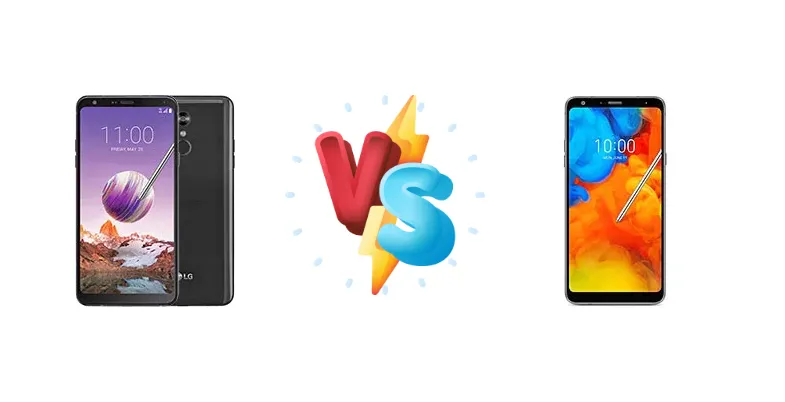
The LG Q Stylo 4 and LG Q Stylus represent LG's attempts to capture the budget stylus market. While both offer the convenience of a built-in stylus, they diverge significantly in their internal hardware, particularly in their chipsets. This comparison dissects these differences to determine which device delivers the best experience for the price.
🏆 Quick Verdict
For the average user prioritizing consistent performance and a slightly more modern architecture, the LG Q Stylo 4 emerges as the better choice. Its Qualcomm Snapdragon 450, built on a 14nm process, offers a more efficient and generally smoother experience than the Mediatek MT6750 found in the Q Stylus.
| Network |
|---|
| 2G bands | GSM 850 / 900 / 1800 / 1900 | GSM 850 / 900 / 1800 / 1900 |
| 3G bands | HSDPA 850 / 900 / 1900 / 2100 | HSDPA 850 / 900 / 1900 / 2100 |
| 4G bands | 1, 2, 3, 4, 5, 7, 12, 13, 20, 38, 41, 66, 71 | 1, 3, 5, 7, 8, 28, 38, 39, 40, 41 |
| Speed | HSPA 42.2/5.76 Mbps, LTE (2CA) Cat6 300/50 Mbps | HSPA, LTE |
| Technology | GSM / HSPA / LTE | GSM / HSPA / LTE |
| Launch |
|---|
| Announced | 2018, June. Released 2018, June | 2018, June. Released 2018, August |
| Status | Discontinued | Discontinued |
| Body |
|---|
| Build | - | Glass front, plastic back, aluminum frame |
| Dimensions | 160 x 77.7 x 8.1 mm (6.30 x 3.06 x 0.32 in) | 160.1 x 77.7 x 8.1 mm (6.30 x 3.06 x 0.32 in) |
| SIM | Nano-SIM | · Nano-SIM· Nano-SIM + Nano-SIM |
| Weight | 172 g (6.07 oz) | 171 g (6.03 oz) |
| | Stylus | Stylus
IP68 dust/water resistant (up to 1.5m for 30 mins)
MIL-STD-810G compliant*
*does not guarantee ruggedness or use in extreme conditions |
| Display |
|---|
| Resolution | 1080 x 2160 pixels, 18:9 ratio (~390 ppi density) | 1080 x 2160 pixels, 18:9 ratio (~389 ppi density) |
| Size | 6.2 inches, 99.2 cm2 (~79.8% screen-to-body ratio) | 6.2 inches, 99.7 cm2 (~80.2% screen-to-body ratio) |
| Type | IPS LCD | IPS LCD |
| Platform |
|---|
| CPU | Octa-core 1.8 GHz Cortex-A53 | Octa-core (4x1.5 GHz Cortex-A53 & 4x1.0 GHz Cortex-A53) - Q Stylus/Q Stylus αOcta-core 1.8 GHz |
| Chipset | Qualcomm SDM450 Snapdragon 450 (14 nm) | Mediatek MT6750 - Q Stylus/Q Stylus α |
| GPU | Adreno 506 | Mali-T860MP2 - Q Stylus/Q Stylus α |
| OS | Android 8.1 (Oreo), LG UX 7 | Android 8.1 (Oreo) |
| Memory |
|---|
| Card slot | microSDXC (dedicated slot) | microSDXC (dedicated slot) |
| Internal | 32GB 2GB RAM | 32GB 3GB RAM, 64GB 4GB RAM |
| | eMMC 5.1 | eMMC 5.1 |
| Main Camera |
|---|
| Features | LED flash, panorama, HDR | LED flash, panorama, HDR |
| Single | 13 MP, f/2.4, PDAF | 13 MP, PDAF (Q Stylus α)
16 MP, PDAF (Q Stylus/ Q Stylus+) |
| Video | 1080p@30fps | 1080p@30fps |
| Selfie camera |
|---|
| Single | 5 MP | 8 MP or 5 MP - Q Stylus/Q Stylus+
5 MP - Q Stylus α |
| Video | 720p | - |
| Sound |
|---|
| 3.5mm jack | Yes | Yes |
| 35mm jack | Yes | Yes |
| Loudspeaker | Yes | Yes |
| Comms |
|---|
| Bluetooth | 4.2, A2DP, LE | 4.2, A2DP, LE |
| NFC | Yes | Yes |
| Positioning | GPS, GLONASS | GPS, GLONASS, BDS, GALILEO |
| Radio | No | FM radio |
| USB | USB Type-C 2.0 | USB Type-C 2.0 |
| WLAN | Wi-Fi 802.11 a/b/g/n/ac, dual-band, Wi-Fi Direct, DLNA | Wi-Fi 802.11 b/g/n, Wi-Fi Direct, DLNA |
| Features |
|---|
| Sensors | Fingerprint (rear-mounted), accelerometer, gyro, proximity, compass | Fingerprint (rear-mounted), accelerometer, gyro, proximity, compass |
| Battery |
|---|
| Charging | 10W wired | 10W wired |
| Type | Li-Ion 3300 mAh, non-removable | Li-Ion 3300 mAh, non-removable |
| Misc |
|---|
| Colors | Aurora Black | Aurora Black, Moroccan Blue, Lavender Violet |
| Models | LM-Q710(FGN), LM-Q710.FGN, Q710AL, LML713DL, Q710PL | Q710, LM-Q710.FG |
| Price | About 250 EUR | About 300 EUR |
| SAR | 1.12 W/kg (head) 1.22 W/kg (body) | - |
LG Q Stylo 4
- More efficient Snapdragon 450 chipset
- Potentially better sustained performance
- Likely better thermal management
- Lower peak CPU clock speed compared to Q Stylus
- Display specifications are unknown
LG Q Stylus
- Higher theoretical peak CPU clock speed
- Potentially better for short bursts of demanding tasks
- Stylus functionality
- Less efficient Mediatek MT6750 chipset
- Potential for thermal throttling
- Inconsistent performance due to core configuration
Display Comparison
Both devices share a similar display cost of $240, suggesting comparable panel quality. However, detailed specifications like resolution, brightness, and color gamut are missing. Given the budget nature of these phones, expect IPS LCD panels with 720p or 1080p resolution. The lack of information prevents a definitive assessment of display quality, but the price point suggests neither will compete with higher-end displays in terms of color accuracy or peak brightness.
Camera Comparison
Without detailed camera specifications, a direct comparison is difficult. Both phones likely feature similar budget camera sensors. The absence of information regarding sensor size, aperture, or image stabilization suggests neither will excel in low-light photography. Any differences in image quality will likely stem from software processing rather than hardware capabilities. The inclusion of a 2MP macro camera on either device is likely a marketing gimmick with limited practical benefit.
Performance
The core difference lies in the chipsets. The LG Q Stylo 4 utilizes the Qualcomm Snapdragon 450 (14nm), an octa-core processor clocked at 1.8 GHz using Cortex-A53 cores. The LG Q Stylus employs the Mediatek MT6750, also an octa-core processor, but with a more complex configuration: four cores at 1.5 GHz and four at 1.0 GHz, both Cortex-A53. While the Q Stylus boasts a higher theoretical peak clock speed, the Snapdragon 450's more efficient 14nm manufacturing process and Qualcomm's optimizations generally translate to better sustained performance and thermal management. The Snapdragon 450's architecture is better suited for consistent multitasking and gaming, while the MT6750 may exhibit more throttling under sustained load.
Battery Life
Both devices share a 10W wired charging capability. Without knowing the battery capacity (mAh) of each device, it's impossible to determine which offers better battery life. However, the Snapdragon 450's greater power efficiency in the Q Stylo 4 could translate to slightly longer battery life, even with a similar capacity battery. The 10W charging speed is relatively slow by modern standards, meaning both phones will require a significant amount of time to fully charge.
Buying Guide
Buy the LG Q Stylo 4 if you need a reliably performing device for everyday tasks like browsing, social media, and light multitasking. Its Snapdragon chipset provides a more consistent experience. Buy the LG Q Stylus if you prioritize a potentially higher peak CPU clock speed for short bursts of demanding tasks, and are willing to accept potential thermal throttling or inconsistent performance due to the Mediatek chipset's architecture.
Frequently Asked Questions
❓ Will the Mediatek MT6750 in the Q Stylus overheat during extended gaming sessions?
The Mediatek MT6750 is known to be less thermally efficient than the Snapdragon 450. While it can handle short gaming sessions, prolonged gaming is likely to cause noticeable throttling, resulting in reduced frame rates and a less enjoyable experience. The Q Stylo 4's Snapdragon 450 is better equipped to handle sustained loads.
❓ Is the stylus on either phone compatible with pressure sensitivity for drawing or note-taking?
Detailed specifications regarding stylus pressure sensitivity are unavailable for either device. Given their budget nature, it's unlikely that either stylus offers advanced pressure sensitivity features. They are likely designed primarily for basic navigation and input, rather than artistic applications.
❓ Which phone is better for running multiple apps simultaneously?
The LG Q Stylo 4, with its Snapdragon 450 chipset, is better suited for multitasking. The Snapdragon 450's architecture and optimizations provide a smoother experience when switching between apps and running multiple applications concurrently compared to the Mediatek MT6750.