
Google Pixel 6a vs LG Q Stylo 4: A Deep Dive into Performance and Value
| Phones Images | |||||
|---|---|---|---|---|---|
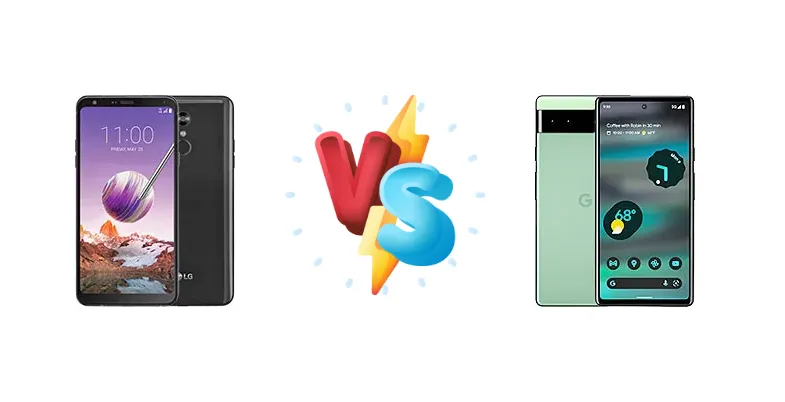
|
🏆 Quick Verdict
For the vast majority of users, the Google Pixel 6a is the clear winner. Its Google Tensor chip delivers significantly faster performance, a vastly superior camera experience, and a brighter, more vibrant display. While the LG Q Stylo 4 offers basic functionality at a lower price, the Pixel 6a provides a dramatically improved user experience.
| PHONES | ||
|---|---|---|
| Phone Names | LG Q Stylo 4 | Google Pixel 6a |
| Network | ||
|---|---|---|
| 2G bands | GSM 850 / 900 / 1800 / 1900 | GSM 850 / 900 / 1800 / 1900 |
| 3G bands | HSDPA 850 / 900 / 1900 / 2100 | HSDPA 800 / 850 / 900 / 1700(AWS) / 1900 / 2100 |
| 4G bands | 1, 2, 3, 4, 5, 7, 12, 13, 20, 38, 41, 66, 71 | 1, 2, 3, 4, 5, 7, 8, 12, 13, 14, 17, 18, 19, 20, 25, 26, 28, 29, 30, 38, 39, 40, 41, 42, 48, 66, 71 - GX7AS, GB62Z (USA/Canada) |
| 5G bands | - | 1, 2, 3, 5, 7, 8, 12, 20, 25, 28, 30, 38, 40, 41, 48, 66, 71, 77, 78 SA/NSA/Sub6 - GX7AS (USA/Canada) |
| Speed | HSPA 42.2/5.76 Mbps, LTE (2CA) Cat6 300/50 Mbps | HSPA, LTE, 5G |
| Technology | GSM / HSPA / LTE | GSM / HSPA / LTE / 5G |
| - | 1, 2, 3, 5, 7, 8, 12, 20, 25, 28, 30, 40, 48, 66, 71, 77, 78 SA/NSA/Sub6 - G1AZG (International) | |
| Launch | ||
|---|---|---|
| Announced | 2018, June. Released 2018, June | 2022, May 11 |
| Status | Discontinued | Available. Released 2022, July 21 |
| Body | ||
|---|---|---|
| Build | - | Glass front (Gorilla Glass 3), aluminum frame, plastic back |
| Dimensions | 160 x 77.7 x 8.1 mm (6.30 x 3.06 x 0.32 in) | 152.2 x 71.8 x 8.9 mm (5.99 x 2.83 x 0.35 in) |
| SIM | Nano-SIM | Nano-SIM + eSIM |
| Weight | 172 g (6.07 oz) | 178 g (6.28 oz) |
| Stylus | IP67 dust/water resistant (up to 1m for 30 min) | |
| Display | ||
|---|---|---|
| Protection | - | Corning Gorilla Glass 3 |
| Resolution | 1080 x 2160 pixels, 18:9 ratio (~390 ppi density) | 1080 x 2400 pixels, 20:9 ratio (~429 ppi density) |
| Size | 6.2 inches, 99.2 cm2 (~79.8% screen-to-body ratio) | 6.1 inches, 90.7 cm2 (~83.0% screen-to-body ratio) |
| Type | IPS LCD | OLED, HDR |
| - | Always-on display | |
| Platform | ||
|---|---|---|
| CPU | Octa-core 1.8 GHz Cortex-A53 | Octa-core (2x2.80 GHz Cortex-X1 & 2x2.25 GHz Cortex-A76 & 4x1.80 GHz Cortex-A55) |
| Chipset | Qualcomm SDM450 Snapdragon 450 (14 nm) | Google Tensor (5 nm) |
| GPU | Adreno 506 | Mali-G78 MP20 |
| OS | Android 8.1 (Oreo), LG UX 7 | Android 12, upgradable to Android 15, up to 5 major Android upgrades |
| Memory | ||
|---|---|---|
| Card slot | microSDXC (dedicated slot) | No |
| Internal | 32GB 2GB RAM | 128GB 6GB RAM |
| eMMC 5.1 | UFS 3.1 | |
| Main Camera | ||
|---|---|---|
| Dual | - | 12.2 MP, f/1.7, 27mm, (wide), 1/2.55", 1.4µm, dual pixel PDAF, OIS 12 MP, f/2.2, 17mm, 114˚ (ultrawide), 1.25µm |
| Features | LED flash, panorama, HDR | Dual-LED flash, Pixel Shift, Auto-HDR, panorama |
| Single | 13 MP, f/2.4, PDAF | 8 MP, f/2.0, 24mm (wide), 1.12µm |
| Video | 1080p@30fps | 4K@30/60fps, 1080p@30/60/120/240fps; gyro-EIS, OIS |
| Selfie camera | ||
|---|---|---|
| Features | - | HDR, panorama |
| Single | 5 MP | 8 MP, f/2.0, 24mm (wide), 1.12µm |
| Video | 720p | 1080p@30fps |
| Sound | ||
|---|---|---|
| 3.5mm jack | Yes | No |
| 35mm jack | Yes | No |
| Loudspeaker | Yes | Yes, with stereo speakers |
| Comms | ||
|---|---|---|
| Bluetooth | 4.2, A2DP, LE | 5.2, A2DP, LE |
| NFC | Yes | Yes |
| Positioning | GPS, GLONASS | GPS, GLONASS, GALILEO, QZSS |
| Radio | No | No |
| USB | USB Type-C 2.0 | USB Type-C 3.1 |
| WLAN | Wi-Fi 802.11 a/b/g/n/ac, dual-band, Wi-Fi Direct, DLNA | Wi-Fi 802.11 a/b/g/n/ac/6e, dual-band, Wi-Fi Direct |
| Features | ||
|---|---|---|
| Sensors | Fingerprint (rear-mounted), accelerometer, gyro, proximity, compass | Fingerprint (under display, optical), accelerometer, gyro, proximity, compass, barometer |
| Battery | ||
|---|---|---|
| Charging | 10W wired | 18W wired, PD3.0 |
| Type | Li-Ion 3300 mAh, non-removable | Li-Po 4410 mAh |
| Misc | ||
|---|---|---|
| Colors | Aurora Black | Chalk, Charcoal, Sage |
| Models | LM-Q710(FGN), LM-Q710.FGN, Q710AL, LML713DL, Q710PL | GX7AS, GB62Z, G1AZG, GB17L |
| Price | About 250 EUR | $ 138.99 / C$ 228.74 / ₹ 23,999 |
| SAR | 1.12 W/kg (head) 1.22 W/kg (body) | - |
| Tests | ||
|---|---|---|
| Battery life | - | Endurance rating 94h |
| Display | 240 USD | Contrast ratio: Infinite (nominal) |
LG Q Stylo 4
- Lowest possible upfront cost
- Simple and easy-to-use interface
- Acceptable battery life for basic use
- Poor performance for demanding tasks
- Low-quality display
- Outdated chipset
Google Pixel 6a
- Exceptional performance with Google Tensor
- Excellent camera quality with Google’s image processing
- Bright and vibrant display
- Fast charging with PD3.0
- Higher price point
- May be overkill for basic users
- No expandable storage
Display Comparison
The LG Q Stylo 4’s display, priced at $240, is a significant weakness compared to the Pixel 6a. While both have similar physical sizes (assumed based on market segment), the Pixel 6a boasts a maximum brightness of 876 nits, measured, offering far superior visibility in outdoor conditions. The Pixel 6a’s ‘Infinite’ (nominal) contrast ratio, typical of OLED panels, provides deeper blacks and more vibrant colors, a stark contrast to the likely IPS LCD panel in the Q Stylo 4. The lack of specific display technology details for the Q Stylo 4 suggests a lower-quality panel overall.
Camera Comparison
The Pixel 6a’s camera system is in a different league. While specific camera specs for the Q Stylo 4 are unavailable, its market positioning suggests a basic camera setup. The Pixel 6a benefits from Google’s renowned computational photography, leveraging the Tensor chip’s image signal processor (ISP) for superior image quality, especially in low-light conditions. The Pixel 6a’s image processing excels in dynamic range and detail preservation, features likely absent in the Q Stylo 4’s camera.
Performance
The performance gap between these devices is immense. The LG Q Stylo 4’s Qualcomm SDM450 Snapdragon 450 (14 nm) with its octa-core 1.8 GHz Cortex-A53 CPU is designed for basic tasks. The Google Pixel 6a, powered by the Google Tensor (5 nm) chip, features a more complex CPU configuration – 2x2.80 GHz Cortex-X1, 2x2.25 GHz Cortex-A76, and 4x1.80 GHz Cortex-A55 cores – delivering significantly faster processing speeds and improved efficiency. The 5nm fabrication process of the Tensor chip further enhances efficiency and reduces thermal throttling, crucial for sustained performance. This translates to a much smoother experience with demanding apps and games on the Pixel 6a.
Battery Life
Both devices share an endurance rating of 94 hours, suggesting comparable battery life under similar usage scenarios. However, the Pixel 6a’s 18W wired charging with PD3.0 support offers faster charging speeds compared to the Q Stylo 4’s 10W charging. While both may last a full day, the Pixel 6a can replenish its battery more quickly, minimizing downtime.
Buying Guide
Buy the LG Q Stylo 4 if you absolutely need the lowest possible upfront cost and only require basic smartphone functionality like calls, texts, and light social media use. You're willing to compromise on performance, camera quality, and display experience. Buy the Google Pixel 6a if you prioritize smooth performance, excellent camera capabilities, a vibrant display, and long-term software support. You're willing to spend more for a significantly better overall experience.