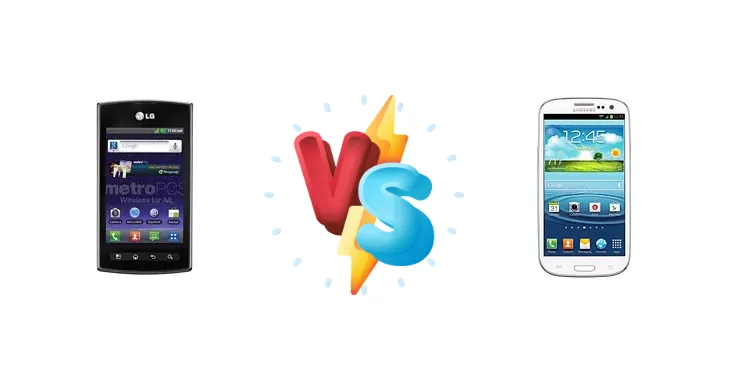
Released in different eras of Android development, the LG Optimus M+ and Samsung Galaxy S III CDMA represent distinct approaches to the smartphone market. The Optimus M+ aimed for affordability, while the Galaxy S III was a flagship, albeit one now showing its age. This comparison dissects their core hardware to determine which device holds up better today, considering performance, efficiency, and overall value.
🏆 Quick Verdict
For the average user seeking a functional, albeit slow, smartphone experience, the LG Optimus M+ offers a budget-friendly option. However, the Samsung Galaxy S III CDMA, powered by the Snapdragon S4 Plus, provides a demonstrably faster and more responsive experience, making it the superior choice for those prioritizing performance, despite its higher initial cost and age.
| Network |
|---|
| 2G bands | CDMA 800 / 1900 | CDMA 800 / 1900 - SGH-I535, SPH-L710 |
| 3G bands | CDMA2000 1xEV-DO | CDMA2000 1xEV-DO - SGH-I535, SPH-L710 |
| 4G bands | - | 13 - SGH-I535 |
| Speed | CDMA2000 1x, 153 Kbps | LTE Cat3 100/50 Mbps, EV-DO Rev.A 3.1 Mbps |
| Technology | CDMA / EVDO | CDMA / EVDO / LTE |
| | - | 25 - SPH-L710 |
| Launch |
|---|
| Announced | 2012, March. Released 2012, April | 2012, June. Released 2012, July |
| Status | Discontinued | Discontinued |
| Body |
|---|
| Dimensions | 113.8 x 62.7 x 9.9 mm (4.48 x 2.47 x 0.39 in) | 137.2 x 71.1 x 7.6 mm (5.40 x 2.80 x 0.30 in) |
| SIM | Mini-SIM | Micro-SIM |
| Weight | 119 g (4.20 oz) | 133.2 g (4.69 oz) |
| Display |
|---|
| Protection | - | Corning Gorilla Glass 2 |
| Resolution | 320 x 480 pixels, 3:2 ratio (~165 ppi density) | 720 x 1280 pixels, 16:9 ratio (~306 ppi density) |
| Size | 3.5 inches, 36.5 cm2 (~51.1% screen-to-body ratio) | 4.8 inches, 63.5 cm2 (~65.1% screen-to-body ratio) |
| Type | TFT, 256K colors | Super AMOLED |
| | - | TouchWiz UI
|
| Platform |
|---|
| CPU | 800 MHz Cortex A5 | Dual-core 1.5 GHz Krait |
| Chipset | Qualcomm MSM7627A Snapdragon S1 | Qualcomm MSM8960 Snapdragon S4 Plus |
| GPU | Adreno 200 | Adreno 225 |
| OS | Android 2.3 (Gingerbread) | Android 4.1 (Jelly Bean), upgradаble to 4.3 (Jelly Bean) |
| Memory |
|---|
| Card slot | microSDHC (dedicated slot) | microSDXC (dedicated slot) |
| Internal | 4GB 512MB RAM | 16GB 2GB RAM, 32GB 2GB RAM |
| Main Camera |
|---|
| Features | LED flash | LED flash |
| Single | 5 MP, AF | 8 MP, f/2.6, 1/3.0", AF |
| Video | 480p | 1080p@30fps |
| Selfie camera |
|---|
| Single | - | 1.9 MP, f/2.6 |
| Video | - | 720p@30fps |
| Sound |
|---|
| 3.5mm jack | - | Yes |
| 35mm jack | Yes | Yes |
| Loudspeaker | Yes | Yes |
| Comms |
|---|
| Bluetooth | 3.0, A2DP | 4.0, A2DP, EDR, aptX |
| NFC | - | Yes |
| Positioning | GPS, A-GPS | GPS, A-GPS |
| Radio | No | No |
| USB | microUSB 2.0 | microUSB 2.0 (MHL TV-out), OTG |
| WLAN | Wi-Fi 802.11 b/g/n, hotspot | Wi-Fi 802.11 a/b/g/n, dual-band, Wi-Fi Direct, DLNA, hotspot |
| Features |
|---|
| Sensors | Accelerometer, proximity, compass | Accelerometer, gyro, proximity, compass, barometer |
| | - | S-Voice natural language commands and dictation
Dropbox (50 GB cloud storage)
MP4/DivX/XviD/WMV/H.264 player
MP3/WAV/eAAC+/AC3/FLAC player
Photo/video editor
Document editor |
| Battery |
|---|
| Stand-by | Up to 250 h | Up to 200 h |
| Talk time | Up to 4 h | Up to 15 h |
| Type | Removable Li-Ion 1300 mAh battery | Removable Li-Ion 2100 mAh battery |
| Misc |
|---|
| Colors | Black | Pebble blue, Marble white, Purple |
| Models | - | SCH-I535, SPH-L710 |
| Price | About 100 EUR | About 280 EUR |
| SAR | 1.11 W/kg (head) 0.71 W/kg (body) | 0.48 W/kg (head) 1.29 W/kg (body) |
| SAR EU | - | 0.88 W/kg (head) |
LG Optimus M+ MS695
- Lower price point (historically)
- Potentially longer battery life due to lower power consumption
- Simpler, more basic user experience
- Significantly slower performance
- Outdated chipset architecture
- Inferior camera capabilities
Samsung Galaxy S III CDMA
- Faster performance with dual-core Krait CPU
- More efficient Snapdragon S4 Plus chipset
- Superior camera capabilities (likely)
- Higher initial cost (historically)
- Potentially shorter battery life compared to Optimus M+
- Older software and potential security vulnerabilities
Display Comparison
Details regarding the displays of both devices are unavailable. However, given the Optimus M+'s budget positioning, it likely features a lower-resolution panel with narrower color gamut coverage compared to the Galaxy S III. The S III, as a flagship, would have benefitted from Samsung’s Super AMOLED technology, offering vibrant colors and deep blacks, though potentially at the cost of outdoor visibility. Bezels on the S III were likely slimmer, reflecting its higher-end status.
Camera Comparison
Camera specifications are not fully available. However, the Galaxy S III, as a flagship, likely featured a higher-resolution main sensor with better image processing capabilities than the Optimus M+. The S4 Plus chipset also includes an improved image signal processor (ISP), enabling faster image capture and better low-light performance. While both phones likely offered basic video recording, the S III’s superior processing power would have allowed for smoother recording and potentially higher resolutions. The Optimus M+ likely focused on affordability, resulting in a simpler camera system.
Performance
The core difference lies in the chipsets. The LG Optimus M+ utilizes the Qualcomm MSM7627A Snapdragon S1 with a single-core 800 MHz Cortex-A5 CPU. This architecture is significantly older and less efficient than the Samsung Galaxy S III’s Qualcomm MSM8960 Snapdragon S4 Plus, featuring a dual-core 1.5 GHz Krait CPU. The Krait architecture, built on a 28nm process, offers substantially improved performance per watt compared to the S1’s older architecture. This translates to faster app launches, smoother multitasking, and a more responsive user interface on the Galaxy S III. The S4 Plus also includes a more capable Adreno GPU, providing a better gaming experience. The S III’s LPDDR2 RAM likely offers faster speeds than the Optimus M+'s, further contributing to its performance advantage.
Battery Life
Battery capacity details are unavailable for both devices. However, the Snapdragon S4 Plus in the Galaxy S III, despite its higher performance, is built on a more efficient 28nm process. This means it consumes less power per operation than the Snapdragon S1 in the Optimus M+. Therefore, while the Optimus M+ might have a slightly larger battery, the S III’s efficiency could offset this difference, resulting in comparable real-world battery life. Charging speeds would have been significantly slower on both devices by today’s standards, but the S III’s more advanced power management features might have offered slightly faster charging times.
Buying Guide
Buy the LG Optimus M+ MS695 if you need a very inexpensive device for basic tasks like calls, texts, and light web browsing, and battery life is paramount. Buy the Samsung Galaxy S III CDMA if you prefer a smoother, more capable user experience with faster app loading and multitasking, and are willing to accept potentially shorter battery life and a higher price point on the used market.
Frequently Asked Questions
❓ Is the Samsung Galaxy S III CDMA still usable in 2024, considering its age?
Yes, but with caveats. While it can run basic Android applications, performance will be noticeably slower than modern smartphones. Compatibility with newer apps and services may be limited, and security updates are no longer available, posing a potential risk. It's best suited for users with very basic needs or those interested in retro tech.
❓ Will the LG Optimus M+ struggle with modern apps like WhatsApp or Facebook?
Absolutely. The single-core 800 MHz processor and limited RAM will result in extremely slow loading times and a frustrating user experience with modern, resource-intensive apps. These apps may even be incompatible or crash frequently. It's best suited for simple tasks and older applications.
❓ Does the CDMA designation on the Galaxy S III limit its usability today?
Yes, significantly. CDMA networks are largely phased out in many regions. The Galaxy S III CDMA will only function on carriers that still support CDMA, or potentially with limited functionality on some LTE networks depending on carrier compatibility. This is a major limitation for most users.