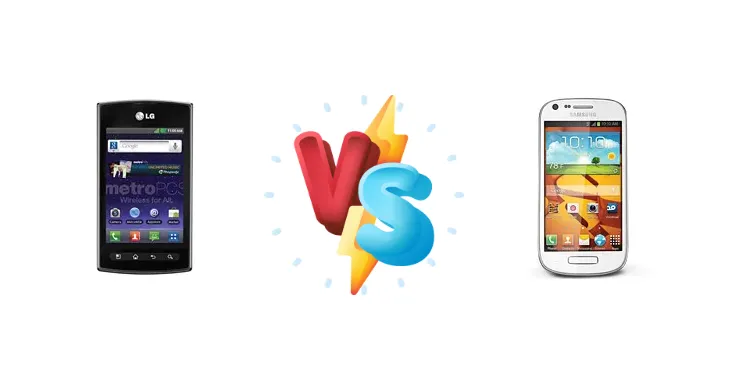
Released around the same time, the LG Optimus M+ and Samsung Galaxy Prevail 2 represent the entry-level Android experience of 2011. Both aimed to deliver smartphone functionality at an accessible price point, but they differed significantly in their underlying hardware. This comparison focuses on the core performance differences stemming from their respective Qualcomm Snapdragon chipsets.
🏆 Quick Verdict
For the average user prioritizing responsiveness and future-proofing (even within the constraints of the era), the Samsung Galaxy Prevail 2 is the better choice. Its 1.4 GHz Snapdragon S2 chipset offers a substantial performance advantage over the LG Optimus M+'s 800 MHz Snapdragon S1, translating to smoother multitasking and app loading.
| Network |
|---|
| 2G bands | CDMA 800 / 1900 | CDMA 800 / 1900 |
| 3G bands | CDMA2000 1xEV-DO | CDMA2000 1xEV-DO |
| Speed | CDMA2000 1x, 153 Kbps | EV-DO Rev.A 3.1 Mbps |
| Technology | CDMA / EVDO | CDMA / EVDO |
| Launch |
|---|
| Announced | 2012, March. Released 2012, April | 2013, July. Released 2013, July |
| Status | Discontinued | Discontinued |
| Body |
|---|
| Dimensions | 113.8 x 62.7 x 9.9 mm (4.48 x 2.47 x 0.39 in) | 122 x 63.5 x 12.7 mm (4.80 x 2.5 x 0.5 in) |
| SIM | Mini-SIM | Mini-SIM |
| Weight | 119 g (4.20 oz) | 130.4 g (4.59 oz) |
| Display |
|---|
| Resolution | 320 x 480 pixels, 3:2 ratio (~165 ppi density) | 480 x 800 pixels, 5:3 ratio (~233 ppi density) |
| Size | 3.5 inches, 36.5 cm2 (~51.1% screen-to-body ratio) | 4.0 inches, 45.5 cm2 (~58.8% screen-to-body ratio) |
| Type | TFT, 256K colors | TFT |
| Platform |
|---|
| CPU | 800 MHz Cortex A5 | 1.4 GHz |
| Chipset | Qualcomm MSM7627A Snapdragon S1 | Qualcomm MSM8655 Snapdragon S2 |
| GPU | Adreno 200 | Adreno 205 |
| OS | Android 2.3 (Gingerbread) | Android 4.1 (Jelly Bean) |
| Memory |
|---|
| Card slot | microSDHC (dedicated slot) | microSDXC (dedicated slot), 2 GB included |
| Internal | 4GB 512MB RAM | 4GB 512MB RAM |
| Main Camera |
|---|
| Features | LED flash | LED flash, panorama |
| Single | 5 MP, AF | 5 MP, AF |
| Video | 480p | Yes |
| Selfie camera |
|---|
| Single | - | 1.3 MP |
| Sound |
|---|
| 3.5mm jack | - | Yes |
| 35mm jack | Yes | Yes |
| Loudspeaker | Yes | Yes |
| Comms |
|---|
| Bluetooth | 3.0, A2DP | 4.0, A2DP |
| NFC | - | No |
| Positioning | GPS, A-GPS | GPS |
| Radio | No | No |
| USB | microUSB 2.0 | microUSB 2.0 |
| WLAN | Wi-Fi 802.11 b/g/n, hotspot | Wi-Fi 802.11 b/g |
| Features |
|---|
| Sensors | Accelerometer, proximity, compass | Accelerometer, proximity |
| Battery |
|---|
| Stand-by | Up to 250 h | Up to 490 h |
| Talk time | Up to 4 h | Up to 8 h |
| Type | Removable Li-Ion 1300 mAh battery | Li-Ion 1750 mAh, removable |
| Misc |
|---|
| Colors | Black | White, Gray |
| Price | About 100 EUR | About 140 EUR |
| SAR | 1.11 W/kg (head) 0.71 W/kg (body) | 0.60 W/kg (head) 1.34 W/kg (body) |
LG Optimus M+ MS695
- Potentially better battery life due to lower clock speed.
- Proven stability and reliability (typical of LG's software at the time).
- Likely lower initial cost.
- Significantly slower processor.
- Less responsive user interface.
- Struggles with multitasking.
Samsung Galaxy Prevail 2
- Faster processor for smoother performance.
- More responsive user interface.
- Better suited for running more apps.
- Improved GPU performance.
- Potentially shorter battery life.
- May have been slightly more expensive at launch.
Display Comparison
Neither device boasts a particularly impressive display by modern standards. Given the era, both likely utilized TFT LCD panels. Specific resolution and size data is unavailable, but the focus here is on performance, not visual fidelity. The display quality on both would have been adequate for basic tasks, but not ideal for media consumption. Bezels were substantial on both devices, typical for the time.
Camera Comparison
Camera performance on both devices would have been limited. Without specific sensor details, it’s safe to assume both featured low-resolution cameras (likely around 3-5 megapixels). Image quality would have been acceptable in good lighting conditions, but poor in low light. The focus here isn't on image quality, but on the processing power required to operate the camera app – an area where the Prevail 2’s S2 chipset would have an advantage, enabling faster image capture and processing.
Performance
The core difference lies in the chipsets. The Samsung Galaxy Prevail 2’s Qualcomm MSM8655 Snapdragon S2, with its 1.4 GHz CPU, represents a significant step up from the LG Optimus M+'s Qualcomm MSM7627A Snapdragon S1 running at 800 MHz. While both utilize a Cortex A5 architecture, the higher clock speed of the S2 directly translates to faster processing. This means quicker app launch times, smoother web browsing, and a more responsive user interface. The S2 also benefits from architectural improvements within the Snapdragon S2 series, offering better performance per clock cycle. The S2's GPU would also have been more capable, though both would struggle with graphically intensive tasks.
Battery Life
Battery capacity details are unavailable for both devices. However, the Samsung Galaxy Prevail 2’s more powerful processor will likely consume more power. While the LG Optimus M+’s slower processor will be more efficient, the difference in battery life may not be substantial, especially with typical usage patterns of the time (calls, texts, and light web browsing). The higher clock speed of the S2 necessitates a more robust power management system, which may or may not fully offset the increased power draw.
Buying Guide
Buy the LG Optimus M+ MS695 if you need a reliably basic smartphone with a proven track record of stability and are primarily focused on core communication features like calls and texts. Buy the Samsung Galaxy Prevail 2 if you prefer a slightly more responsive experience, anticipate using more apps, or value a marginally faster processor for a smoother user interface, even if it comes at a potential cost to battery life due to the higher clock speed.
Frequently Asked Questions
❓ Will the Samsung Galaxy Prevail 2 experience noticeable lag when running multiple apps?
While the Snapdragon S2 is a significant improvement over the S1, it's important to remember these are entry-level devices from 2011. Running numerous apps simultaneously will still likely result in some lag, but it will be considerably less pronounced than on the LG Optimus M+.
❓ Is the performance difference between these phones noticeable for basic tasks like calling and texting?
For core communication tasks like making calls and sending texts, the performance difference will be minimal. Both phones are perfectly capable of handling these functions. The advantage of the Prevail 2 becomes apparent when launching apps, browsing the web, or performing more demanding tasks.
❓ Does the Snapdragon S2 in the Prevail 2 offer any gaming capabilities?
The Snapdragon S2 can handle very basic 2D games, but it will struggle with anything graphically intensive. Don't expect to play modern mobile games on either device. The S2 will offer a slightly smoother experience with simpler games compared to the S1.