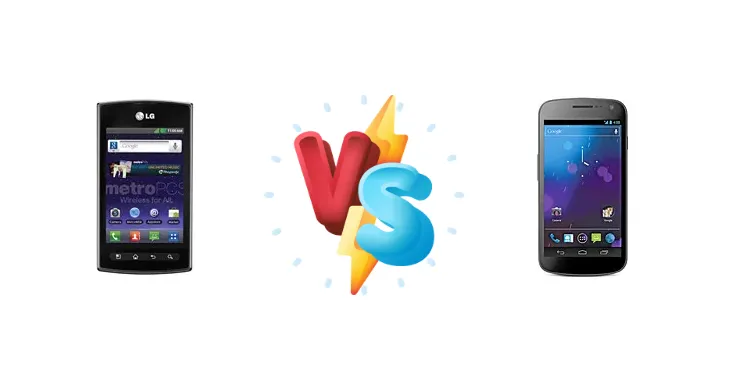
Released in late 2011 and early 2012 respectively, the LG Optimus M+ and Samsung Galaxy Nexus represent distinct approaches to the burgeoning Android market. The Optimus M+ aimed for affordability, while the Galaxy Nexus served as a Google experience flagship. This comparison dissects their core hardware – the Qualcomm MSM7627A Snapdragon S1 and the Texas Instruments OMAP 4460 – to determine which device offered the better user experience given the constraints of the era.
🏆 Quick Verdict
For the average user seeking a responsive Android experience, the Samsung Galaxy Nexus is the clear winner. Its dual-core 1.2 GHz Cortex-A9 processor, built on a more advanced architecture than the Optimus M+'s single-core 800 MHz Cortex-A5, delivers significantly faster performance in everyday tasks and applications. While the Optimus M+ offered a lower price point, the performance gap is substantial.
| Network |
|---|
| 2G bands | CDMA 800 / 1900 | GSM 850 / 900 / 1800 / 1900 |
| 3G bands | CDMA2000 1xEV-DO | HSDPA 850 / 1700 / 1900 / 2100 |
| Speed | CDMA2000 1x, 153 Kbps | HSPA 21.1/5.76 Mbps |
| Technology | CDMA / EVDO | GSM / HSPA |
| Launch |
|---|
| Announced | 2012, March. Released 2012, April | 2012, January. Released 2012, January |
| Status | Discontinued | Discontinued |
| Body |
|---|
| Dimensions | 113.8 x 62.7 x 9.9 mm (4.48 x 2.47 x 0.39 in) | 135.5 x 67.9 x 8.9 mm (5.33 x 2.67 x 0.35 in) |
| SIM | Mini-SIM | Mini-SIM |
| Weight | 119 g (4.20 oz) | 135 g (4.76 oz) |
| Display |
|---|
| Protection | - | Oleophobic coating |
| Resolution | 320 x 480 pixels, 3:2 ratio (~165 ppi density) | 720 x 1280 pixels, 16:9 ratio (~316 ppi density) |
| Size | 3.5 inches, 36.5 cm2 (~51.1% screen-to-body ratio) | 4.65 inches, 59.6 cm2 (~64.8% screen-to-body ratio) |
| Type | TFT, 256K colors | Super AMOLED |
| Platform |
|---|
| CPU | 800 MHz Cortex A5 | Dual-core 1.2 GHz Cortex-A9 |
| Chipset | Qualcomm MSM7627A Snapdragon S1 | TI OMAP 4460 |
| GPU | Adreno 200 | PowerVR SGX540 |
| OS | Android 2.3 (Gingerbread) | Android 4.0 (Ice Cream Sandwich) |
| Memory |
|---|
| Card slot | microSDHC (dedicated slot) | No |
| Internal | 4GB 512MB RAM | 16GB 1GB RAM |
| Main Camera |
|---|
| Features | LED flash | LED flash |
| Single | 5 MP, AF | 5 MP, AF |
| Video | 480p | 1080p@30fps |
| Selfie camera |
|---|
| Single | - | 1.3 MP |
| Video | - | 720p@30fps |
| Sound |
|---|
| 3.5mm jack | - | Yes |
| 35mm jack | Yes | Yes |
| Loudspeaker | Yes | Yes |
| Comms |
|---|
| Bluetooth | 3.0, A2DP | 3.0, A2DP |
| NFC | - | Yes |
| Positioning | GPS, A-GPS | GPS, A-GPS |
| Radio | No | No |
| USB | microUSB 2.0 | microUSB 2.0 (MHL TV-out) |
| WLAN | Wi-Fi 802.11 b/g/n, hotspot | Wi-Fi 802.11 a/b/g/n, dual-band, DLNA, hotspot |
| Features |
|---|
| Sensors | Accelerometer, proximity, compass | Accelerometer, gyro, proximity, compass, barometer |
| | - | MP4/H.264 player
MP3/WAV/eAAC+ player
Photo/video editor
Document viewer |
| Battery |
|---|
| Stand-by | Up to 250 h | Up to 600 h |
| Talk time | Up to 4 h | Up to 9 h |
| Type | Removable Li-Ion 1300 mAh battery | Removable Li-Ion 1750 mAh battery |
| Misc |
|---|
| Colors | Black | Black |
| Models | - | GT-I9250M |
| Price | About 100 EUR | About 240 EUR |
| SAR | 1.11 W/kg (head) 0.71 W/kg (body) | 0.40 W/kg (head) 0.74 W/kg (body) |
| SAR EU | - | 0.35 W/kg (head) |
LG Optimus M+ MS695
- Lower price point made it accessible to a wider audience.
- Potentially more compact form factor.
- Likely better battery efficiency due to the single-core processor.
- Significantly slower performance compared to the Galaxy Nexus.
- Less responsive user interface.
- Inferior camera quality.
Samsung Galaxy Nexus I9250M
- Faster dual-core processor for a smoother experience.
- More capable GPU for better gaming performance.
- Likely superior camera quality.
- Higher price point.
- Potentially shorter battery life due to the more powerful processor.
- Larger form factor.
Display Comparison
Details regarding display technology are unavailable in the provided context. However, given the release timeframe, both likely utilized LCD panels. The Galaxy Nexus, being a flagship, likely featured a higher resolution display and potentially better viewing angles. The Optimus M+ likely focused on cost reduction, potentially resulting in a lower-quality panel. Bezels were substantial on both devices, typical for the period.
Camera Comparison
Without specific sensor details, a direct comparison is difficult. However, the Galaxy Nexus, as a higher-end device, likely featured a larger sensor and better image processing capabilities. The Optimus M+ likely employed a smaller, lower-resolution sensor focused on basic photography. Image quality on the Galaxy Nexus would have been noticeably superior, particularly in low-light conditions. The presence of image stabilization (OIS) is unknown for both devices, but less likely on the Optimus M+.
Performance
The core difference lies in the chipsets. The LG Optimus M+ utilizes the Qualcomm MSM7627A Snapdragon S1, featuring a single-core 800 MHz Cortex-A5 processor. This architecture, while efficient, is significantly less powerful than the Samsung Galaxy Nexus’s TI OMAP 4460, which boasts a dual-core 1.2 GHz Cortex-A9 processor. The Cortex-A9 offers a wider instruction set and greater processing power per clock cycle, resulting in faster application launches, smoother multitasking, and improved gaming performance. The OMAP 4460 also included a more capable GPU, further widening the performance gap.
Battery Life
Battery capacity details are missing. However, the more efficient Cortex-A5 processor in the Optimus M+ might have offered comparable battery life to the Galaxy Nexus despite a potentially smaller battery size. The OMAP 4460’s higher performance demands would have consumed more power. Charging wattage is also unknown, but both devices likely utilized slower charging speeds compared to modern standards. Real-world battery life would have heavily depended on usage patterns.
Buying Guide
Buy the LG Optimus M+ MS695 if you prioritized absolute affordability and a smaller form factor, accepting significant performance limitations. It's suitable for basic communication and light app usage. Buy the Samsung Galaxy Nexus I9250M if you valued a smoother, more responsive Android experience, faster app loading times, and a more future-proof device, even at a higher initial cost. The Galaxy Nexus was the better choice for users who wanted to experience Android as Google intended.
Frequently Asked Questions
❓ Did the OMAP 4460 in the Galaxy Nexus suffer from overheating issues?
While the OMAP 4460 wasn't known for *severe* overheating, it could experience thermal throttling under sustained heavy loads, such as prolonged gaming sessions. The Cortex-A9 architecture, while powerful, was less thermally efficient than later processor designs. The Snapdragon S1 in the Optimus M+ was less prone to throttling due to its lower performance ceiling.
❓ How did the software experience differ between the Optimus M+ and the Galaxy Nexus?
The Galaxy Nexus, being a Google experience device, ran a near-stock version of Android with faster updates directly from Google. The Optimus M+ featured LG’s custom UI, which added bloatware and potentially slowed down performance. The Nexus also benefited from Google’s optimizations for the OMAP 4460 chipset.
❓ Could the LG Optimus M+ handle modern Android ROMs?
Attempting to install a modern Android ROM on the Optimus M+ would likely result in a severely degraded experience. The limited processing power and RAM of the Snapdragon S1 would struggle to handle the demands of newer Android versions. While technically possible, it's not recommended for practical use.