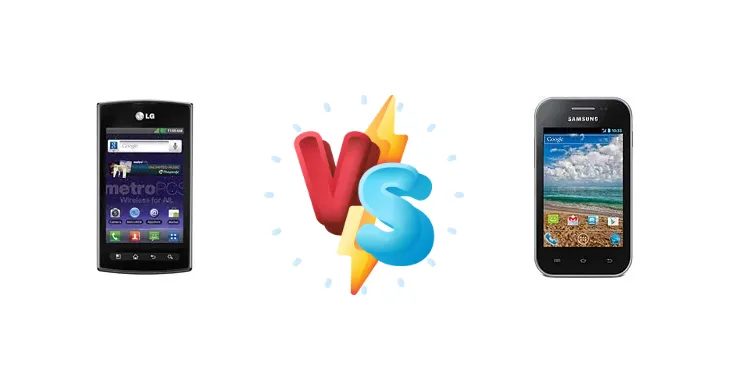
Released around the same era, the LG Optimus M+ and Samsung Galaxy Discover represent a generation of affordable Android smartphones powered by Qualcomm's Snapdragon S1 platform. While both aimed for the budget-conscious consumer, subtle differences in their chipsets and likely software implementations create distinct user experiences. This comparison dissects those differences to determine which device holds up better today.
🏆 Quick Verdict
For the average user seeking a functional, albeit slow, Android experience, the LG Optimus M+ edges out the Samsung Galaxy Discover. The MSM7627A chipset, while similar, likely offers slightly better sustained performance due to potential architectural refinements, making it a marginally smoother experience for basic tasks.
| Network |
|---|
| 2G bands | CDMA 800 / 1900 | GSM 850 / 900 / 1800 / 1900 |
| 3G bands | CDMA2000 1xEV-DO | HSDPA 850 / 1900 |
| Speed | CDMA2000 1x, 153 Kbps | HSPA 7.2/0.384 Mbps |
| Technology | CDMA / EVDO | GSM / HSPA |
| Launch |
|---|
| Announced | 2012, March. Released 2012, April | 2012, November. Released 2012, November |
| Status | Discontinued | Discontinued |
| Body |
|---|
| Dimensions | 113.8 x 62.7 x 9.9 mm (4.48 x 2.47 x 0.39 in) | 112.8 x 61.5 x 11.5 mm (4.44 x 2.42 x 0.45 in) |
| SIM | Mini-SIM | Mini-SIM |
| Weight | 119 g (4.20 oz) | 122 g (4.30 oz) |
| Display |
|---|
| Resolution | 320 x 480 pixels, 3:2 ratio (~165 ppi density) | 320 x 480 pixels, 3:2 ratio (~165 ppi density) |
| Size | 3.5 inches, 36.5 cm2 (~51.1% screen-to-body ratio) | 3.5 inches, 36.5 cm2 (~52.6% screen-to-body ratio) |
| Type | TFT, 256K colors | TFT, 256K colors |
| | - | Touch sensitive controls |
| Platform |
|---|
| CPU | 800 MHz Cortex A5 | 800 MHz Cortex-A5 |
| Chipset | Qualcomm MSM7627A Snapdragon S1 | Qualcomm MSM7225A Snapdragon S1 |
| GPU | Adreno 200 | Adreno 200 |
| OS | Android 2.3 (Gingerbread) | Android 4.0.4 (Ice Cream Sandwich) |
| Memory |
|---|
| Card slot | microSDHC (dedicated slot) | microSDHC (dedicated slot) |
| Internal | 4GB 512MB RAM | 4GB (2.7GB user available), 512MB RAM |
| Main Camera |
|---|
| Features | LED flash | LED flash |
| Single | 5 MP, AF | 3.15 MP |
| Video | 480p | Yes |
| Sound |
|---|
| 3.5mm jack | - | Yes |
| 35mm jack | Yes | Yes |
| Loudspeaker | Yes | Yes |
| Comms |
|---|
| Bluetooth | 3.0, A2DP | Yes |
| NFC | - | No |
| Positioning | GPS, A-GPS | GPS |
| Radio | No | No |
| USB | microUSB 2.0 | microUSB 2.0 |
| WLAN | Wi-Fi 802.11 b/g/n, hotspot | Wi-Fi 802.11 b/g, hotspot |
| Features |
|---|
| Sensors | Accelerometer, proximity, compass | Accelerometer |
| Battery |
|---|
| Stand-by | Up to 250 h | Up to 440 h |
| Talk time | Up to 4 h | Up to 7 h 20 min |
| Type | Removable Li-Ion 1300 mAh battery | Li-Ion 1300 mAh, removable |
| Misc |
|---|
| Colors | Black | Black |
| Price | About 100 EUR | About 80 EUR |
| SAR | 1.11 W/kg (head) 0.71 W/kg (body) | 0.85 W/kg (head) 0.77 W/kg (body) |
| SAR EU | - | 0.35 W/kg (head) |
LG Optimus M+ MS695
- Potentially better sustained performance due to MSM7627A revision.
- Likely more efficient chipset leading to slightly better battery life.
- LG's Optimus UI, while dated, may offer a different user experience preference.
- Limited RAM and storage.
- Outdated Android version (likely Gingerbread).
- Poor camera performance.
Samsung Galaxy Discover S730M
- Samsung brand recognition and potential software optimizations.
- Similar battery life to the LG Optimus M+.
- Familiar Samsung TouchWiz UI (for those accustomed to it).
- MSM7225A chipset may exhibit slightly more thermal throttling.
- Limited RAM and storage.
- Poor camera performance.
Display Comparison
Both devices likely feature similar low-resolution displays typical of the era, around 480x320 pixels. Given the target market, neither is expected to boast high brightness or color accuracy. The absence of detailed display specifications necessitates focusing on the chipset's ability to efficiently drive the display; a more capable chipset will result in smoother scrolling and animations. Bezels were substantial on both devices, maximizing screen real estate within the constraints of the time.
Camera Comparison
Camera performance on both devices will be rudimentary. Expect 3.2MP or 5MP sensors with limited features. Image quality will be poor in low light, and detail will be lacking. The absence of Optical Image Stabilization (OIS) is a given. The focus should be on functionality for basic snapshots rather than photographic quality. Any differences in image processing algorithms between LG and Samsung software will likely be more noticeable than any hardware differences in the camera sensors themselves.
Performance
The core difference lies in the chipsets: the LG Optimus M+ utilizes the Qualcomm MSM7627A Snapdragon S1, while the Samsung Galaxy Discover employs the MSM7225A Snapdragon S1. Both feature an 800 MHz Cortex-A5 CPU. While the clock speed is identical, the 'A' revision of the MSM7627 suggests potential architectural improvements or manufacturing process refinements (likely still 45nm for both). This could translate to slightly better thermal management and sustained performance under load. Both devices likely shipped with limited RAM (512MB is common for this era), severely limiting multitasking capabilities. The GPU performance will be similar, adequate for basic 2D games but struggling with more demanding 3D titles.
Battery Life
Battery capacity is likely in the 1500-1600 mAh range for both devices. Given the low-power chipset and display, battery life should be sufficient for a full day of light use (calls, texts, minimal app usage). Charging times will be slow, likely several hours via micro-USB. The efficiency of the MSM7627A, if marginally better, could translate to slightly longer battery life for the LG Optimus M+ under similar usage patterns.
Buying Guide
Buy the LG Optimus M+ MS695 if you prioritize a potentially smoother, more responsive user experience for basic tasks like calling, texting, and light web browsing. Buy the Samsung Galaxy Discover S730M if you prefer the Samsung brand ecosystem and potentially benefit from any region-specific software optimizations Samsung may have implemented, though performance will likely be comparable.
Frequently Asked Questions
❓ Will either of these phones run modern apps like WhatsApp or Facebook?
While older versions of WhatsApp and Facebook *might* function, performance will be extremely slow and unreliable. These phones lack the processing power and RAM to handle modern app requirements. Expect frequent crashes and a frustrating user experience.
❓ Can I upgrade the Android version on either of these phones?
Officially, no. Both devices were released with older versions of Android (likely Gingerbread or Ice Cream Sandwich) and did not receive significant software updates. Unofficial custom ROMs *may* be available, but installing them requires technical expertise and carries risks.
❓ Is the difference between the MSM7627A and MSM7225A chipset significant in real-world use?
The difference is subtle, but the MSM7627A's 'A' revision suggests potential improvements in efficiency and thermal management. This could translate to slightly smoother performance during prolonged use, but the overall experience will still be limited by the 800MHz Cortex-A5 CPU and limited RAM.