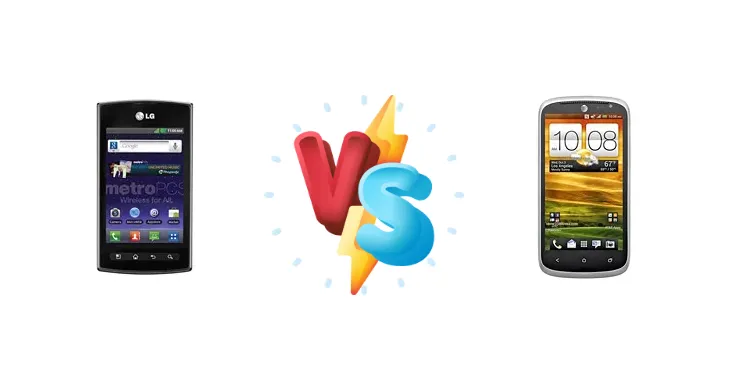
Released in different eras of the budget Android market, the LG Optimus M+ (2011) and HTC One VX (2012) represent distinct approaches to affordability. The M+ aimed for a low entry price, while the One VX offered a step up in processing power. This comparison dissects the core differences between their Qualcomm Snapdragon chipsets to determine which device holds up better today.
🏆 Quick Verdict
For users seeking any semblance of modern app performance, the HTC One VX is the clear winner. Its Snapdragon 400, built on a 28nm process and featuring dual-core Krait architecture, provides a significantly faster experience than the LG Optimus M+'s aging Snapdragon S1. While the M+ might appeal to retro tech enthusiasts, the One VX offers a more usable experience.
| Network |
|---|
| 2G bands | CDMA 800 / 1900 | GSM 850 / 900 / 1800 / 1900 |
| 3G bands | CDMA2000 1xEV-DO | HSDPA 850 / 1900 |
| 4G bands | - | 4, 17 |
| Speed | CDMA2000 1x, 153 Kbps | HSPA 42.2/5.76 Mbps, LTE Cat3 100/50 Mbps |
| Technology | CDMA / EVDO | GSM / HSPA / LTE |
| Launch |
|---|
| Announced | 2012, March. Released 2012, April | 2012, October. Released 2012, November |
| Status | Discontinued | Discontinued |
| Body |
|---|
| Dimensions | 113.8 x 62.7 x 9.9 mm (4.48 x 2.47 x 0.39 in) | 133.5 x 67.6 x 9.2 mm (5.26 x 2.66 x 0.36 in) |
| SIM | Mini-SIM | Micro-SIM |
| Weight | 119 g (4.20 oz) | 124.7 g (4.37 oz) |
| Display |
|---|
| Resolution | 320 x 480 pixels, 3:2 ratio (~165 ppi density) | 540 x 960 pixels, 16:9 ratio (~245 ppi density) |
| Size | 3.5 inches, 36.5 cm2 (~51.1% screen-to-body ratio) | 4.5 inches, 55.8 cm2 (~61.9% screen-to-body ratio) |
| Type | TFT, 256K colors | Super LCD2 |
| Platform |
|---|
| CPU | 800 MHz Cortex A5 | Dual-core 1.2 GHz Krait |
| Chipset | Qualcomm MSM7627A Snapdragon S1 | Qualcomm MSM8930 Snapdragon 400 (28 nm) |
| GPU | Adreno 200 | Adreno 305 |
| OS | Android 2.3 (Gingerbread) | Android 4.0 (Ice Cream Sandwich), Sense UI 4 |
| Memory |
|---|
| Card slot | microSDHC (dedicated slot) | microSDHC (dedicated slot) |
| Internal | 4GB 512MB RAM | 8GB 1GB RAM |
| | - | eMMC 4.5 |
| Main Camera |
|---|
| Features | LED flash | LED flash, HDR |
| Single | 5 MP, AF | 5 MP, AF |
| Video | 480p | 1080p@30fps |
| Sound |
|---|
| 3.5mm jack | - | Yes |
| 35mm jack | Yes | Yes |
| Loudspeaker | Yes | Yes |
| Comms |
|---|
| Bluetooth | 3.0, A2DP | 4.0, A2DP, aptX |
| NFC | - | Yes |
| Positioning | GPS, A-GPS | GPS |
| Radio | No | FM radio |
| USB | microUSB 2.0 | microUSB 2.0 |
| WLAN | Wi-Fi 802.11 b/g/n, hotspot | Wi-Fi 802.11 a/b/g/n, dual-band, DLNA, hotspot |
| Features |
|---|
| Sensors | Accelerometer, proximity, compass | Accelerometer, proximity, compass |
| | - | DivX/XviD/MP4/H.264/WMV player
MP3/eAAC+/WMA/WAV/FLAC player
Document viewer |
| Battery |
|---|
| Stand-by | Up to 250 h | Up to 300 h |
| Talk time | Up to 4 h | Up to 5 h |
| Type | Removable Li-Ion 1300 mAh battery | Li-Ion 1800 mAh, non-removable |
| Misc |
|---|
| Colors | Black | White, Black, Gray |
| Models | - | Y511-U30, Y511-U10 |
| Price | About 100 EUR | About 290 EUR |
| SAR | 1.11 W/kg (head) 0.71 W/kg (body) | 1.16 W/kg (head) 1.23 W/kg (body) |
LG Optimus M+ MS695
- Potentially lower price (due to age)
- Simpler Android experience (less bloatware)
- Collector's item for early Android enthusiasts
- Significantly slower performance
- Outdated software and limited app compatibility
- Poor multitasking capabilities
HTC One VX
- Faster processor and GPU
- More responsive user interface
- Better app compatibility
- May be harder to find in good condition
- Still limited by age and hardware
- Battery life may be degraded
Display Comparison
Detailed display specifications are unavailable for both devices. However, given their release dates and market positioning, both likely featured LCD panels with resolutions around 480x800. The One VX, being slightly newer, may have benefited from minor improvements in color accuracy and viewing angles. Bezels were substantial on both, typical of the era. Neither device is expected to offer high brightness or advanced features like LTPO.
Camera Comparison
Camera details are sparse. Both devices likely featured basic rear cameras, probably around 5MP. The One VX, given its slightly higher market positioning, *may* have included features like autofocus or improved image processing. However, without specific sensor size or aperture information, it’s difficult to assess a significant difference in image quality. The presence of a dedicated camera app with basic filters is the most likely distinction. Both devices would struggle in low-light conditions.
Performance
The core difference lies in the chipsets. The LG Optimus M+ utilizes the Qualcomm MSM7627A Snapdragon S1, featuring a single-core 800 MHz Cortex-A5 processor. This architecture is significantly older and less efficient than the HTC One VX’s Qualcomm MSM8930 Snapdragon 400, which boasts a dual-core 1.2 GHz Krait processor. The Krait architecture, coupled with the 28nm manufacturing process, delivers substantially improved performance and power efficiency. The Snapdragon 400’s Adreno 305 GPU also provides a far superior graphics experience, enabling smoother UI transitions and limited gaming capabilities compared to the S1’s Adreno 200. The One VX will exhibit noticeably faster app launch times and multitasking.
Battery Life
Battery capacity details are unavailable for both devices. However, given their similar form factors and hardware, battery life would have been comparable – likely around 1500-2000 mAh. The Snapdragon 400’s improved power efficiency in the One VX *could* translate to slightly longer battery life under moderate usage, but the difference would likely be marginal. Charging times would have been slow on both, relying on micro-USB and lacking fast-charging capabilities.
Buying Guide
Buy the LG Optimus M+ MS695 if you are a collector of early Android devices, or require a very basic phone for calls and texts with minimal app usage. Buy the HTC One VX if you want a slightly more modern Android experience, capable of handling basic social media and light web browsing, and appreciate the improved processing power for a minimal price increase.
Frequently Asked Questions
❓ Will the LG Optimus M+ run modern apps like WhatsApp or Facebook?
While some older versions of these apps *might* function, the Snapdragon S1's limited processing power and outdated Android version will likely result in a very slow and frustrating experience. Many modern apps will simply be incompatible.
❓ Can the HTC One VX be upgraded to a newer version of Android?
Officially, no. The HTC One VX shipped with Android 4.0 (Ice Cream Sandwich) and did not receive major Android updates. However, custom ROM development *may* exist, allowing enthusiasts to install newer Android versions, but this requires technical expertise and voids the warranty.
❓ Is the difference in performance between these two phones really that noticeable?
Yes, absolutely. The Snapdragon 400 in the One VX is a generation ahead and features a more efficient architecture. You'll experience significantly faster app loading times, smoother scrolling, and a more responsive overall user experience compared to the Optimus M+.