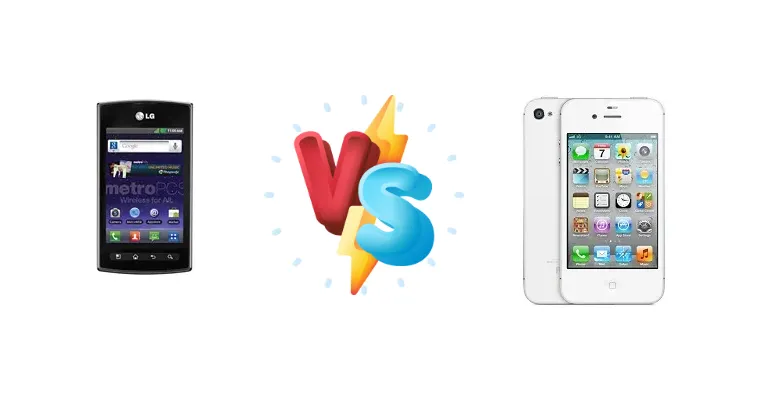
The LG Optimus M+ and Apple iPhone 4S represent pivotal moments in the early smartphone landscape. Released in 2011, these devices showcase contrasting approaches to mobile computing – the Optimus M+ leveraging Android’s open ecosystem and the iPhone 4S refining Apple’s tightly integrated iOS experience. This comparison revisits these phones, analyzing their strengths and weaknesses in a modern context.
🏆 Quick Verdict
For the average user seeking a functional, albeit dated, smartphone experience, the Apple iPhone 4S emerges as the superior choice. Its dual-core 1.0 GHz Cortex-A9 processor and optimized iOS deliver a smoother, more responsive experience than the LG Optimus M+'s 800 MHz Cortex-A5, despite both having similar battery endurance.
| Network |
|---|
| 2G bands | CDMA 800 / 1900 | GSM 850 / 900 / 1800 / 1900 |
| 3G bands | CDMA2000 1xEV-DO | HSDPA 850 / 900 / 1900 / 2100 |
| Speed | CDMA2000 1x, 153 Kbps | HSPA 14.4/5.76 Mbps |
| Technology | CDMA / EVDO | GSM / CDMA / HSPA / EVDO |
| | - | CDMA2000 1xEV-DO |
| Launch |
|---|
| Announced | 2012, March. Released 2012, April | 2011, October 04. Released 2011, October 14 |
| Status | Discontinued | Discontinued |
| Body |
|---|
| Build | - | Glass front (Corning-made glass), glass back, stainless steel frame |
| Dimensions | 113.8 x 62.7 x 9.9 mm (4.48 x 2.47 x 0.39 in) | 115.2 x 58.6 x 9.3 mm (4.54 x 2.31 x 0.37 in) |
| SIM | Mini-SIM | Micro-SIM |
| Weight | 119 g (4.20 oz) | 140 g (4.94 oz) |
| | - | Scratch-resistant glass back panel |
| Display |
|---|
| Protection | - | Corning Gorilla Glass, oleophobic coating |
| Resolution | 320 x 480 pixels, 3:2 ratio (~165 ppi density) | 640 x 960 pixels, 3:2 ratio (~330 ppi density) |
| Size | 3.5 inches, 36.5 cm2 (~51.1% screen-to-body ratio) | 3.5 inches, 36.5 cm2 (~54.0% screen-to-body ratio) |
| Type | TFT, 256K colors | IPS LCD |
| Platform |
|---|
| CPU | 800 MHz Cortex A5 | Dual-core 1.0 GHz Cortex-A9 |
| Chipset | Qualcomm MSM7627A Snapdragon S1 | Apple A5 (45 nm) |
| GPU | Adreno 200 | PowerVR SGX543MP2 |
| OS | Android 2.3 (Gingerbread) | iOS 5, upgradable to iOS 9.3.6 |
| Memory |
|---|
| Card slot | microSDHC (dedicated slot) | No |
| Internal | 4GB 512MB RAM | 8GB 512MB RAM, 16GB 512MB RAM, 32GB 512MB RAM, 64GB 512MB RAM |
| Main Camera |
|---|
| Features | LED flash | LED flash, panorama, HDR |
| Single | 5 MP, AF | 8 MP, f/2.4, 35mm (standard), 1/3.2", 1.4µm, AF |
| Video | 480p | 1080p@30fps |
| Selfie camera |
|---|
| Single | - | VGA, videocalling over Wi-Fi and 3G |
| Video | - | 480p@30fps |
| Sound |
|---|
| 3.5mm jack | - | Yes |
| 35mm jack | Yes | Yes |
| Loudspeaker | Yes | Yes |
| Comms |
|---|
| Bluetooth | 3.0, A2DP | 4.0, A2DP, LE |
| Positioning | GPS, A-GPS | GPS, A-GPS, GLONASS |
| Radio | No | No |
| USB | microUSB 2.0 | 2.0 |
| WLAN | Wi-Fi 802.11 b/g/n, hotspot | Wi-Fi 802.11 b/g/n, hotspot |
| Features |
|---|
| Sensors | Accelerometer, proximity, compass | Accelerometer, gyro, proximity, compass |
| Battery |
|---|
| Stand-by | Up to 250 h | Up to 200 h (3G) |
| Talk time | Up to 4 h | Up to 8 h (3G) |
| Type | Removable Li-Ion 1300 mAh battery | Li-Po 1432 mAh, non-removable (5.3 Wh) |
| Misc |
|---|
| Colors | Black | Black, White |
| Models | - | A1431, A1387, iPhone4,1 |
| Price | About 100 EUR | About 190 EUR |
| SAR | 1.11 W/kg (head) 0.71 W/kg (body) | 1.18 W/kg (head) 0.98 W/kg (body) |
| SAR EU | - | 0.99 W/kg (head) 0.99 W/kg (body) |
| Tests |
|---|
| Audio quality | - |
Noise -91.2dB / Crosstalk -93.0dB |
| Battery life | - |
Endurance rating 45h
|
| Camera | - |
Photo / Video |
| Display | - |
Contrast ratio: 1261:1 (nominal) / 2.269:1 (sunlight) |
| Loudspeaker | - |
Voice 65dB / Noise 64dB / Ring 74dB
|
LG Optimus M+ MS695
- More affordable (in the used market)
- Android’s open ecosystem allows for greater customization
- MicroSD card slot for expandable storage (likely, based on market segment)
- Significantly slower processor
- Inferior camera performance
- Outdated software and limited app support
Apple iPhone 4s
- Faster processor and smoother performance
- Better camera quality and image processing
- More polished and user-friendly iOS experience
- Higher price (in the used market)
- Closed ecosystem with limited customization
- Non-removable battery
Display Comparison
Both devices share a similar contrast ratio of 1261:1 (nominal) and 2.269:1 (sunlight), suggesting comparable outdoor visibility. However, the Optimus M+’s display specifications are largely unknown, while the iPhone 4S’s Retina display, though small by today’s standards, was groundbreaking for its pixel density. The iPhone 4S’s display benefits from Apple’s color management, likely offering more accurate color reproduction than the Optimus M+.
Camera Comparison
Both devices offer photo and video capabilities, but detailed specifications are lacking for the Optimus M+. The iPhone 4S’s 5MP camera, while modest by modern standards, benefited from Apple’s image signal processing, delivering consistently good results in various lighting conditions. The Optimus M+’s camera performance is likely to be significantly inferior due to its less advanced hardware and software.
Performance
The core difference lies in the chipsets. The Apple A5, fabricated on a 45nm process, features a dual-core 1.0 GHz Cortex-A9 CPU. This architecture significantly outperforms the LG Optimus M+'s Qualcomm MSM7627A Snapdragon S1, which utilizes a single-core 800 MHz Cortex-A5. The A5’s architecture and higher clock speed translate to faster app loading times, smoother multitasking, and a more responsive user interface. The 45nm process also contributes to better thermal efficiency, potentially reducing throttling during sustained use. While both are dated, the A5 represents a more advanced design.
Battery Life
Interestingly, both devices achieve an endurance rating of 45 hours. This suggests that despite the iPhone 4S’s more powerful processor, Apple’s software optimization and power management are highly effective. The Optimus M+ likely achieves similar endurance through its less demanding hardware, but users may experience shorter real-world battery life with heavier usage due to the less efficient Snapdragon S1.
Buying Guide
Buy the LG Optimus M+ MS695 if you need a highly customizable Android experience on a budget, and are comfortable with significantly slower performance and limited app support. Buy the Apple iPhone 4S if you prioritize a more polished user interface, better performance for basic tasks, and a more robust (though aging) app ecosystem, even if it means being locked into the Apple ecosystem.
Frequently Asked Questions
❓ Will the iPhone 4S still receive software updates in 2024?
No, Apple officially ceased software support for the iPhone 4S in 2014 with iOS 7.1.2. Users will be limited to running older versions of iOS, which may lack modern security features and app compatibility.
❓ Can I easily find replacement batteries for either of these phones?
Replacement batteries are available for both phones through third-party vendors, but quality can vary significantly. The iPhone 4S battery replacement is a relatively common repair, while finding a reliable battery for the Optimus M+ may be more challenging.
❓ What kind of apps will realistically run on the LG Optimus M+ in 2024?
Due to its limited processing power and outdated Android version, the LG Optimus M+ will struggle to run most modern apps. Users will likely be limited to older versions of apps or lightweight alternatives.
❓ Is the iPhone 4S still usable for basic tasks like calls, texts, and web browsing?
Yes, the iPhone 4S remains usable for basic tasks like calls, texts, and web browsing, although performance will be noticeably slower compared to modern smartphones. The experience will be hampered by the lack of modern app support and security updates.