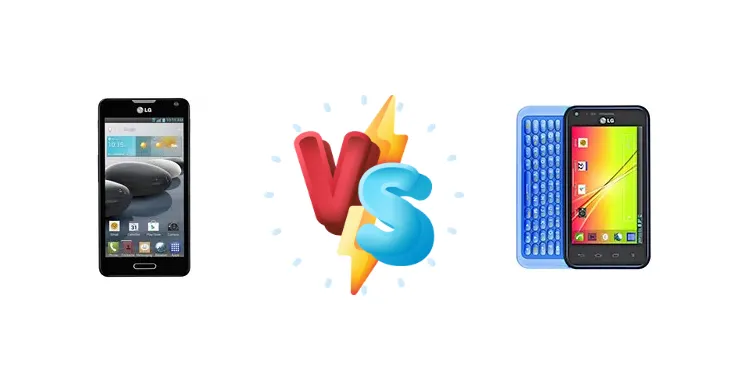
The LG Optimus F6 and F3Q were budget-friendly smartphones released around the same time, targeting users seeking affordability. While they share a similar core chipset, subtle differences in design, features, and software could make one a better choice than the other. Let's dive into a comprehensive comparison to help you decide.
🏆 Quick Verdict
Both phones are quite dated. The F6 likely edges out the F3Q due to potentially slightly better build quality and a marginally larger screen. However, neither is recommended for modern use; consider newer budget options for a significantly improved experience.
| Network |
|---|
| 2G bands | GSM 850 / 900 / 1800 / 1900 | GSM 850 / 900 / 1800 / 1900 |
| 3G bands | HSDPA 850 / 1700 / 1900 / 2100 - D500 | HSDPA 850 / 1700 / 1900 / 2100 |
| 4G bands | 4, 17 - D500 | 2, 4, 13 |
| Speed | HSPA 42.2/5.76 Mbps, LTE Cat3 100/50 Mbps | HSPA, LTE |
| Technology | GSM / HSPA / LTE | GSM / HSPA / LTE |
| | 3, 7, 8, 20 - D505 | - |
| Launch |
|---|
| Announced | 2013, August. Released 2013, September | 2014, January. Released 2014, February |
| Status | Discontinued | Discontinued |
| Body |
|---|
| Dimensions | 128 x 65.9 x 10.2 mm (5.04 x 2.59 x 0.40 in) | 121.9 x 64.8 x 14 mm (4.80 x 2.55 x 0.55 in) |
| Keyboard | - | QWERTY |
| SIM | Micro-SIM | Micro-SIM |
| Weight | 126 g (4.44 oz) | 159.9 g (5.61 oz) |
| Display |
|---|
| Protection | Corning Gorilla Glass 2 | - |
| Resolution | 540 x 960 pixels, 16:9 ratio (~245 ppi density) | 480 x 800 pixels, 5:3 ratio (~233 ppi density) |
| Size | 4.5 inches, 55.8 cm2 (~66.2% screen-to-body ratio) | 4.0 inches, 45.5 cm2 (~57.7% screen-to-body ratio) |
| Type | IPS LCD | IPS LCD |
| Platform |
|---|
| CPU | Dual-core 1.2 GHz Krait | Dual-core 1.2 GHz Krait |
| Chipset | Qualcomm MSM8930 Snapdragon 400 (28 nm) | Qualcomm MSM8930 Snapdragon 400 (28 nm) |
| GPU | Adreno 305 | Adreno 305 |
| OS | Android 4.1.2 (Jelly Bean), LG Optimus UI 4 | Android 4.1.2 (Jelly Bean) |
| Memory |
|---|
| Card slot | microSDHC (dedicated slot) | microSDHC (dedicated slot) |
| Internal | 4GB 1GB RAM (D500), 8GB 1GB RAM (D505) | 4GB 1GB RAM |
| | eMMC 4.5 | eMMC 4.5 |
| Main Camera |
|---|
| Features | LED flash, panorama, HDR | LED flash |
| Single | 5 MP, AF (D500)
8 MP, AF (D505) | 5 MP, AF |
| Video | 1080p@30fps | Yes |
| Selfie camera |
|---|
| Single | 1.3 MP | VGA |
| Sound |
|---|
| 3.5mm jack | Yes | Yes |
| 35mm jack | Yes | Yes |
| Loudspeaker | Yes | Yes |
| Comms |
|---|
| Bluetooth | 4.0, A2DP, LE | 4.0, A2DP |
| Infrared port | - | Yes |
| NFC | Yes | Yes |
| Positioning | GPS, GLONASS | GPS |
| Radio | FM radio | No |
| USB | microUSB 2.0 | microUSB 2.0 |
| WLAN | Wi-Fi 802.11 a/b/g/n, Wi-Fi Direct, hotspot, DLNA | Wi-Fi 802.11 b/g/n, hotspot |
| Features |
|---|
| Sensors | Accelerometer, proximity, compass | Accelerometer, proximity |
| Battery |
|---|
| Stand-by | Up to 540 h (2G) / Up to 540 h (3G) | - |
| Talk time | Up to 15 h (2G) / Up to 10 h (3G) | - |
| Type | Li-Ion 2460 mAh, removable | Li-Ion 2460 mAh, removable |
| Misc |
|---|
| Colors | Black, White | Blue |
| Price | About 200 EUR | About 230 EUR |
| SAR | 0.98 W/kg (head) 1.28 W/kg (body) | - |
| SAR EU | 0.56 W/kg (head) 0.57 W/kg (body) | - |
LG Optimus F6
- Larger Display
- Better Battery Life
- Potentially Slightly Better Build Quality
- Outdated Performance
- Low-Resolution Display
- Limited Storage
LG Optimus F3Q
- Compact Size
- Similar Performance to F6
- Smaller Display
- Shorter Battery Life
- Outdated Performance
- Limited Storage
Display Comparison
The LG Optimus F6 typically featured a 4.5-inch IPS display, while the F3Q had a slightly smaller 4.3-inch display. Both offered standard resolution for their time, but the F6's larger size provides a slightly more immersive viewing experience. Color accuracy and brightness were typical for budget phones of that era.
Camera Comparison
The LG Optimus F6 generally had an 8MP rear camera, while the F3Q often featured a similar 8MP camera. Image quality was average for the time, with limited low-light performance. Front-facing cameras were basic, likely 1.2MP on both.
Performance
Both devices share the same Qualcomm MSM8930 Snapdragon 400 chipset with a dual-core 1.2 GHz Krait CPU. Performance will be very similar, adequate for basic tasks like web browsing and light app usage, but struggles with demanding games or multitasking. Expect noticeable lag.
Battery Life
Battery capacity is a key differentiator. The F6 typically had a larger 2100mAh battery compared to the F3Q's 1500mAh. This translates to noticeably better battery life on the F6, potentially lasting a full day with light usage, whereas the F3Q would require more frequent charging.
Buying Guide
The LG Optimus F6 might appeal to someone seeking a very basic, ultra-budget phone for calls and simple tasks, or perhaps as a secondary device. The LG Optimus F3Q is similarly suited for minimal usage, but its smaller screen might be a drawback. Neither is recommended for power users or those needing modern features.
Frequently Asked Questions
❓ Are these phones still worth buying?
Generally no. These phones are quite old and lack modern features and security updates. Consider newer budget smartphones for a significantly better experience.
❓ What operating system did these phones run?
Both phones originally shipped with Android 4.4 KitKat, though updates were limited.
❓ How much storage did these phones have?
Typically, both offered 4GB of internal storage, expandable via microSD card.