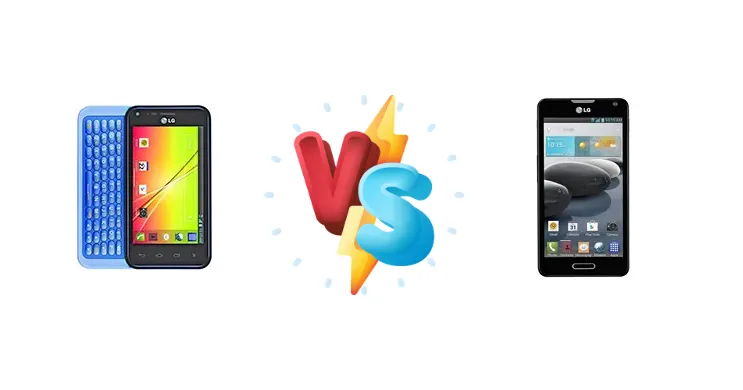
The LG Optimus F3Q and F6 were both budget-friendly Android smartphones aiming to deliver value. While they share a similar core processor, subtle differences in design, features, and potentially software support could make one a better choice than the other. Let's dive into a detailed comparison to help you decide.
🏆 Quick Verdict
The LG Optimus F6 likely edges out the F3Q due to potentially better build quality, a slightly improved display (likely higher resolution), and potentially more timely software updates. Both offer similar performance thanks to the Snapdragon 400, but the F6's refinements make it the slightly better overall package.
| Network |
|---|
| 2G bands | GSM 850 / 900 / 1800 / 1900 | GSM 850 / 900 / 1800 / 1900 |
| 3G bands | HSDPA 850 / 1700 / 1900 / 2100 | HSDPA 850 / 1700 / 1900 / 2100 - D500 |
| 4G bands | 2, 4, 13 | 4, 17 - D500 |
| Speed | HSPA, LTE | HSPA 42.2/5.76 Mbps, LTE Cat3 100/50 Mbps |
| Technology | GSM / HSPA / LTE | GSM / HSPA / LTE |
| | - | 3, 7, 8, 20 - D505 |
| Launch |
|---|
| Announced | 2014, January. Released 2014, February | 2013, August. Released 2013, September |
| Status | Discontinued | Discontinued |
| Body |
|---|
| Dimensions | 121.9 x 64.8 x 14 mm (4.80 x 2.55 x 0.55 in) | 128 x 65.9 x 10.2 mm (5.04 x 2.59 x 0.40 in) |
| Keyboard | QWERTY | - |
| SIM | Micro-SIM | Micro-SIM |
| Weight | 159.9 g (5.61 oz) | 126 g (4.44 oz) |
| Display |
|---|
| Protection | - | Corning Gorilla Glass 2 |
| Resolution | 480 x 800 pixels, 5:3 ratio (~233 ppi density) | 540 x 960 pixels, 16:9 ratio (~245 ppi density) |
| Size | 4.0 inches, 45.5 cm2 (~57.7% screen-to-body ratio) | 4.5 inches, 55.8 cm2 (~66.2% screen-to-body ratio) |
| Type | IPS LCD | IPS LCD |
| Platform |
|---|
| CPU | Dual-core 1.2 GHz Krait | Dual-core 1.2 GHz Krait |
| Chipset | Qualcomm MSM8930 Snapdragon 400 (28 nm) | Qualcomm MSM8930 Snapdragon 400 (28 nm) |
| GPU | Adreno 305 | Adreno 305 |
| OS | Android 4.1.2 (Jelly Bean) | Android 4.1.2 (Jelly Bean), LG Optimus UI 4 |
| Memory |
|---|
| Card slot | microSDHC (dedicated slot) | microSDHC (dedicated slot) |
| Internal | 4GB 1GB RAM | 4GB 1GB RAM (D500), 8GB 1GB RAM (D505) |
| | eMMC 4.5 | eMMC 4.5 |
| Main Camera |
|---|
| Features | LED flash | LED flash, panorama, HDR |
| Single | 5 MP, AF | 5 MP, AF (D500)
8 MP, AF (D505) |
| Video | Yes | 1080p@30fps |
| Selfie camera |
|---|
| Single | VGA | 1.3 MP |
| Sound |
|---|
| 3.5mm jack | Yes | Yes |
| 35mm jack | Yes | Yes |
| Loudspeaker | Yes | Yes |
| Comms |
|---|
| Bluetooth | 4.0, A2DP | 4.0, A2DP, LE |
| Infrared port | Yes | - |
| NFC | Yes | Yes |
| Positioning | GPS | GPS, GLONASS |
| Radio | No | FM radio |
| USB | microUSB 2.0 | microUSB 2.0 |
| WLAN | Wi-Fi 802.11 b/g/n, hotspot | Wi-Fi 802.11 a/b/g/n, Wi-Fi Direct, hotspot, DLNA |
| Features |
|---|
| Sensors | Accelerometer, proximity | Accelerometer, proximity, compass |
| Battery |
|---|
| Stand-by | - | Up to 540 h (2G) / Up to 540 h (3G) |
| Talk time | - | Up to 15 h (2G) / Up to 10 h (3G) |
| Type | Li-Ion 2460 mAh, removable | Li-Ion 2460 mAh, removable |
| Misc |
|---|
| Colors | Blue | Black, White |
| Price | About 230 EUR | About 200 EUR |
| SAR | - | 0.98 W/kg (head) 1.28 W/kg (body) |
| SAR EU | - | 0.56 W/kg (head) 0.57 W/kg (body) |
LG Optimus F3Q
- Extremely Affordable
- Compact Size
- Decent Battery Life (for its size)
- Lower Resolution Display
- Potentially Slower Software Updates
- Basic Camera Performance
LG Optimus F6
- Slightly Better Display Resolution
- Potentially Better Build Quality
- Likely More Timely Software Updates
- Slightly Improved Camera
- Still a Budget Phone (Limited Performance)
- May be Harder to Find New
Display Comparison
Both phones likely feature IPS LCD displays, but the F6 likely boasts a higher resolution (potentially 720p vs. the F3Q's likely qHD). This translates to sharper images and text on the F6. Color accuracy and brightness are likely comparable, though the F6 might have slightly better viewing angles.
Camera Comparison
The F6 likely has a slightly better camera sensor and image processing capabilities, resulting in marginally better photo quality, especially in low light. Both likely feature a 5MP main camera and a front-facing camera for selfies. Video recording capabilities are likely similar, around 720p.
Performance
Performance is largely identical. Both are powered by the Qualcomm Snapdragon 400 chipset with a dual-core 1.2 GHz Krait CPU. Expect adequate performance for basic tasks like browsing, social media, and light gaming, but don't expect blazing speeds. Multitasking will be limited.
Battery Life
The F6 likely has a slightly larger battery capacity (potentially 2100mAh vs. the F3Q's likely 1800mAh), which could translate to slightly longer battery life. However, real-world usage will depend on individual habits and settings.
Buying Guide
The LG Optimus F3Q is a viable option for users on an extremely tight budget who prioritize affordability above all else. The LG Optimus F6 is a better choice for those seeking a slightly more refined experience with a potentially better display and build, even if the price difference is minimal.
Frequently Asked Questions
❓ Are these phones still worth buying in 2024?
Given their age, finding these phones new is unlikely. If you find them used at a very low price, they can still be functional for basic tasks, but modern smartphones offer significantly better performance and features.
❓ What Android version did these phones ship with?
The LG Optimus F3Q likely shipped with Android 4.4.2 KitKat. The LG Optimus F6 likely shipped with Android 4.4.2 KitKat, with potential for minor updates.