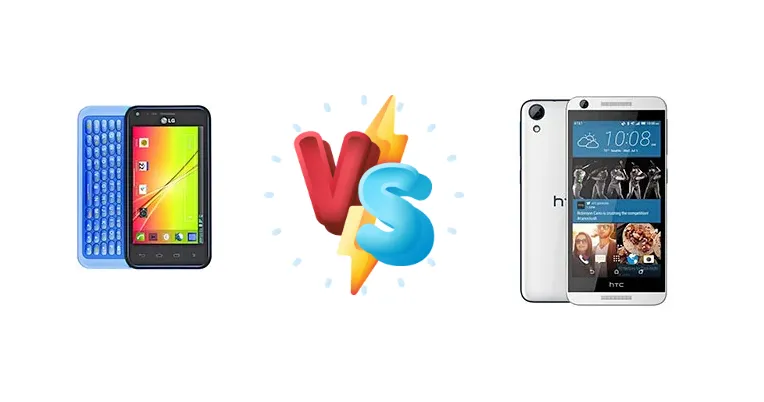
The LG Optimus F3Q and HTC Desire 626s were popular budget smartphones offering accessible Android experiences. But which one truly delivers the better value? This in-depth comparison will break down their key features, performance, and overall appeal to help you make an informed decision.
🏆 Quick Verdict
The HTC Desire 626s edges out the LG Optimus F3Q thanks to its quad-core processor, offering noticeably smoother performance for everyday tasks. While both are budget options, the Desire 626s provides a slightly more responsive and enjoyable user experience.
| Network |
|---|
| 2G bands | GSM 850 / 900 / 1800 / 1900 | GSM 850 / 900 / 1800 / 1900 |
| 3G bands | HSDPA 850 / 1700 / 1900 / 2100 | HSDPA 850 / 1700(AWS) / 1900 / 2100 - T-Mobile |
| 4G bands | 2, 4, 13 | 2, 4, 5, 12 - T-Mobile |
| Speed | HSPA, LTE | HSPA, LTE Cat4 150/50 Mbps |
| Technology | GSM / HSPA / LTE | GSM / HSPA / LTE |
| Launch |
|---|
| Announced | 2014, January. Released 2014, February | 2015, July. Released 2015, July |
| Status | Discontinued | Discontinued |
| Body |
|---|
| Dimensions | 121.9 x 64.8 x 14 mm (4.80 x 2.55 x 0.55 in) | 146.8 x 70.9 x 8.1 mm (5.78 x 2.79 x 0.32 in) |
| Keyboard | QWERTY | - |
| SIM | Micro-SIM | Nano-SIM |
| Weight | 159.9 g (5.61 oz) | 138.9 g (4.90 oz) |
| Display |
|---|
| Resolution | 480 x 800 pixels, 5:3 ratio (~233 ppi density) | 720 x 1280 pixels, 16:9 ratio (~294 ppi density) |
| Size | 4.0 inches, 45.5 cm2 (~57.7% screen-to-body ratio) | 5.0 inches, 68.9 cm2 (~66.2% screen-to-body ratio) |
| Type | IPS LCD | IPS LCD |
| Platform |
|---|
| CPU | Dual-core 1.2 GHz Krait | Quad-core 1.1 GHz Cortex-A7 |
| Chipset | Qualcomm MSM8930 Snapdragon 400 (28 nm) | Qualcomm MSM8909 Snapdragon 210 (28 nm) |
| GPU | Adreno 305 | Adreno 304 |
| OS | Android 4.1.2 (Jelly Bean) | Android 5.1.1 (Lollipop), upgradable to 6.0.1 (Marshmallow), Sense UI 7 |
| Memory |
|---|
| Card slot | microSDHC (dedicated slot) | microSDXC (dedicated slot) |
| Internal | 4GB 1GB RAM | 8GB 1GB RAM, 8GB 1.5GB RAM (T-Mobile) |
| | eMMC 4.5 | eMMC 4.5 |
| Main Camera |
|---|
| Features | LED flash | LED flash |
| Single | 5 MP, AF | 8 MP, AF |
| Video | Yes | 720p@30fps |
| Selfie camera |
|---|
| Single | VGA | 2 MP |
| Video | - | 720p |
| Sound |
|---|
| 3.5mm jack | Yes | Yes |
| 35mm jack | Yes | Yes |
| Loudspeaker | Yes | Yes |
| Comms |
|---|
| Bluetooth | 4.0, A2DP | 4.1, A2DP |
| Infrared port | Yes | - |
| NFC | Yes | No |
| Positioning | GPS | GPS |
| Radio | No | FM radio |
| USB | microUSB 2.0 | microUSB 2.0 |
| WLAN | Wi-Fi 802.11 b/g/n, hotspot | Wi-Fi 802.11 b/g/n, hotspot |
| Features |
|---|
| Sensors | Accelerometer, proximity | Yes |
| Battery |
|---|
| Stand-by | - | Up to 540 h (3G) |
| Talk time | - | Up to 15 h (3G) |
| Type | Li-Ion 2460 mAh, removable | Li-Ion 2000 mAh, non-removable |
| Misc |
|---|
| Colors | Blue | Black, White |
| Models | - | Desire 626s, 0PM92 |
| Price | About 230 EUR | About 190 EUR |
LG Optimus F3Q
- Compact and lightweight
- Simple and easy to use
- Affordable
- Underpowered processor
- Low-resolution display
- Limited storage
HTC Desire 626s
- Better performance than F3Q
- Slightly better battery life
- More responsive user interface
- Still a budget device with limitations
- Low-resolution display
- Plastic build quality
Display Comparison
Both phones feature relatively small, low-resolution displays (likely around 4.5-5 inches with 854x480 resolution). The LG might have slightly better color accuracy, but overall, display quality is comparable and not a strong differentiator. Viewing angles and brightness are typical for budget devices of this era.
Camera Comparison
Camera quality on both phones is modest. Both likely feature 8MP main cameras and 5MP front cameras. Image quality will be adequate in good lighting conditions, but expect noise and limited detail in low light. The HTC might have slightly better image processing algorithms, but the difference is minimal.
Performance
This is where the HTC Desire 626s has a clear advantage. Its quad-core Cortex-A7 processor, while not powerful, is superior to the LG's dual-core Krait processor. Expect smoother app loading, better multitasking, and a more responsive user interface on the Desire 626s. The Snapdragon 210 chipset generally handles basic tasks better than the Snapdragon 400 in this context.
Battery Life
The HTC Desire 626s likely has a slightly larger battery capacity (around 2000mAh) compared to the LG Optimus F3Q (around 1800mAh). This translates to slightly better battery life, though both phones will require daily charging with moderate usage.
Buying Guide
The LG Optimus F3Q is a decent choice for users on an extremely tight budget who prioritize a compact form factor and basic functionality. The HTC Desire 626s is better suited for those who want a slightly more capable device for multitasking and light gaming, without breaking the bank.
Frequently Asked Questions
❓ Are these phones still worth buying in 2024?
Given their age, neither phone is recommended for primary use. However, they could be suitable for very basic tasks or as secondary devices for specific purposes, provided they are available at a very low price.
❓ What operating system do these phones run?
Both phones originally shipped with Android 4.4 KitKat. Software updates were limited, and they likely run older versions of Android now.