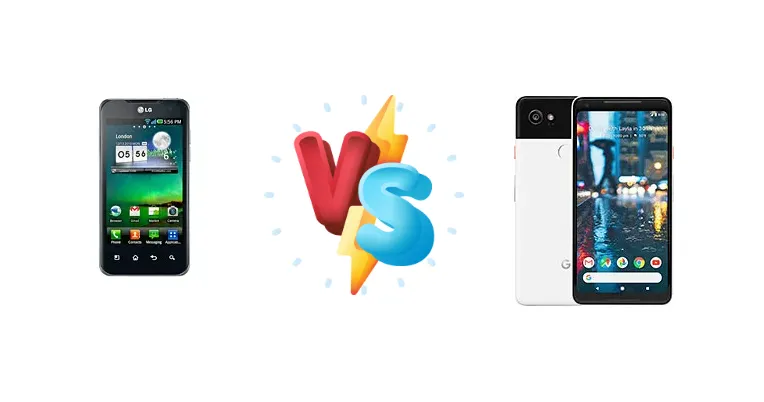
The LG Optimus 2X was a groundbreaking phone in its time, boasting one of the first dual-core processors. Now, let's pit it against the Google Pixel 2 XL, a modern Android powerhouse. This comparison explores how these devices stack up, highlighting the evolution of smartphone technology.
🏆 Quick Verdict
The Google Pixel 2 XL utterly dominates this comparison. While the Optimus 2X was impressive for 2010, the Pixel 2 XL’s superior processing power, camera, display, and battery life make it the clear winner. It’s a testament to how far smartphone technology has advanced.
| Network |
|---|
| 2G bands | GSM 850 / 900 / 1800 / 1900 | GSM 850 / 900 / 1800 / 1900 |
| 3G bands | HSDPA 900 / 1900 / 2100 | HSDPA 850 / 900 / 1700(AWS) / 1900 / 2100 |
| 4G bands | - | 1, 2, 3, 4, 5, 7, 8, 12, 13, 17, 20, 25, 26, 28, 29, 30, 32, 38, 40, 41, 66 |
| Speed | HSPA 7.2/5.76 Mbps | HSPA 42.2/5.76 Mbps, LTE (3CA) Cat15 800/75 Mbps |
| Technology | GSM / HSPA | GSM / CDMA / HSPA / EVDO / LTE |
| | HSDPA 900 / 1700 / 2100 | - |
| Launch |
|---|
| Announced | 2010, December. Released 2011, February | 2017, October 04. Released 2017, October 17 |
| Status | Discontinued | Discontinued |
| Body |
|---|
| Build | - | Glass front (Gorilla Glass 5), aluminum/glass back, aluminum frame |
| Dimensions | 123.9 x 63.2 x 10.9 mm (4.88 x 2.49 x 0.43 in) | 157.9 x 76.7 x 7.9 mm (6.22 x 3.02 x 0.31 in) |
| SIM | Mini-SIM | Nano-SIM + eSIM |
| Weight | 139 g (4.90 oz) | 175 g (6.17 oz) |
| Display |
|---|
| Protection | Corning Gorilla Glass | Corning Gorilla Glass 5 |
| Resolution | 480 x 800 pixels, 5:3 ratio (~233 ppi density) | 1440 x 2880 pixels, 18:9 ratio (~538 ppi density) |
| Size | 4.0 inches, 45.5 cm2 (~58.2% screen-to-body ratio) | 6.0 inches, 92.6 cm2 (~76.4% screen-to-body ratio) |
| Type | IPS LCD | P-OLED |
| Platform |
|---|
| CPU | Dual-core 1.0 GHz Cortex-A9 | Octa-core (4x2.35 GHz Kryo & 4x1.9 GHz Kryo) |
| Chipset | Nvidia Tegra 2 AP20H | Qualcomm MSM8998 Snapdragon 835 (10 nm) |
| GPU | ULP GeForce | Adreno 540 |
| OS | Android 2.2 (Froyo), 2.3, upgradable to 4.0 (Ice Cream Sandwich) | Android 8.0 (Oreo), upgradable to Android 11 |
| Memory |
|---|
| Card slot | microSDHC (dedicated slot) | No |
| Internal | 8GB 512MB RAM | 64GB 4GB RAM, 128GB 4GB RAM |
| Main Camera |
|---|
| Features | LED flash | Laser AF, Dual-LED flash, HDR, panorama |
| Single | 8 MP, AF | 12.2 MP, f/1.8, 27mm (wide), 1/2.55", 1.4µm, dual pixel PDAF, OIS |
| Video | 1080p@24fps, 720p@30fps | 4K@30fps (gyro-EIS), 1080p@30/60/120fps (gyro-EIS), 720p@240fps (gyro-EIS) |
| Selfie camera |
|---|
| Features | - | HDR |
| Single | 1.3 MP | 8 MP, f/2.4, 25mm (wide), 1/3.2", 1.4µm |
| Video | - | 1080p@30fps |
| Sound |
|---|
| 3.5mm jack | Yes | No |
| 35mm jack | Yes | No |
| Loudspeaker | Yes | Yes, with stereo speakers |
| Comms |
|---|
| Bluetooth | 2.1, A2DP | 5.0, A2DP, LE, aptX HD |
| NFC | No | Yes |
| Positioning | GPS, A-GPS | GPS, GLONASS, BDS, GALILEO |
| Radio | Stereo FM radio, RDS | No |
| USB | microUSB 2.0 | USB Type-C 3.1 |
| WLAN | Wi-Fi 802.11 b/g/n, DLNA, hotspot | Wi-Fi 802.11 a/b/g/n/ac, dual-band, Wi-Fi Direct, DLNA |
| Features |
|---|
| Browser | HTML, Adobe Flash | - |
| Sensors | Accelerometer, gyro, proximity, compass | Fingerprint (rear-mounted), accelerometer, gyro, proximity, compass, barometer |
| | HDMI port
DivX/Xvid/MP4/H.264/WMV player
MP3/WAV/WMA/eAAC+ player
Document editor
Organizer
Voice memo/dial/commands
Predictive text input | - |
| Battery |
|---|
| Charging | - | 10.5W wired (capped), PD2.0 |
| Stand-by | Up to 400 h | - |
| Talk time | Up to 7 h 50 min | - |
| Type | Removable Li-Ion 1500 mAh battery | Li-Ion 3520 mAh, non-removable |
| Misc |
|---|
| Colors | Black | Just Black, Black & White |
| Models | - | G011C |
| Price | About 150 EUR | About 520 EUR |
| SAR | 0.27 W/kg (head) 0.62 W/kg (body) | - |
| SAR EU | 0.55 W/kg (head) 0.90 W/kg (body) | - |
| Tests |
|---|
| Audio quality |
Noise -90.1dB / Crosstalk -89.2dB |
Noise - 93.7 / Crosstalk - 79.7 |
| Battery life |
Endurance rating 76h
|
Endurance rating 88h
|
| Camera |
Photo / Video |
Photo / Video |
| Display |
Contrast ratio: 1001:1 (nominal) |
Contrast ratio: ∞ |
| Loudspeaker |
Voice 65dB / Noise 60dB / Ring 67dB
|
Voice 66dB / Noise 70dB / Ring 78dB
|
| Performance | - |
AnTuTu: 206711 (v7)
GeekBench: 6055 (v4.4)
GFXBench: 13fps (ES 3.1 onscreen) |
LG Optimus 2X
- Early dual-core processor
- Relatively compact design for its time
- Nvidia Tegra 2 GPU
- Outdated processor
- Low-resolution display
- Poor camera quality by modern standards
- Limited app compatibility
Google Pixel 2 XL
- Excellent camera
- Powerful Snapdragon 835 processor
- Vibrant display
- Clean Android experience
- Long battery life
- Potential for screen burn-in
- Older device - finding a good condition unit can be difficult
- Charging speed is relatively slow
Display Comparison
The Pixel 2 XL’s display is in a different league. Its '∞' contrast ratio (effectively infinite) signifies exceptional blacks and vibrant colors, a stark contrast to the Optimus 2X's 1001:1 ratio. The Pixel 2 XL also likely has a higher resolution and better color accuracy. The Optimus 2X's display was decent for its time, but simply can't compete.
Camera Comparison
Both phones have 'Photo / Video' capabilities listed, but the Pixel 2 XL’s camera is renowned for its exceptional image quality, HDR+, and computational photography. The Optimus 2X’s camera was adequate for its time, but lacks the advanced features and image processing of the Pixel 2 XL.
Performance
The Pixel 2 XL’s Snapdragon 835 octa-core processor blows the Optimus 2X’s dual-core Cortex-A9 out of the water. The 835’s 10nm process offers significantly better efficiency and performance. Expect the Pixel 2 XL to handle demanding games and multitasking with ease, while the Optimus 2X would struggle.
Battery Life
While both phones have an endurance rating of 88h, the Pixel 2 XL’s more efficient chipset and modern battery technology likely translate to better real-world battery life. The Optimus 2X's battery life was good for 2010, but falls short compared to modern standards.
Buying Guide
Who should buy the LG Optimus 2X? Likely, only collectors or those interested in experiencing early Android dual-core devices. The Google Pixel 2 XL is for anyone seeking a reliable, high-performing smartphone with a fantastic camera and long battery life, though finding one in good condition may be challenging.
Frequently Asked Questions
❓ Was the LG Optimus 2X a good phone when it was released?
Yes, the Optimus 2X was a significant phone in 2010, being one of the first smartphones with a dual-core processor. However, it has been surpassed by modern technology.
❓ Can I still use the LG Optimus 2X today?
While technically possible, using the Optimus 2X in 2024 would be challenging due to outdated software, limited app compatibility, and slow performance. The Google Pixel 2 XL is a more viable option, though also aging.