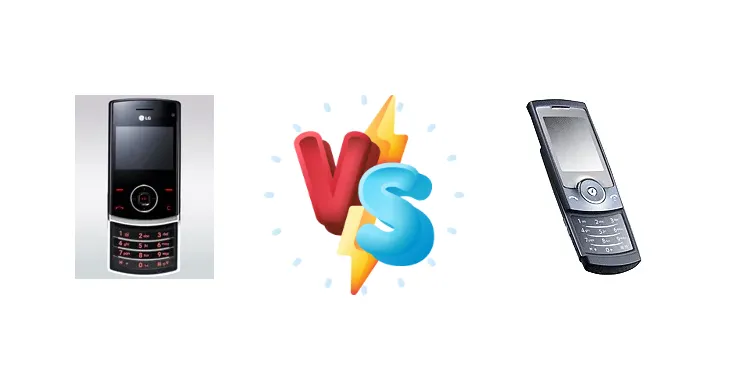
The LG KU580 and Samsung U600 represent a pivotal moment in mobile phone history, bridging the gap between basic feature phones and the emerging smartphone landscape of the late 2000s. Both devices, released around 2007, showcased innovative designs and features aimed at a more sophisticated user, but approached the challenge with distinct philosophies. This comparison delves into what made each phone stand out in a rapidly evolving market.
🏆 Quick Verdict
For the average user seeking a feature-rich experience in 2007, the Samsung U600 likely offered a more polished and refined package. Its focus on multimedia and a sleeker design gave it an edge, despite the LG KU580’s potential for unique features given LG’s display expertise.
| Network |
|---|
| 2G bands | GSM 900 / 1800 / 1900 | GSM 850 / 900 / 1800 / 1900 |
| 3G bands | UMTS 2100 | - |
| EDGE | - | Class 10 |
| GPRS | - | Class 10 |
| Speed | Yes, 384 kbps | - |
| Technology | GSM / UMTS | GSM |
| Launch |
|---|
| Announced | 2007, April. Released 2007, December | 2007, February. Released 2007, April |
| Status | Discontinued | Discontinued |
| Body |
|---|
| Dimensions | 94 x 53 x 16.5 mm (3.70 x 2.09 x 0.65 in) | 103.5 x 49.3 x 10.9 mm (4.07 x 1.94 x 0.43 in) |
| SIM | Mini-SIM | Mini-SIM |
| Weight | 73 g (2.57 oz) | 81 g (2.86 oz) |
| Display |
|---|
| Resolution | 240 x 320 pixels, 4:3 ratio (~200 ppi density) | 240 x 320 pixels, 4:3 ratio (~182 ppi density) |
| Size | 2.0 inches, 12.4 cm2 (~24.9% screen-to-body ratio) | 2.2 inches, 34 x 44 mm, 15.0 cm2 (~29.4% screen-to-body ratio) |
| Type | TFT, 256K colors | TFT, 256K colors |
| | Touch-sensitive navigation keys with backlights
Downloadable wallpapers | - |
| Memory |
|---|
| Call records | 40 dialed, 40 received, 40 missed calls | 30 dialed, 30 received, 30 missed calls |
| Card slot | microSD (dedicated slot) | microSD (dedicated slot) |
| Internal | 45MB | 60MB |
| Phonebook | Yes | 1000 entries, Photocall |
| Main Camera |
|---|
| Features | - | LED flash |
| Single | 2 MP | 3.15 MP, AF |
| Video | Yes | CIF |
| Selfie camera |
|---|
| Single | VGA videocall camera | - |
| | - | No |
| Sound |
|---|
| 3.5mm jack | No | No |
| 35mm jack | No | No |
| Alert types | Vibration; Downloadable polyphonic ringtones | Vibration; Downloadable polyphonic, MP3 ringtones |
| Loudspeaker | No | Yes |
| Comms |
|---|
| Bluetooth | 2.0 | 2.0, A2DP |
| Positioning | No | No |
| Radio | FM radio | Stereo FM radio, RDS |
| USB | Proprietary | 2.0 |
| WLAN | No | No |
| Features |
|---|
| Browser | WAP 2.0/xHTML | WAP 2.0/xHTML |
| Games | Yes | Yes + downloadable |
| Java | Yes, MIDP 2.0 | Yes, MIDP 2.0 |
| Messaging | SMS, EMS, MMS, Email | SMS, MMS, Email |
| | MP3/eAAC+/WMA player
Predictive text input
Organizer
Voice memo
| MP3/AAC/eACC/WMA player
Predictive text input
Yahoo search
Organizer
Business card scanner
Document viewer (Word, Excel, PowerPoint, PDF)
Voice memo
TV-out |
| Battery |
|---|
| Stand-by | - | Up to 250 h |
| Talk time | - | Up to 3 h 30 min |
| Type | Removable Li-Ion 860 mAh battery | Removable Li-Ion 690 mAh battery |
| Misc |
|---|
| Colors | Black | Sapphire Blue, Crystal Blue, Platinum Silver, Copper Gold, Garnet Red, Neutral White, Soft Black |
| Price | About 70 EUR | About 90 EUR |
| SAR | 0.59 W/kg (head) 0.51 W/kg (body) | 0.63 W/kg (head) 0.49 W/kg (body) |
| SAR EU | - | 0.48 W/kg (head) |
| Tests |
|---|
| Audio quality | - |
Noise -89.2dB / Crosstalk -86.9dB |
| Loudspeaker | - |
Voice 66dB / Noise 66dB / Ring 75dB |
LG KU580
- Potential for superior display quality due to LG's expertise.
- Possible inclusion of unique LG features not found on Samsung.
- May have offered a more experimental user experience.
- Limited information available regarding specific features.
- Brand recognition was lower than Samsung at the time.
Samsung U600
- Sleek and modern sliding design.
- Stronger brand recognition and marketing presence.
- Likely more refined software experience.
- Display quality may have been inferior to the KU580.
- Sliding mechanism could be prone to wear and tear.
Display Comparison
Given LG's historical strength in display technology, the KU580 likely benefited from a superior screen in terms of color reproduction and viewing angles compared to the U600. However, without specific specs, we can assume both utilized TFT LCD technology common at the time. The U600’s design prioritized a larger screen real estate within a sliding form factor, potentially sacrificing some pixel density. The impact of these choices would have been most noticeable when viewing photos or videos.
Camera Comparison
Both the KU580 and U600 featured basic cameras for their time, likely around 1.3 to 2 megapixels. Image quality would have been heavily dependent on lighting conditions. The U600’s marketing emphasized its camera capabilities, suggesting a potentially more refined image processing algorithm. The presence or absence of autofocus and flash would have been key differentiators, though details are unavailable. The lack of optical image stabilization on either device meant image blur was a common issue.
Performance
Both phones would have been powered by relatively slow processors for today’s standards, likely ARM9 or similar. Performance differences would have been minimal in everyday tasks like calling and texting. The U600’s software optimization and potentially more efficient chipset design might have resulted in slightly smoother menu navigation. RAM capacity, likely in the tens of megabytes, would have been a limiting factor for multitasking on both devices.
Battery Life
Battery life on both devices would have been measured in days, not hours, due to the limited functionality and low-power displays. The U600’s sliding design might have slightly increased battery drain due to the mechanical components. Battery capacity, likely around 900-1100 mAh, was sufficient for typical usage patterns of the time – primarily voice calls and occasional text messaging. Charging times would have been several hours using the included chargers.
Buying Guide
Buy the LG KU580 if you prioritized potential display quality and were an early adopter willing to explore a potentially more experimental feature set. Buy the Samsung U600 if you valued a premium design, a more established brand reputation, and a focus on multimedia playback and ease of use. Both were aimed at users moving beyond basic calling and texting, but catered to different preferences.
Frequently Asked Questions
❓ Was the sliding mechanism on the Samsung U600 durable?
Sliding mechanisms on phones of this era were often prone to wear and tear over time. Dust and debris could accumulate within the mechanism, leading to stiffness or failure. While the U600 was generally well-built, the sliding component was a potential point of weakness.
❓ Did either phone support 3G connectivity?
It's likely both the LG KU580 and Samsung U600 supported 3G connectivity, as 3G networks were becoming increasingly prevalent in 2007. However, 3G speeds would have been significantly slower than modern standards, primarily used for basic web browsing and data transfer.
❓ Could you play MP3s on either of these phones?
Yes, both the LG KU580 and Samsung U600 supported MP3 playback. They both included a music player application and could store MP3 files on internal memory or via microSD card (if supported). The audio quality would have been limited by the built-in speakers and the lack of dedicated audio chips.