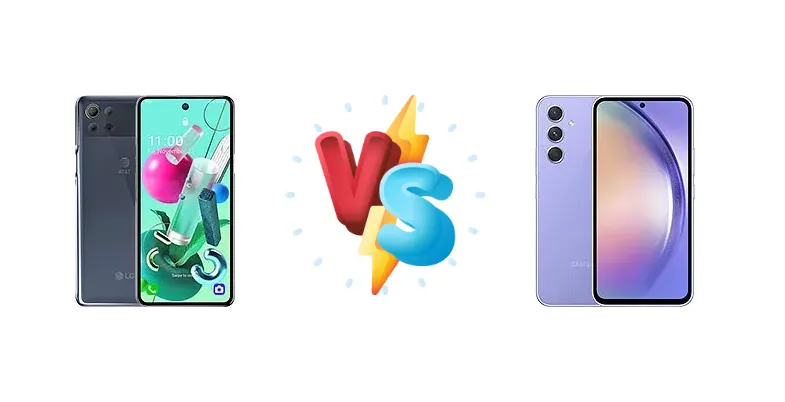
The LG K92 5G and Samsung Galaxy A54 represent different approaches to the mid-range 5G smartphone market. The K92 5G, now an older model, prioritized early 5G access at a lower price point, while the A54 aims for a more refined experience with a newer chipset and improved display. This comparison dissects their key differences to determine which device offers the best value today.
🏆 Quick Verdict
For most users, the Samsung Galaxy A54 is the superior choice. Its more efficient Exynos 1380 chipset, coupled with a brighter and likely more color-accurate display, provides a smoother and more enjoyable user experience. While the K92 5G offers 5G connectivity at a potentially lower cost, the A54’s overall refinement justifies the price difference.
| Network |
|---|
| 2G bands | GSM 850 / 900 / 1800 / 1900 | GSM 850 / 900 / 1800 / 1900 |
| 3G bands | HSDPA 850 / 900 / 1700(AWS) / 1900 / 2100 | HSDPA 850 / 900 / 1700(AWS) / 1900 / 2100 |
| 4G bands | LTE | 1, 2, 3, 4, 5, 7, 8, 12, 17, 20, 26, 28, 32, 38, 40, 41, 66 - International |
| 5G bands | SA/NSA/Sub6 | 1, 3, 7, 8, 20, 28, 38, 40, 41, 77, 78 SA/NSA/Sub6 - International |
| Speed | HSPA, LTE, 5G | HSPA, LTE, 5G |
| Technology | GSM / HSPA / LTE / 5G | GSM / HSPA / LTE / 5G |
| | - | 25, 41, 66, 71 SA/NSA/Sub6/mmWave - USA |
| Launch |
|---|
| Announced | 2020, September 29. Released 2020, November 06 | 2023, March 15 |
| Status | Discontinued | Available. Released 2023, March 24 |
| Body |
|---|
| Build | - | Glass front (Gorilla Glass 5), glass back (Gorilla Glass 5), plastic frame |
| Dimensions | 166.4 x 77.2 x 8.4 mm (6.55 x 3.04 x 0.33 in) | 158.2 x 76.7 x 8.2 mm (6.23 x 3.02 x 0.32 in) |
| SIM | Nano-SIM + Nano-SIM | · Nano-SIM + eSIM· Nano-SIM + Nano-SIM |
| Weight | 202.4 g (7.13 oz) | 202 g (7.13 oz) |
| | - | IP67 dust/water resistant (up to 1m for 30 min) |
| Display |
|---|
| Protection | - | Corning Gorilla Glass 5 |
| Resolution | 1080 x 2400 pixels, 20:9 ratio (~393 ppi density) | 1080 x 2340 pixels, 19.5:9 ratio (~403 ppi density) |
| Size | 6.7 inches, 108.4 cm2 (~84.4% screen-to-body ratio) | 6.4 inches, 100.5 cm2 (~82.9% screen-to-body ratio) |
| Type | IPS LCD | Super AMOLED, 120Hz, HDR10+, 1000 nits (HBM) |
| Platform |
|---|
| CPU | Octa-core (2x2.0 GHz Kryo 560 Gold & 6x1.7 GHz Kryo 560 Silver) | Octa-core (4x2.4 GHz Cortex-A78 & 4x2.0 GHz Cortex-A55) |
| Chipset | Qualcomm SM6350 Snapdragon 690 5G (8 nm) | Exynos 1380 (5 nm) |
| GPU | Adreno 619L | Mali-G68 MP5 |
| OS | Android 10 | Android 13, up to 4 major Android upgrades, One UI 7 |
| Memory |
|---|
| Card slot | microSDXC | microSDXC (uses shared SIM slot) |
| Internal | 128GB 6GB RAM | 128GB 4GB RAM, 128GB 6GB RAM, 128GB 8GB RAM, 256GB 6GB RAM, 256GB 8GB RAM |
| Main Camera |
|---|
| Features | Quad-LED flash, panorama, HDR | LED flash, panorama, HDR |
| Quad | 64 MP, f/1.8, 25mm (wide), 1/1.97", 0.7µm, PDAF
5 MP, f/2.2, 115˚ (ultrawide), 1/5.0", 1.12µm
2 MP (macro)
Auxiliary lens | - |
| Single | - | 32 MP, f/2.2, 26mm (wide), 1/2.8", 0.8µm |
| Triple | - | 50 MP, f/1.8, 23mm (wide), 1/1.56", 1.0µm, PDAF, OIS
12 MP, f/2.2, 13mm, 123˚ (ultrawide), 1/3.X", 1.12µm
5 MP (macro) |
| Video | 4K@30fps, 1080p@30fps | 4K@30fps, 1080p@30/60fps, 720p@480fps, gyro-EIS |
| Selfie camera |
|---|
| Single | 16 MP, f/2.0, 27mm (wide), 1/3.06, 1.0µm | 32 MP, f/2.2, 26mm (wide), 1/2.8", 0.8µm |
| Video | 1080p@30fps | 4K@30fps, 1080p@30/60fps |
| Sound |
|---|
| 3.5mm jack | Yes | No |
| 35mm jack | Yes | No |
| Loudspeaker | Yes, with stereo speakers | Yes, with stereo speakers |
| Comms |
|---|
| Bluetooth | 5.1, A2DP, LE | 5.3, A2DP, LE |
| NFC | Yes | Yes (market/region dependent) |
| Positioning | GPS, GLONASS, GALILEO | GPS, GLONASS, GALILEO, BDS |
| Radio | No | No |
| USB | USB Type-C 3.1 | USB Type-C 2.0, OTG |
| WLAN | Wi-Fi 802.11 a/b/g/n/ac, dual-band, Wi-Fi Direct | Wi-Fi 802.11 a/b/g/n/ac/6, dual-band, Wi-Fi Direct |
| Features |
|---|
| Sensors | Fingerprint (side-mounted), accelerometer, proximity, compass | Fingerprint (under display, optical), accelerometer, gyro, compass, barometer (USA only) |
| | - | Virtual proximity sensing |
| Battery |
|---|
| Charging | Quick Charge 4.0 | 25W wired |
| Type | Li-Po 4000 mAh | 5000 mAh |
| Misc |
|---|
| Colors | Titan Gray | Lime, Graphite, Violet, White |
| Models | LMK920, LM-K920 | SM-A546V, SM-A546U, SM-A546U1, SM-A546B, SM-A546B/DS, SM-A546E, SM-A546E/DS, SM-A5460, SM-A546M, SM-A546M/DS, SM-A546W |
| Price | About 340 EUR | € 210.00 / $ 119.11 / £ 169.95 / ₹ 28,999 |
| SAR | - | 0.81 W/kg (head) 0.67 W/kg (body) |
| SAR EU | - | 0.69 W/kg (head) 1.34 W/kg (body) |
| Tests |
|---|
| Battery life | - |
Endurance rating 119h
|
| Camera | - |
Photo / Video |
| Display | - |
Contrast ratio: Infinite (nominal) |
| Loudspeaker | - |
-26.6 LUFS (Good)
|
| Performance | - |
AnTuTu: 506678 (v9)
GeekBench: 2703 (v5.1), 2797 (v6)
GFXBench: 25fps (ES 3.1 onscreen) |
LG K92 5G
- Potentially lower price point
- Early 5G adoption
- Quick Charge 4.0 support
- Less efficient Snapdragon 690 chipset
- Likely inferior display quality
- Older model with potentially limited software support
Samsung Galaxy A54
- More powerful and efficient Exynos 1380 chipset
- Brighter and more vibrant Super AMOLED display
- Superior camera performance
- Longer battery life
- Higher price point
- 25W charging is not the fastest available
- May lack a headphone jack (market dependent)
Display Comparison
The Samsung Galaxy A54 boasts a significantly brighter display, reaching a measured 980 nits, compared to the LG K92 5G’s unspecified brightness. This higher peak brightness translates to better visibility outdoors under direct sunlight. While the K92 5G’s display size isn’t specified, the A54’s likely utilizes a Super AMOLED panel with an 'Infinite' contrast ratio, offering deeper blacks and more vivid colors. The A54’s panel technology is a clear advantage for media consumption and gaming. We can assume the K92 5G uses an LCD panel, which is less efficient and offers lower contrast.
Camera Comparison
Both devices offer photo and video capabilities, but the Samsung Galaxy A54 is expected to deliver superior image quality. While specific sensor details are missing for both, Samsung’s image processing algorithms are generally more refined. The A54 likely benefits from more advanced features like improved night mode and better dynamic range. The LG K92 5G, while capable, will likely fall behind in image clarity and detail, especially in challenging lighting conditions. The presence of a 2MP macro camera on the K92 5G is likely a marketing gimmick, offering limited practical benefit.
Performance
The Samsung Galaxy A54’s Exynos 1380, fabricated on a 5nm process, offers a substantial performance and efficiency advantage over the LG K92 5G’s Snapdragon 690 (8nm). The Exynos 1380’s octa-core configuration, featuring four Cortex-A78 cores clocked at 2.4 GHz, provides significantly more processing power than the K92 5G’s Kryo 560 Gold cores at 2.0 GHz. This translates to faster app loading times, smoother multitasking, and improved gaming performance on the A54. The 5nm process also contributes to better thermal management, reducing the likelihood of performance throttling during sustained workloads. The K92 5G’s Snapdragon 690 is adequate for basic tasks, but will struggle with demanding applications.
Battery Life
The Samsung Galaxy A54 achieves an impressive endurance rating of 119 hours and a real-world active use score of 11:15h, indicating excellent battery life. The LG K92 5G’s battery capacity is unknown, but its less efficient Snapdragon 690 chipset will likely result in shorter battery life. The A54 supports 25W wired charging, allowing for relatively quick top-ups, while the K92 5G utilizes Quick Charge 4.0, which, while fast, may not be as widely supported as USB Power Delivery. The A54’s combination of efficient chipset and optimized software gives it a clear edge in battery performance.
Buying Guide
Buy the LG K92 5G if your primary concern is accessing 5G connectivity on a very tight budget and you prioritize a larger screen size over processing power or camera quality. Buy the Samsung Galaxy A54 if you value a brighter, more vibrant display, smoother performance for everyday tasks and gaming, and a more modern camera system with better image processing.
Frequently Asked Questions
❓ Does the Exynos 1380 in the Galaxy A54 tend to overheat during prolonged gaming sessions?
The Exynos 1380, built on a 5nm process, is generally well-managed in terms of thermal performance. While it can get warm during extended gaming, it's less prone to significant throttling compared to the Snapdragon 690 in the K92 5G, which runs on a less efficient 8nm process. Samsung’s thermal management system is also generally effective.
❓ Is the Quick Charge 4.0 support on the LG K92 5G still relevant, or is it outdated compared to newer charging standards?
Quick Charge 4.0 is still a functional fast-charging standard, but it's becoming less common as USB Power Delivery (USB-PD) gains wider adoption. The Samsung Galaxy A54’s 25W charging, while not the fastest available, utilizes USB-PD, offering broader compatibility with chargers and accessories.
❓ How does the 5G performance differ between the Snapdragon 690 and the Exynos 1380 in real-world scenarios?
Both chipsets support 5G, but the Exynos 1380 benefits from a more advanced modem and overall system optimization. While both will connect to 5G networks, the A54 is likely to maintain a more stable connection and achieve higher data speeds in areas with strong 5G coverage. The Snapdragon 690 was an early adopter of 5G, and the Exynos 1380 represents a more mature implementation.