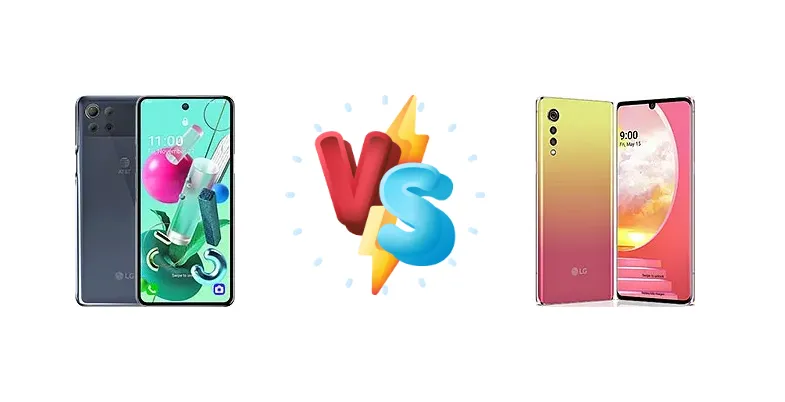
LG's 2020 5G lineup offered a range of choices, but the K92 5G and Velvet 5G represent distinct approaches. The K92 5G aimed for affordability, while the Velvet 5G prioritized a more premium experience. This comparison dissects the key differences to help you determine which LG phone best suits your needs, especially considering the current market where both devices can be found at discounted prices.
🏆 Quick Verdict
For most users, the LG Velvet 5G is the superior choice. Its Snapdragon 765G chipset provides a noticeable performance boost over the K92 5G’s Snapdragon 690, and the brighter 617 nit display enhances the viewing experience. While both offer similar battery endurance, the Velvet’s faster 25W charging is a significant convenience.
| Network |
|---|
| 2G bands | GSM 850 / 900 / 1800 / 1900 | GSM 850 / 900 / 1800 / 1900 |
| 3G bands | HSDPA 850 / 900 / 1700(AWS) / 1900 / 2100 | HSDPA 850 / 900 / 1900 / 2100 |
| 4G bands | LTE | 1, 2, 3, 4, 5, 7, 8, 12, 17, 20, 28, 32, 38, 39, 40, 41 |
| 5G bands | SA/NSA/Sub6 | 1, 3, 28, 78 SA/NSA |
| Speed | HSPA, LTE, 5G | HSPA 42.2/5.76 Mbps, LTE (5CA) Cat16 1000/75 Mbps, 5G 2Gbps |
| Technology | GSM / HSPA / LTE / 5G | GSM / HSPA / LTE / 5G |
| Launch |
|---|
| Announced | 2020, September 29. Released 2020, November 06 | 2020, May 07. Released 2020, May 15 |
| Status | Discontinued | Discontinued |
| Body |
|---|
| Build | - | Glass front, glass back, aluminum frame |
| Dimensions | 166.4 x 77.2 x 8.4 mm (6.55 x 3.04 x 0.33 in) | 167.2 x 74.1 x 7.9 mm (6.58 x 2.92 x 0.31 in) |
| SIM | Nano-SIM + Nano-SIM | Nano-SIM + Nano-SIM |
| Weight | 202.4 g (7.13 oz) | 180 g (6.35 oz) |
| | - | IP68 dust/water resistant (up to 1.5m for 30 mins)
MIL-STD-810G compliant*
*does not guarantee ruggedness or use in extreme conditions |
| Display |
|---|
| Resolution | 1080 x 2400 pixels, 20:9 ratio (~393 ppi density) | 1080 x 2460 pixels (~395 ppi density) |
| Size | 6.7 inches, 108.4 cm2 (~84.4% screen-to-body ratio) | 6.8 inches, 109.8 cm2 (~88.6% screen-to-body ratio) |
| Type | IPS LCD | P-OLED |
| Platform |
|---|
| CPU | Octa-core (2x2.0 GHz Kryo 560 Gold & 6x1.7 GHz Kryo 560 Silver) | Octa-core (1x2.4 GHz Kryo 475 Prime & 1x2.2 GHz Kryo 475 Gold & 6x1.8 GHz Kryo 475 Silver) |
| Chipset | Qualcomm SM6350 Snapdragon 690 5G (8 nm) | Qualcomm SM7250 Snapdragon 765G 5G (7 nm) |
| GPU | Adreno 619L | Adreno 620 |
| OS | Android 10 | Android 10, upgradable to Android 13, LG UX |
| Memory |
|---|
| Card slot | microSDXC | microSDXC (uses shared SIM slot) |
| Internal | 128GB 6GB RAM | 128GB 6GB RAM, 128GB 8GB RAM |
| | - | UFS 2.1 |
| Main Camera |
|---|
| Features | Quad-LED flash, panorama, HDR | LED flash, panorama, HDR |
| Quad | 64 MP, f/1.8, 25mm (wide), 1/1.97", 0.7µm, PDAF
5 MP, f/2.2, 115˚ (ultrawide), 1/5.0", 1.12µm
2 MP (macro)
Auxiliary lens | - |
| Triple | - | 48 MP, f/1.8, 26mm (wide), 1/2.0", 0.8µm, PDAF
8 MP, f/2.2, 120˚, 15mm (ultrawide), 1/4.0", 1.12µm
Auxiliary lens |
| Video | 4K@30fps, 1080p@30fps | 4K@30fps, 1080p@30/60fps, gyro-EIS |
| Selfie camera |
|---|
| Features | - | HDR |
| Single | 16 MP, f/2.0, 27mm (wide), 1/3.06, 1.0µm | 16 MP, f/1.9, 29mm (standard), 1/3.06, 1.0µm |
| Video | 1080p@30fps | 1080p@30fps |
| Sound |
|---|
| 3.5mm jack | Yes | Yes |
| 35mm jack | Yes | Yes |
| Loudspeaker | Yes, with stereo speakers | Yes, with stereo speakers |
| Comms |
|---|
| Bluetooth | 5.1, A2DP, LE | 5.1, A2DP, LE, aptX HD |
| NFC | Yes | Yes |
| Positioning | GPS, GLONASS, GALILEO | GPS (L1+L5), GLONASS, BDS, GALILEO, QZSS |
| Radio | No | FM radio (market/region dependent) |
| USB | USB Type-C 3.1 | USB Type-C, OTG |
| WLAN | Wi-Fi 802.11 a/b/g/n/ac, dual-band, Wi-Fi Direct | Wi-Fi 802.11 a/b/g/n/ac, dual-band, Wi-Fi Direct, DLNA |
| Features |
|---|
| Sensors | Fingerprint (side-mounted), accelerometer, proximity, compass | Fingerprint (under display, optical), accelerometer, gyro, proximity, compass, barometer |
| Battery |
|---|
| Charging | Quick Charge 4.0 | 25W wired, PD3.0, QC4
9W wireless |
| Type | Li-Po 4000 mAh | Li-Po 4300 mAh |
| Misc |
|---|
| Colors | Titan Gray | Aurora White, Aurora Green, Aurora Gray, Illusion Sunset, Red, Pink |
| Models | LMK920, LM-K920 | LM-G900N, LM-G900EM, LM-G900, LM-G900TM |
| Price | About 340 EUR | About 470 EUR |
| SAR | - | 0.23 W/kg (head) 1.02 W/kg (body) |
| Tests |
|---|
| Battery life | - | Endurance rating 79h |
| Camera | - |
Photo / Video |
| Display | - |
Contrast ratio: Infinite (nominal) |
| Loudspeaker | - |
-23.5 LUFS (Very good) |
| Performance | - |
AnTuTu: 297372 (v8)
GeekBench: 1905 (v5.1)
GFXBench: 16fps (ES 3.1 onscreen) |
LG K92 5G
- More affordable price point
- 5G connectivity
- Acceptable battery life
- Less powerful processor
- Likely lower display quality
- Slower charging speeds
LG Velvet 5G
- Faster Snapdragon 765G processor
- Brighter and potentially higher-quality display
- Faster 25W charging with wireless charging support
- Higher initial cost
- Similar battery life to K92 5G
- May be harder to find new
Display Comparison
The LG Velvet 5G boasts a significantly brighter display, reaching a measured 617 nits, compared to an unspecified brightness for the K92 5G (though likely lower given its market positioning). This difference translates to better visibility outdoors. While both displays are described as having an 'infinite' contrast ratio (typical for OLED/P-OLED panels), the Velvet’s superior brightness is the key differentiator. The Velvet’s panel technology is likely P-OLED, offering richer colors and deeper blacks, while the K92 5G likely uses an LCD panel.
Camera Comparison
Both phones feature photo and video capabilities, but detailed camera specs are limited. The Velvet 5G likely benefits from LG’s more advanced image processing algorithms, typically found in their higher-end devices. While both likely have multi-camera setups, the Velvet’s image quality is expected to be superior due to the more powerful ISP (Image Signal Processor) within the Snapdragon 765G. Without specific sensor details, it’s difficult to make a definitive statement, but the Velvet’s chipset provides a foundation for better image processing.
Performance
The core difference lies in the chipsets. The LG Velvet 5G utilizes the Qualcomm Snapdragon 765G (7nm), featuring a Kryo 475 Prime core clocked at 2.4 GHz, alongside a Kryo 475 Gold core at 2.2 GHz and six Kryo 475 Silver cores at 1.8 GHz. This configuration provides a performance edge over the K92 5G’s Snapdragon 690 (8nm) with its 2.0 GHz Kryo 560 Gold and 1.7 GHz Kryo 560 Silver cores. The 7nm process node of the 765G is more efficient, potentially leading to better sustained performance under load. The Velvet is better suited for demanding applications and multitasking.
Battery Life
Both the LG K92 5G and Velvet 5G achieve an endurance rating of 79 hours, suggesting similar real-world battery life. However, the Velvet 5G offers significantly faster charging with 25W wired charging, supporting both PD3.0 and QC4, as well as 9W wireless charging. The K92 5G is limited to Quick Charge 4.0. This means the Velvet can replenish its battery much quicker, reducing downtime. A full charge from 0-100% on the Velvet will be considerably faster than on the K92 5G.
Buying Guide
Buy the LG K92 5G if you prioritize a lower upfront cost and are a light user who primarily needs 5G connectivity for basic tasks like browsing and social media. Buy the LG Velvet 5G if you value a smoother user experience, a brighter and more vibrant display, and faster charging speeds, even if it means spending a bit more. The Velvet is also the better option for those who enjoy mobile gaming.
Frequently Asked Questions
❓ Does the Snapdragon 690 in the K92 5G struggle with graphically intensive games?
Yes, the Snapdragon 690 is a mid-range chipset and will likely exhibit frame drops and require lower graphics settings in demanding games compared to the Snapdragon 765G in the Velvet 5G. The 765G’s Adreno 620 GPU is significantly more capable.
❓ Is the 9W wireless charging on the Velvet 5G fast enough for convenient daily use?
9W wireless charging is relatively slow compared to modern standards. It's convenient for overnight charging, but won't provide a significant charge boost in a short period. The 25W wired charging is the preferred method for quickly replenishing the battery.
❓ Given both phones have similar battery endurance, does the Velvet 5G's faster charging make a real-world difference?
Absolutely. While both last roughly the same on a single charge, the Velvet 5G’s 25W charging significantly reduces the time spent tethered to a wall. A quick 30-minute charge can provide a substantial amount of power, making it ideal for users who need to top up quickly.