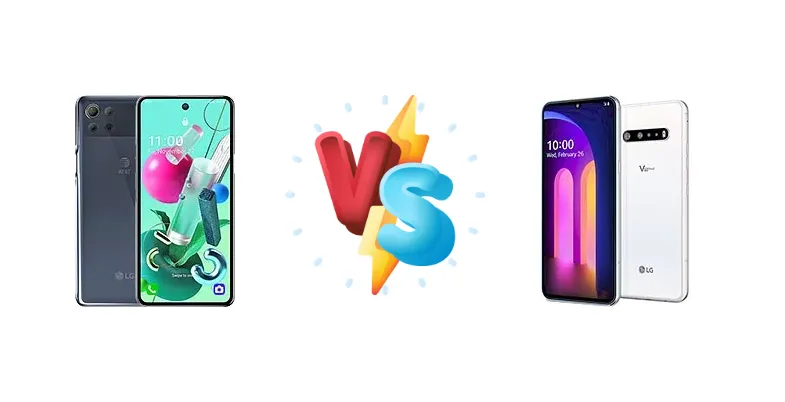
The LG K92 5G and V60 ThinQ 5G represent distinct approaches to 5G connectivity. The K92 aims to bring 5G to a more accessible price point, while the V60 was LG’s 2020 flagship, boasting top-tier performance and features. This comparison dissects the core differences between these two devices, helping you determine which best suits your needs and budget.
🏆 Quick Verdict
For the average user prioritizing value, the LG K92 5G offers a compelling 5G experience at a significantly lower cost. However, users demanding uncompromising performance for gaming or demanding tasks will find the LG V60 ThinQ 5G’s Snapdragon 865 a worthwhile investment.
| Network |
|---|
| 2G bands | GSM 850 / 900 / 1800 / 1900 | GSM 850 / 900 / 1800 / 1900 |
| 3G bands | HSDPA 850 / 900 / 1700(AWS) / 1900 / 2100 | HSDPA 850 / 900 / 1700(AWS) / 1900 / 2100 |
| 4G bands | LTE | 2, 4, 5, 12, 25, 26, 41, 46, 48, 66, 71 - USA |
| 5G bands | SA/NSA/Sub6 | 2, 25, 41, 66, 71 SA/NSA/Sub6 |
| Speed | HSPA, LTE, 5G | HSPA 42.2/5.76 Mbps, LTE (7CA) Cat22, 5G |
| Technology | GSM / HSPA / LTE / 5G | GSM / CDMA / HSPA / EVDO / LTE / 5G |
| | - | CDMA2000 1xEV-DO |
| Launch |
|---|
| Announced | 2020, September 29. Released 2020, November 06 | 2020, February 26. Released 2020, March 20 |
| Status | Discontinued | Discontinued |
| Body |
|---|
| Build | - | Glass front (Gorilla Glass 5), glass back (Gorilla Glass 6), aluminum frame |
| Dimensions | 166.4 x 77.2 x 8.4 mm (6.55 x 3.04 x 0.33 in) | 169.3 x 77.6 x 8.9 mm (6.67 x 3.06 x 0.35 in) |
| SIM | Nano-SIM + Nano-SIM | · Nano-SIM· Nano-SIM + Nano-SIM |
| Weight | 202.4 g (7.13 oz) | 213 g (Global)/ 218 g (Verizon) (7.51 oz) |
| | - | IP68 dust/water resistant (up to 1.5m for 30 min)
MIL-STD-810G compliant*
Method 516.6, Procedure IV "Transit Drop"
*does not guarantee ruggedness or use in extreme conditions |
| Display |
|---|
| Protection | - | Corning Gorilla Glass 5 |
| Resolution | 1080 x 2400 pixels, 20:9 ratio (~393 ppi density) | 1080 x 2460 pixels (~395 ppi density) |
| Size | 6.7 inches, 108.4 cm2 (~84.4% screen-to-body ratio) | 6.8 inches, 109.8 cm2 (~83.6% screen-to-body ratio) |
| Type | IPS LCD | P-OLED, HDR10+ |
| | - | Always-on display |
| Platform |
|---|
| CPU | Octa-core (2x2.0 GHz Kryo 560 Gold & 6x1.7 GHz Kryo 560 Silver) | Octa-core (1x2.84 GHz Cortex-A77 & 3x2.42 GHz Cortex-A77 & 4x1.80 GHz Cortex-A55) |
| Chipset | Qualcomm SM6350 Snapdragon 690 5G (8 nm) | Qualcomm SM8250 Snapdragon 865 5G (7 nm+) |
| GPU | Adreno 619L | Adreno 650 |
| OS | Android 10 | Android 10, upgradable to Android 13 |
| Memory |
|---|
| Card slot | microSDXC | microSDXC (uses shared SIM slot) - dual-SIM model |
| Internal | 128GB 6GB RAM | 128GB 8GB RAM, 256GB 8GB RAM |
| | - | UFS 2.1 |
| Main Camera |
|---|
| Dual | - | 64 MP, f/1.8, 27mm (standard), 1/1.72", 0.8µm, dual pixel PDAF, OIS
13 MP, f/1.9, 12mm (ultrawide), 1/3.4", 1.0µm
0.3 MP, TOF 3D, f/1.4, (depth) |
| Features | Quad-LED flash, panorama, HDR | Dual-LED dual-tone flash, HDR, panorama |
| Quad | 64 MP, f/1.8, 25mm (wide), 1/1.97", 0.7µm, PDAF
5 MP, f/2.2, 115˚ (ultrawide), 1/5.0", 1.12µm
2 MP (macro)
Auxiliary lens | - |
| Video | 4K@30fps, 1080p@30fps | 8K@30fps, 4K@30/60fps, 1080p, HDR10+, 24-bit/192kHz stereo sound rec., gyro-EIS |
| Selfie camera |
|---|
| Features | - | HDR |
| Single | 16 MP, f/2.0, 27mm (wide), 1/3.06, 1.0µm | 10 MP, f/1.9, 30mm (standard), 1/3.1", 1.22µm |
| Video | 1080p@30fps | 4K@30fps, gyro-EIS |
| Sound |
|---|
| 3.5mm jack | Yes | Yes |
| 35mm jack | Yes | Yes |
| Loudspeaker | Yes, with stereo speakers | Yes, with stereo speakers |
| | - | 32-bit/192kHz audio
24-bit/192kHz audio recording |
| Comms |
|---|
| Bluetooth | 5.1, A2DP, LE | 5.1, A2DP, LE, aptX HD |
| NFC | Yes | Yes |
| Positioning | GPS, GLONASS, GALILEO | GPS, GLONASS, GALILEO, BDS |
| Radio | No | FM radio (USA model only) |
| USB | USB Type-C 3.1 | USB Type-C 3.1, OTG |
| WLAN | Wi-Fi 802.11 a/b/g/n/ac, dual-band, Wi-Fi Direct | Wi-Fi 802.11 a/b/g/n/ac/6, dual-band, Wi-Fi Direct, DLNA |
| Features |
|---|
| Sensors | Fingerprint (side-mounted), accelerometer, proximity, compass | Fingerprint (under display, optical), accelerometer, gyro, proximity, compass, barometer |
| Battery |
|---|
| Charging | Quick Charge 4.0 | Wired, PD2.0, QC4
Wireless |
| Type | Li-Po 4000 mAh | Li-Po 5000 mAh |
| Misc |
|---|
| Colors | Titan Gray | Classy Blue, Classy White |
| Models | LMK920, LM-K920 | LM-V600, A001LG |
| Price | About 340 EUR | About 700 EUR |
| Tests |
|---|
| Battery life | - |
Endurance rating 103h
|
LG K92 5G
- More affordable price point
- 5G connectivity
- Quick Charge 4.0 support
- Less powerful processor
- Likely lower quality display
- Potentially limited camera capabilities
LG V60 ThinQ 5G
- Flagship-level performance with Snapdragon 865
- Faster charging with PD2.0, QC4, and wireless charging
- Likely superior camera system
- Higher price
- May be harder to find new
- Potentially larger and heavier
Display Comparison
While specific display specs for the K92 5G are not provided, its market positioning suggests an LCD panel, likely 60Hz. The V60, being a flagship, likely features a higher quality display. The key difference lies in the processing power driving the display; the V60’s Snapdragon 865 can handle more complex graphics rendering, potentially resulting in smoother animations and a more responsive user experience. The V60’s display likely has higher peak brightness and better color accuracy, enhancing media consumption.
Camera Comparison
Without detailed camera specs for the K92 5G, it’s reasonable to assume a more basic camera system focused on everyday photography. The V60, as a flagship, likely boasts a more sophisticated camera setup with larger sensors, optical image stabilization (OIS), and advanced image processing algorithms. While both phones support 5G, the V60’s image signal processor (ISP) within the Snapdragon 865 will deliver faster image processing, better low-light performance, and potentially more detailed photos and videos. The V60’s video recording capabilities are likely far superior, potentially supporting higher resolutions and frame rates.
Performance
The core difference here is the chipset. The LG V60 ThinQ 5G’s Snapdragon 865 (7nm+) is significantly more powerful than the K92 5G’s Snapdragon 690 (8nm). The 865 features a more advanced CPU architecture – a 1x2.84 GHz Cortex-A77 prime core, 3x2.42 GHz Cortex-A77 cores, and 4x1.80 GHz Cortex-A55 cores – compared to the K92’s 2x2.0 GHz Kryo 560 Gold & 6x1.7 GHz Kryo 560 Silver. This translates to substantially faster app loading times, smoother multitasking, and a far superior gaming experience on the V60. The 7nm+ process node also contributes to better thermal efficiency, reducing the likelihood of throttling under sustained load.
Battery Life
Both devices share an endurance rating of 103 hours, suggesting similar overall battery life despite the V60’s more powerful processor. This indicates efficient power management on both sides. However, the V60 offers significantly faster charging with support for both PD2.0 and QC4, as well as wireless charging, while the K92 5G is limited to Quick Charge 4.0. This means the V60 can replenish its battery much quicker, minimizing downtime.
Buying Guide
Buy the LG K92 5G if you need affordable 5G connectivity for everyday tasks like browsing, streaming, and social media, and are willing to compromise on raw processing power. Buy the LG V60 ThinQ 5G if you prioritize a flagship-level experience with superior performance for gaming, video editing, and multitasking, and value features like faster charging and potentially better camera image processing.
Frequently Asked Questions
❓ Is the Snapdragon 690 in the LG K92 5G powerful enough for demanding games like PUBG Mobile?
While the Snapdragon 690 can run PUBG Mobile, you’ll likely need to lower the graphics settings to achieve a smooth frame rate. The V60’s Snapdragon 865 offers a significantly better gaming experience with the ability to run games at higher settings without performance issues.
❓ Does the LG V60 ThinQ 5G still receive software updates?
LG has exited the smartphone market, so official software updates are unlikely. However, the V60 may still be supported by custom ROM communities, offering continued functionality and security patches. The K92 5G is also unlikely to receive further official updates.
❓ How does the 5G performance differ between the K92 5G and V60 ThinQ 5G?
Both phones support 5G, but the V60’s more advanced modem within the Snapdragon 865 may offer slightly faster and more stable 5G connections, particularly in areas with weaker signal strength. However, real-world 5G speeds are heavily dependent on carrier infrastructure and network congestion.