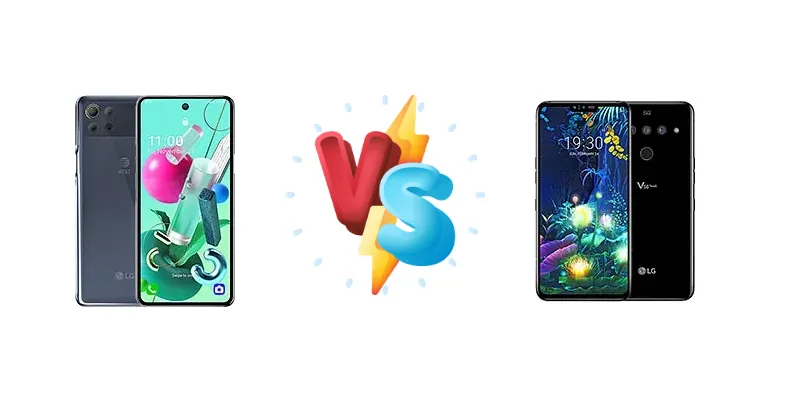
The LG K92 5G and V50 ThinQ 5G represent different eras of LG's smartphone strategy. The K92 5G aimed to bring 5G connectivity to a more affordable price point, while the V50 ThinQ 5G was a flagship contender boasting a premium experience. This comparison dissects their key differences to help you determine which device offers the best value in today's market.
🏆 Quick Verdict
For the average user prioritizing affordability and 5G access, the LG K92 5G is the better choice. While the V50 ThinQ 5G offers a more powerful Snapdragon 855 and a superior display, the K92 5G delivers a functional 5G experience at a significantly lower cost, making it the more practical option.
| Network |
|---|
| 2G bands | GSM 850 / 900 / 1800 / 1900 | GSM 850 / 900 / 1800 / 1900 |
| 3G bands | HSDPA 850 / 900 / 1700(AWS) / 1900 / 2100 | HSDPA 850 / 900 / 1700(AWS) / 1900 / 2100 - USA |
| 4G bands | LTE | 1, 2, 3, 4, 5, 7, 8, 12, 13, 17, 20, 25, 26, 28, 40, 41, 46, 66, 71 - USA |
| 5G bands | SA/NSA/Sub6 | 41, 260, 261 NSA |
| Speed | HSPA, LTE, 5G | HSPA 42.2/5.76 Mbps, LTE (6CA) Cat18 1200/75 Mbps, 5G (2+ Gbps DL) |
| Technology | GSM / HSPA / LTE / 5G | GSM / CDMA / HSPA / EVDO / LTE / 5G |
| | - | CDMA2000 1xEV-DO |
| Launch |
|---|
| Announced | 2020, September 29. Released 2020, November 06 | 2019, February 24. Released 2019, April 19 |
| Status | Discontinued | Discontinued |
| Body |
|---|
| Build | - | Glass front (Gorilla Glass 5), glass back (Gorilla Glass 6), aluminum frame |
| Dimensions | 166.4 x 77.2 x 8.4 mm (6.55 x 3.04 x 0.33 in) | 159.2 x 76.1 x 8.3 mm (6.27 x 3.00 x 0.33 in) |
| SIM | Nano-SIM + Nano-SIM | · Nano-SIM· Nano-SIM + Nano-SIM |
| Weight | 202.4 g (7.13 oz) | 183 g (6.46 oz) |
| | - | IP68 dust/water resistant (up to 1.5m for 30 min)
MIL-STD-810G compliant*
*does not guarantee ruggedness or use in extreme conditions |
| Display |
|---|
| Protection | - | Corning Gorilla Glass 5 |
| Resolution | 1080 x 2400 pixels, 20:9 ratio (~393 ppi density) | 1440 x 3120 pixels, 19.5:9 ratio (~538 ppi density) |
| Size | 6.7 inches, 108.4 cm2 (~84.4% screen-to-body ratio) | 6.4 inches, 100.2 cm2 (~82.7% screen-to-body ratio) |
| Type | IPS LCD | P-OLED, HDR10 |
| | - | Always-on display |
| Platform |
|---|
| CPU | Octa-core (2x2.0 GHz Kryo 560 Gold & 6x1.7 GHz Kryo 560 Silver) | Octa-core (1x2.84 GHz Kryo 485 & 3x2.42 GHz Kryo 485 & 4x1.78 GHz Kryo 485) |
| Chipset | Qualcomm SM6350 Snapdragon 690 5G (8 nm) | Qualcomm SM8150 Snapdragon 855 (7 nm) |
| GPU | Adreno 619L | Adreno 640 |
| OS | Android 10 | Android 9.0 (Pie), upgradable to Android 11 |
| Memory |
|---|
| Card slot | microSDXC | microSDXC (dedicated slot) |
| Internal | 128GB 6GB RAM | 128GB 6GB RAM |
| | - | UFS 2.1 |
| Main Camera |
|---|
| Features | Quad-LED flash, panorama, HDR | LED flash, HDR, panorama |
| Quad | 64 MP, f/1.8, 25mm (wide), 1/1.97", 0.7µm, PDAF
5 MP, f/2.2, 115˚ (ultrawide), 1/5.0", 1.12µm
2 MP (macro)
Auxiliary lens | - |
| Triple | - | 12 MP, 27mm (wide), f/1.5, 1/2.55", 1.4µm, dual pixel PDAF, 3-axis OIS
12 MP, 52mm (telephoto), f/2.4, 1/3.4", 1.0µm, 2x optical zoom, PDAF, OIS
16 MP, 16mm (ultrawide), f/1.9, 1/3.1", 1.0µm, no AF |
| Video | 4K@30fps, 1080p@30fps | 4K@30/60fps, 1080p@30/60/240fps, 24-bit/192kHz stereo sound rec., HDR10 video, gyro-EIS |
| Selfie camera |
|---|
| Dual | - | 8 MP, f/1.9, 26mm (wide), 1/4.0", 1.12µm
5 MP, 21mm (wide), f/2.2, 1/5.0", 1.12µm |
| Features | - | HDR |
| Single | 16 MP, f/2.0, 27mm (wide), 1/3.06, 1.0µm | - |
| Video | 1080p@30fps | 1080p@60fps |
| Sound |
|---|
| 3.5mm jack | Yes | Yes |
| 35mm jack | Yes | Yes |
| Loudspeaker | Yes, with stereo speakers | Yes, with stereo speakers |
| | - | 32-bit/192kHz audio
24-bit/192kHz audio recording
Tuned with Meridian Audio |
| Comms |
|---|
| Bluetooth | 5.1, A2DP, LE | 5.0, A2DP, LE, aptX HD |
| NFC | Yes | Yes |
| Positioning | GPS, GLONASS, GALILEO | GPS, GLONASS, GALILEO |
| Radio | No | FM radio |
| USB | USB Type-C 3.1 | USB Type-C 3.1 |
| WLAN | Wi-Fi 802.11 a/b/g/n/ac, dual-band, Wi-Fi Direct | Wi-Fi 802.11 a/b/g/n/ac, dual-band, Wi-Fi Direct, DLNA |
| Features |
|---|
| Sensors | Fingerprint (side-mounted), accelerometer, proximity, compass | Fingerprint (rear-mounted), accelerometer, gyro, proximity, compass, barometer |
| Battery |
|---|
| Charging | Quick Charge 4.0 | 18W wired, PD2.0, QC3, 50% in 36 min
10W wireless (Qi) |
| Type | Li-Po 4000 mAh | Li-Po 4000 mAh, non-removable |
| Misc |
|---|
| Colors | Titan Gray | New Aurora Black |
| Models | LMK920, LM-K920 | LM-V500, LM-V500N, LM-V500EM, LM-V500XM, LM-V450PM, LM-V450 |
| Price | About 340 EUR | About 550 EUR |
| Tests |
|---|
| Audio quality | - |
Noise -92.5dB / Crosstalk -92.6dB |
| Battery life | - |
Endurance rating 96h
|
| Camera | - |
Photo / Video |
| Display | - |
Contrast ratio: 194000:1 (nominal) |
| Loudspeaker | - |
-25.2 LUFS (Very good)
|
| Performance | - |
AnTuTu: 343758 (v7), 421934 (v8)
GeekBench: 10928 (v4.4), 2672 (v5.1)
GFXBench: 22fps (ES 3.1 onscreen) |
LG K92 5G
- Affordable 5G connectivity
- Quick Charge 4.0 support
- Long battery endurance (96h)
- Mid-range Snapdragon 690 performance
- Likely lower display quality
- No wireless charging
LG V50 ThinQ 5G
- Flagship Snapdragon 855 performance
- Brighter and higher contrast display
- Faster wired and wireless charging
- Higher price point
- Older chipset (Snapdragon 855)
- May be harder to find new
Display Comparison
The LG V50 ThinQ 5G boasts a significantly brighter display, reaching 533 nits, compared to the K92 5G (brightness data unavailable, assumed lower). The V50’s contrast ratio of 194000:1 suggests deeper blacks and more vibrant colors. While both are likely OLED panels given LG’s history, the V50’s superior specifications indicate a more immersive viewing experience, particularly in outdoor conditions. The K92 5G likely prioritizes cost savings over display quality, resulting in a less visually striking screen.
Camera Comparison
Both devices feature photo and video capabilities, but detailed camera specifications are limited. The V50’s flagship status suggests a more sophisticated camera system with potentially larger sensors and better image processing. While the K92 5G offers 5G connectivity, it likely compromises on camera quality to meet its price point. Without specific sensor size or aperture data, it’s difficult to make a precise comparison, but the V50 is expected to deliver superior image quality, especially in low-light conditions.
Performance
The core difference lies in the chipsets. The LG V50 ThinQ 5G’s Snapdragon 855 (7nm) is a flagship-level processor with a more complex CPU configuration (1x2.84 GHz Kryo 485, 3x2.42 GHz Kryo 485, 4x1.78 GHz Kryo 485) designed for sustained performance. The K92 5G’s Snapdragon 690 (8nm) is a mid-range chip (2x2.0 GHz Kryo 560 Gold & 6x1.7 GHz Kryo 560 Silver) focused on efficiency and 5G connectivity. The 7nm process of the 855 allows for greater transistor density and improved thermal efficiency compared to the 8nm 690, translating to better sustained performance under load. Gamers and power users will find the V50 significantly more capable.
Battery Life
Both phones share an endurance rating of 96 hours, suggesting similar real-world battery life despite the V50’s more powerful processor. This indicates efficient power management on both devices. However, the V50 offers more versatile charging options: 18W wired (with Quick Charge 3.0 and PD2.0) reaching 50% in 36 minutes, and 10W wireless charging (Qi). The K92 5G supports Quick Charge 4.0, but lacks wireless charging. The V50’s faster wired charging and wireless charging convenience provide a more flexible charging experience.
Buying Guide
Buy the LG K92 5G if you need a budget-friendly 5G smartphone for everyday tasks like browsing, social media, and light gaming. You'll benefit from 5G connectivity without breaking the bank. Buy the LG V50 ThinQ 5G if you prioritize performance for demanding applications, gaming, and appreciate a brighter, higher-contrast display, and are willing to pay a premium for the flagship experience.
Frequently Asked Questions
❓ Is the Snapdragon 690 in the LG K92 5G powerful enough for modern mobile games?
The Snapdragon 690 is a capable mid-range processor, but it won't deliver the same gaming experience as the Snapdragon 855 in the V50. You'll be able to play most popular games at medium settings, but demanding titles may require lower graphics settings or experience occasional frame drops.
❓ Does the LG V50 ThinQ 5G still receive software updates?
Software update support for the LG V50 ThinQ 5G is limited, as LG has exited the smartphone market. While it may have received updates to Android 11 or 12, it's unlikely to receive further major Android version updates or security patches. This is a consideration for long-term security.
❓ How does the charging speed of the LG V50 ThinQ 5G compare to other phones in its class?
The 18W charging speed of the V50 ThinQ 5G was competitive for flagship phones in 2019, but it's slower than many modern smartphones that support 25W, 45W, or even 65W charging. While it can reach 50% charge in 36 minutes, newer phones can achieve a full charge much faster.