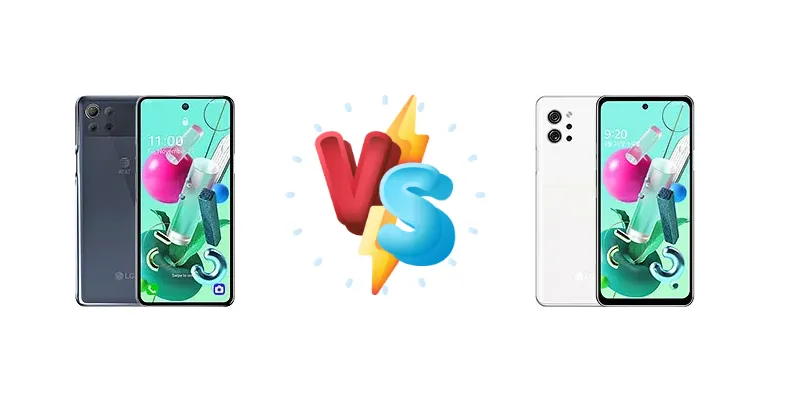
LG's K92 5G and Q92 5G represent a strategic push into affordable 5G connectivity. While both aim to deliver next-gen speeds without breaking the bank, they diverge significantly in their core processing power. This comparison dissects those differences, focusing on how the Snapdragon 690 in the K92 5G stacks up against the Snapdragon 765G powering the Q92 5G, and which phone best suits your needs.
🏆 Quick Verdict
For most users, the LG Q92 5G is the superior choice. The Snapdragon 765G’s more advanced architecture and higher clock speeds translate to noticeably smoother performance in demanding tasks and a more future-proof experience, despite the slower 15W charging.
| Network |
|---|
| 2G bands | GSM 850 / 900 / 1800 / 1900 | GSM 850 / 900 / 1800 / 1900 |
| 3G bands | HSDPA 850 / 900 / 1700(AWS) / 1900 / 2100 | HSDPA 850 / 900 / 1900 / 2100 |
| 4G bands | LTE | LTE |
| 5G bands | SA/NSA/Sub6 | SA/NSA |
| Speed | HSPA, LTE, 5G | HSPA, LTE, 5G |
| Technology | GSM / HSPA / LTE / 5G | GSM / HSPA / LTE / 5G |
| Launch |
|---|
| Announced | 2020, September 29. Released 2020, November 06 | 2020, August 24. Released 2020, August 26 |
| Status | Discontinued | Discontinued |
| Body |
|---|
| Dimensions | 166.4 x 77.2 x 8.4 mm (6.55 x 3.04 x 0.33 in) | 166.5 x 77.3 x 8.5 mm (6.56 x 3.04 x 0.33 in) |
| SIM | Nano-SIM + Nano-SIM | Nano-SIM + Nano-SIM |
| Weight | 202.4 g (7.13 oz) | 193 g (6.81 oz) |
| | - | IP68 dust/water resistant (up to 1.5m for 30 mins)
MIL-STD-810G compliant*
*does not guarantee ruggedness or use in extreme conditions |
| Display |
|---|
| Resolution | 1080 x 2400 pixels, 20:9 ratio (~393 ppi density) | 1080 x 2400 pixels, 20:9 ratio (~395 ppi density) |
| Size | 6.7 inches, 108.4 cm2 (~84.4% screen-to-body ratio) | 6.67 inches, 107.4 cm2 (~83.5% screen-to-body ratio) |
| Type | IPS LCD | IPS LCD |
| Platform |
|---|
| CPU | Octa-core (2x2.0 GHz Kryo 560 Gold & 6x1.7 GHz Kryo 560 Silver) | Octa-core (1x2.4 GHz Kryo 475 Prime & 1x2.2 GHz Kryo 475 Gold & 6x1.8 GHz Kryo 475 Silver) |
| Chipset | Qualcomm SM6350 Snapdragon 690 5G (8 nm) | Qualcomm SM7250 Snapdragon 765G 5G (7 nm) |
| GPU | Adreno 619L | Adreno 620 |
| OS | Android 10 | Android 10 |
| Memory |
|---|
| Card slot | microSDXC | microSDXC |
| Internal | 128GB 6GB RAM | 128GB 6GB RAM |
| Main Camera |
|---|
| Features | Quad-LED flash, panorama, HDR | LED flash, panorama, HDR |
| Quad | 64 MP, f/1.8, 25mm (wide), 1/1.97", 0.7µm, PDAF
5 MP, f/2.2, 115˚ (ultrawide), 1/5.0", 1.12µm
2 MP (macro)
Auxiliary lens | 48 MP, f/1.8, 26mm (wide), 1/2.0", 0.8µm, PDAF
8 MP, f/2.2, 120˚, 15mm (ultrawide), 1/4.0", 1.12µm
2 MP (macro)
Auxiliary lens |
| Video | 4K@30fps, 1080p@30fps | 4K@30fps, 1080p@30fps |
| Selfie camera |
|---|
| Features | - | HDR |
| Single | 16 MP, f/2.0, 27mm (wide), 1/3.06, 1.0µm | 32 MP, f/1.9, 26mm (wide), 1/2.8", 0.8µm |
| Video | 1080p@30fps | 1080p@30fps |
| Sound |
|---|
| 3.5mm jack | Yes | Yes |
| 35mm jack | Yes | Yes |
| Loudspeaker | Yes, with stereo speakers | Yes, with stereo speakers |
| Comms |
|---|
| Bluetooth | 5.1, A2DP, LE | 5.0, A2DP, LE |
| NFC | Yes | Yes |
| Positioning | GPS, GLONASS, GALILEO | GPS, GLONASS, GALILEO, BDS |
| Radio | No | No |
| USB | USB Type-C 3.1 | USB Type-C 2.0 |
| WLAN | Wi-Fi 802.11 a/b/g/n/ac, dual-band, Wi-Fi Direct | Wi-Fi 802.11 a/b/g/n/ac, dual-band, Wi-Fi Direct, DLNA |
| Features |
|---|
| Sensors | Fingerprint (side-mounted), accelerometer, proximity, compass | Fingerprint (side-mounted), accelerometer, gyro, proximity, compass |
| Battery |
|---|
| Charging | Quick Charge 4.0 | 15W wired |
| Type | Li-Po 4000 mAh | Li-Po 4000 mAh |
| Misc |
|---|
| Colors | Titan Gray | White, Dark Blue, Red |
| Models | LMK920, LM-K920 | LM-Q920N |
| Price | About 340 EUR | About 360 EUR |
LG K92 5G
- Faster Quick Charge 4.0 support
- Potentially lower price point
- Sufficient performance for basic tasks
- Less powerful Snapdragon 690 chipset
- Likely lower gaming performance
- Potentially less efficient power consumption
LG Q92 5G
- More powerful Snapdragon 765G chipset
- Smoother multitasking and app performance
- Superior image processing capabilities
- Slower 15W wired charging
- Potentially higher price point
- May experience slightly shorter battery life under heavy load
Display Comparison
Unfortunately, detailed display specifications are unavailable. However, given the market positioning, both likely utilize LCD panels. The Q92 5G’s more powerful chipset *could* support higher refresh rates, though this isn’t confirmed. Bezels are likely comparable, reflecting the budget-conscious nature of both devices. Color accuracy will likely be standard for this price range, prioritizing saturation over absolute fidelity.
Camera Comparison
Without detailed sensor information, a direct comparison is difficult. However, the Snapdragon 765G’s image signal processor (ISP) is more advanced than the 690’s, offering superior image processing capabilities. This means the Q92 5G is likely to produce better photos and videos, particularly in challenging lighting conditions. The ISP’s enhanced noise reduction and dynamic range algorithms will result in more detailed and vibrant images. While both phones likely feature similar secondary cameras (ultrawide, depth), the primary sensor’s performance, driven by the ISP, will be the key differentiator.
Performance
The core difference lies in the chipsets. The LG Q92 5G’s Snapdragon 765G (7nm) boasts a Kryo 475 Prime core clocked at 2.4GHz, alongside a 2.2GHz Gold core and 1.8GHz Silver cores. This contrasts with the K92 5G’s Snapdragon 690 (8nm), featuring 2x2.0 GHz Kryo 560 Gold and 6x1.7 GHz Kryo 560 Silver cores. The 7nm process node of the 765G is more efficient, leading to better thermal management and sustained performance under load. The 765G’s Prime core provides a significant advantage in single-core tasks, while the overall architecture delivers a more robust multi-core experience. This translates to faster app loading times, smoother scrolling, and improved gaming performance on the Q92 5G.
Battery Life
Battery capacity is not specified, but the K92 5G’s Quick Charge 4.0 support (vs. 15W wired on the Q92 5G) is a significant advantage. While the 7nm process of the 765G is more efficient, the faster charging speeds of the K92 5G mean less time tethered to an outlet. A full charge on the K92 5G will likely be significantly quicker, potentially offsetting any minor battery life gains from the Q92 5G’s more efficient chipset. The impact of charging speed is particularly relevant for users who frequently use their phones throughout the day.
Buying Guide
Buy the LG K92 5G if you prioritize quick charging and are primarily focused on basic smartphone tasks like browsing, social media, and light video streaming. Buy the LG Q92 5G if you value smoother multitasking, better gaming performance, and a more responsive user experience, and are willing to trade off faster charging for a more capable chipset.
Frequently Asked Questions
❓ Will the Snapdragon 690 in the LG K92 5G struggle with graphically intensive games like PUBG Mobile?
The Snapdragon 690 is capable of running PUBG Mobile, but you’ll likely need to lower the graphics settings to achieve a smooth frame rate. The Snapdragon 765G in the Q92 5G offers a significantly better gaming experience, allowing for higher settings and more consistent performance.
❓ Does the slower 15W charging on the LG Q92 5G significantly impact usability compared to the K92 5G's Quick Charge 4.0?
While 15W charging is slower, the Snapdragon 765G’s efficiency means the Q92 5G may not require charging as frequently. However, if you regularly deplete your battery and need a quick top-up, the K92 5G’s Quick Charge 4.0 is a clear advantage.
❓ Is the difference in chipset performance noticeable for everyday tasks like browsing and social media?
For basic tasks, the difference will be subtle. However, when multitasking or switching between apps, the Q92 5G’s Snapdragon 765G will provide a noticeably smoother and more responsive experience.