
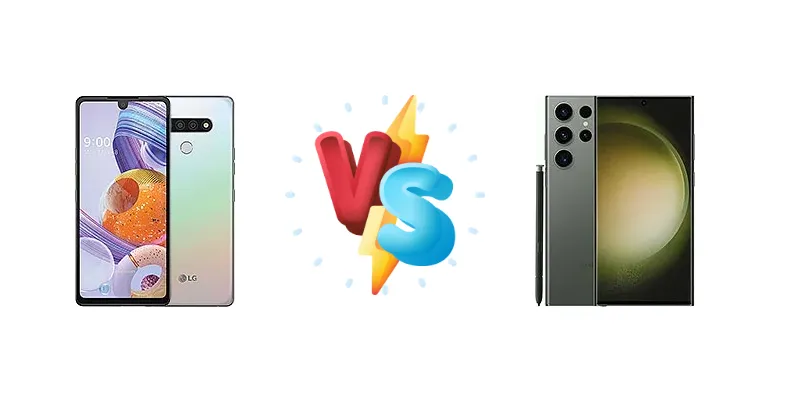
LG K71 vs. Samsung Galaxy S23 Ultra: A Tale of Two Androids
| Phones Images | |||||
|---|---|---|---|---|---|
|
🏆 Quick Verdict
For the vast majority of users, the Samsung Galaxy S23 Ultra is the clear winner. Its vastly superior performance, exceptional camera system, and long-lasting battery justify the higher cost. However, the LG K71 remains a viable option for those on an extremely tight budget who prioritize basic functionality over advanced features.
| PHONES | ||
|---|---|---|
| Phone Names | LG K71 | Samsung Galaxy S23 Ultra |
| Network | ||
|---|---|---|
| 2G bands | GSM 850 / 900 / 1800 / 1900 | GSM 850 / 900 / 1800 / 1900 |
| 3G bands | HSDPA 850 / 900 / 1900 / 2100 | HSDPA 850 / 900 / 1700(AWS) / 1900 / 2100 |
| 4G bands | LTE | 1, 2, 3, 4, 5, 7, 8, 12, 13, 17, 18, 19, 20, 25, 26, 28, 32, 38, 39, 40, 41, 66 - International |
| 5G bands | - | 1, 2, 3, 5, 7, 8, 12, 20, 25, 28, 38, 40, 41, 66, 75, 77, 78 SA/NSA/Sub6 - International |
| Speed | HSPA 42.2/5.76 Mbps, LTE (2CA) Cat6 300/50 Mbps | HSPA, LTE (up to 7CA), 5G |
| Technology | GSM / HSPA / LTE | GSM / CDMA / HSPA / EVDO / LTE / 5G |
| - | 1, 7, 28, 41, 66, 71, 78, 258, 260, 261 SA/NSA/Sub6/mmWave - USA | |
| Launch | ||
|---|---|---|
| Announced | 2020, September 21. Released 2020, September 21 | 2023, February 01 |
| Status | Discontinued | Available. Released 2023, February 17 |
| Body | ||
|---|---|---|
| Build | - | Glass front (Gorilla Glass Victus 2), glass back (Gorilla Glass Victus 2), aluminum frame |
| Dimensions | 171.4 x 77.7 x 8.7 mm (6.75 x 3.06 x 0.34 in) | 163.4 x 78.1 x 8.9 mm (6.43 x 3.07 x 0.35 in) |
| SIM | Nano-SIM | · Nano-SIM + eSIM· Nano-SIM + Nano-SIM + eSIM (max 2 at a time) |
| Weight | 220 g (7.76 oz) | 234 g (8.25 oz) |
| Stylus | IP68 dust/water resistant (up to 1.5m for 30 min) Armor aluminum frame with tougher drop and scratch resistance (advertised) Stylus (Bluetooth integration, accelerometer, gyro) | |
| Display | ||
|---|---|---|
| Protection | - | Corning Gorilla Glass Victus 2 |
| Resolution | 1080 x 2460 pixels (~395 ppi density) | 1440 x 3088 pixels, 19.3:9 ratio (~500 ppi density) |
| Size | 6.8 inches, 109.8 cm2 (~82.5% screen-to-body ratio) | 6.8 inches, 114.7 cm2 (~89.9% screen-to-body ratio) |
| Type | IPS LCD | Dynamic AMOLED 2X, 120Hz, HDR10+, 1200 nits (HBM), 1750 nits (peak) |
| - | Always-on display | |
| Platform | ||
|---|---|---|
| CPU | Octa-core (4x2.3 GHz Cortex-A53 & 4x1.8 GHz Cortex-A53) | Octa-core (1x3.36 GHz Cortex-X3 & 2x2.8 GHz Cortex-A715 & 2x2.8 GHz Cortex-A710 & 3x2.0 GHz Cortex-A510) |
| Chipset | Mediatek MT6765 Helio P35 (12 nm) | Qualcomm SM8550-AC Snapdragon 8 Gen 2 (4 nm) |
| GPU | PowerVR GE8320 | Adreno 740 |
| OS | Android 10 | Android 13, up to 4 major Android upgrades, One UI 8 |
| Memory | ||
|---|---|---|
| Card slot | microSDXC (dedicated slot) | No |
| Internal | 128GB 4GB RAM | 256GB 8GB RAM, 256GB 12GB RAM, 512GB 12GB RAM, 1TB 12GB RAM |
| - | UFS 4.0 | |
| Main Camera | ||
|---|---|---|
| Features | LED flash, panorama, HDR | Laser AF, LED flash, auto-HDR, panorama |
| Quad | - | 200 MP, f/1.7, 24mm (wide), 1/1.3", 0.6µm, multi-directional PDAF, OIS 10 MP, f/2.4, 70mm (telephoto), 1/3.52", 1.12µm, PDAF, OIS, 3x optical zoom 10 MP, f/4.9, 230mm (periscope telephoto), 1/3.52", 1.12µm, PDAF, OIS, 10x optical zoom 12 MP, f/2.2, 13mm, 120˚ (ultrawide), 1/2.55", 1.4µm, dual pixel PDAF, Super Steady video |
| Single | - | 12 MP, f/2.2, 26mm (wide), Dual Pixel PDAF |
| Triple | 48 MP, (wide), 1/2.0", 0.8µm, PDAF 5 MP, 120˚, (ultrawide) Auxiliary lens | - |
| Video | 1080p@30fps | 8K@24/30fps, 4K@30/60fps, 1080p@30/60/120/240fps, HDR10+, stereo sound rec., gyro-EIS |
| Selfie camera | ||
|---|---|---|
| Features | - | HDR, HDR10+ |
| Single | 32 MP, (wide), 1/2.8", 0.8µm | 12 MP, f/2.2, 26mm (wide), 1/3.2", 1.12µm, dual pixel PDAF |
| Video | 1080p@30fps | 4K@30/60fps, 1080p@30fps |
| Sound | ||
|---|---|---|
| 3.5mm jack | Yes | No |
| 35mm jack | Yes | No |
| Loudspeaker | Yes, with stereo speakers | Yes, with stereo speakers |
| - | 32-bit/384kHz audio Tuned by AKG | |
| Comms | ||
|---|---|---|
| Bluetooth | 5.0, A2DP, LE | 5.3, A2DP, LE |
| NFC | No | Yes |
| Positioning | GPS | GPS, GALILEO, GLONASS, BDS, QZSS |
| Radio | No | No |
| USB | USB Type-C 2.0 | USB Type-C 3.2, OTG |
| WLAN | Wi-Fi 802.11 b/g/n, Wi-Fi Direct | Wi-Fi 802.11 a/b/g/n/ac/6e, tri-band, Wi-Fi Direct |
| Features | ||
|---|---|---|
| Sensors | Fingerprint (rear-mounted), accelerometer, proximity | Fingerprint (under display, ultrasonic), accelerometer, gyro, proximity, compass, barometer |
| - | Samsung DeX, Samsung Wireless DeX (desktop experience support) Bixby natural language commands and dictation Samsung Pay (Visa, MasterCard certified) Ultra Wideband (UWB) support | |
| Battery | ||
|---|---|---|
| Charging | - | 45W wired, PD3.0, 65% in 30 min 15W wireless (Qi) 4.5W reverse wireless |
| Type | Li-Po 4000 mAh | Li-Ion 5000 mAh |
| Misc | ||
|---|---|---|
| Colors | White | Phantom Black, Green, Cream, Lavender, Graphite, Sky Blue, Lime, Red, BMW M Edition |
| Models | LMQ730HA, LM-Q730HA | SM-S918B, SM-S918B/DS, SM-S918U, SM-S918U1, SM-S918W, SM-S918N, SM-S9180, SM-S918E, SM-S918E/DS |
| Price | - | € 549.90 / $ 454.99 / £ 433.00 |
| SAR | - | 1.12 W/kg (head) 0.92 W/kg (body) |
| SAR EU | - | 0.96 W/kg (head) 1.40 W/kg (body) |
| Tests | ||
|---|---|---|
| Battery life | - | Endurance rating 126h |
| Camera | - | Photo / Video |
| Display | - | Contrast ratio: Infinite (nominal) |
| Loudspeaker | - | -25.6 LUFS (Very good) |
| Performance | - | AnTuTu: 1241531 (v9) GeekBench: 4927 (v5.1) GFXBench: 67fps (ES 3.1 onscreen) |
LG K71
- Extremely affordable price point
- Functional for basic smartphone tasks
- Potentially longer battery life due to lower power consumption
- Poor performance for demanding apps and games
- Low-quality camera system
- Outdated chipset and software support
Samsung Galaxy S23 Ultra
- Exceptional performance with Snapdragon 8 Gen 2
- Professional-grade camera system
- Stunning display with high brightness and contrast
- Very high price
- Large and heavy form factor
- Potential for software bloat
Display Comparison
The Samsung Galaxy S23 Ultra boasts a significantly more advanced display. While the LG K71’s display specifications are not provided, it’s reasonable to assume a lower resolution and brightness compared to the S23 Ultra’s measured 1274 nits peak brightness. The S23 Ultra likely utilizes an LTPO panel for adaptive refresh rates, conserving battery life, a feature absent in the K71. The 'Infinite' contrast ratio of the S23 Ultra suggests a superior OLED panel, delivering deeper blacks and more vibrant colors than the K71’s likely LCD panel.
Camera Comparison
Both devices feature 'Photo / Video' capabilities, but the implementation differs drastically. The S23 Ultra’s camera system, while details are limited in the provided data, is expected to include a high-resolution main sensor with advanced features like optical image stabilization (OIS). The LG K71’s camera is likely to be a basic setup, lacking the advanced image processing and features found in the S23 Ultra. The S23 Ultra’s superior image processing will result in better dynamic range, low-light performance, and overall image quality. The K71 will likely struggle in challenging lighting conditions.
Performance
The performance disparity is immense. The LG K71’s Mediatek Helio P35 (12nm) is an entry-level chipset with an octa-core CPU configuration (4x2.3 GHz Cortex-A53 & 4x1.8 GHz Cortex-A53). This is dwarfed by the Samsung Galaxy S23 Ultra’s Snapdragon 8 Gen 2 (4nm). The Snapdragon 8 Gen 2’s CPU – a combination of Cortex-X3, A715, A710, and A510 cores – offers significantly higher single-core and multi-core performance. The 4nm fabrication process of the Snapdragon 8 Gen 2 also provides superior power efficiency, resulting in less heat generation and sustained performance during demanding tasks. The K71 will struggle with modern games and multitasking, while the S23 Ultra excels in these areas.
Battery Life
The Samsung Galaxy S23 Ultra achieves an impressive endurance rating of 126 hours and 13:24 hours of active use, indicating excellent battery life. It supports 45W wired charging with PD3.0, achieving 65% charge in 30 minutes, alongside 15W wireless charging and 4.5W reverse wireless charging. The LG K71’s battery capacity and charging speed are not specified, but it’s reasonable to assume a smaller battery and slower charging speeds. While the K71 might offer acceptable battery life for light usage, the S23 Ultra provides significantly longer runtime and faster charging capabilities.
Buying Guide
Buy the LG K71 if you need a functional smartphone for basic tasks like calls, texts, and light social media use, and your budget is under $200. You’re willing to accept compromises in performance, camera quality, and display technology. Buy the Samsung Galaxy S23 Ultra if you demand the best possible performance, a professional-grade camera system, a stunning display, and all-day battery life, and are prepared to pay a premium price for these features.