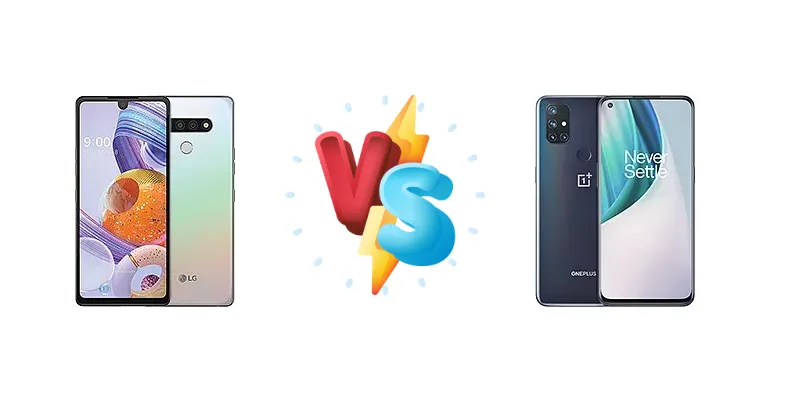
The LG K71 and OnePlus Nord N10 5G represent different approaches to the budget smartphone market. The K71 aims for affordability with a focus on basic functionality, while the Nord N10 5G attempts to deliver a more modern experience, including 5G connectivity and faster charging, at a slightly higher price point. This comparison will dissect their key differences to determine which device offers the best value.
🏆 Quick Verdict
For the average user, the OnePlus Nord N10 5G is the clear winner. Its Snapdragon 690 chipset provides a significantly faster and more responsive experience than the LG K71’s Helio P35. While both phones offer similar battery endurance ratings, the N10 5G’s 30W charging is a game-changer.
| Network |
|---|
| 2G bands | GSM 850 / 900 / 1800 / 1900 | GSM 850 / 900 / 1800 / 1900 |
| 3G bands | HSDPA 850 / 900 / 1900 / 2100 | HSDPA 850 / 900 / 1700(AWS) / 1900 / 2100 |
| 4G bands | LTE | 1, 2, 3, 4, 5, 7, 8, 12, 17, 20, 28, 38, 39, 40, 41, 66 - International |
| 5G bands | - | 1, 3, 7, 28, 41, 66, 78 SA/NSA - International |
| Speed | HSPA 42.2/5.76 Mbps, LTE (2CA) Cat6 300/50 Mbps | HSPA 42.2/5.76 Mbps, LTE Cat18 1024/150 Mbps, 5G |
| Technology | GSM / HSPA / LTE | GSM / CDMA / HSPA / LTE / 5G |
| | - | 2, 5, 25, 41, 66, 71 SA/NSA - USA |
| Launch |
|---|
| Announced | 2020, September 21. Released 2020, September 21 | 2020, October 26 |
| Status | Discontinued | Available. Released 2020, November 21 |
| Body |
|---|
| Build | - | Glass front (Gorilla Glass 3), plastic back, plastic frame |
| Dimensions | 171.4 x 77.7 x 8.7 mm (6.75 x 3.06 x 0.34 in) | 163 x 74.7 x 9 mm (6.42 x 2.94 x 0.35 in) |
| SIM | Nano-SIM | Nano-SIM + Nano-SIM |
| Weight | 220 g (7.76 oz) | 190 g (6.70 oz) |
| | Stylus | - |
| Display |
|---|
| Protection | - | Corning Gorilla Glass 3 |
| Resolution | 1080 x 2460 pixels (~395 ppi density) | 1080 x 2400 pixels, 20:9 ratio (~406 ppi density) |
| Size | 6.8 inches, 109.8 cm2 (~82.5% screen-to-body ratio) | 6.49 inches, 101.7 cm2 (~83.5% screen-to-body ratio) |
| Type | IPS LCD | IPS LCD, 90Hz |
| Platform |
|---|
| CPU | Octa-core (4x2.3 GHz Cortex-A53 & 4x1.8 GHz Cortex-A53) | Octa-core (2x2.0 GHz Kryo 560 Gold & 6x1.7 GHz Kryo 560 Silver) |
| Chipset | Mediatek MT6765 Helio P35 (12 nm) | Qualcomm SM6350 Snapdragon 690 5G (8 nm) |
| GPU | PowerVR GE8320 | Adreno 619L |
| OS | Android 10 | Android 10, OxygenOS 10.5 |
| Memory |
|---|
| Card slot | microSDXC (dedicated slot) | microSDXC |
| Internal | 128GB 4GB RAM | 128GB 6GB RAM |
| | - | UFS 2.1 |
| Main Camera |
|---|
| Features | LED flash, panorama, HDR | LED flash, HDR, panorama |
| Quad | - | 64 MP, f/1.8, (wide), 1/1.72", 0.8µm, PDAF
8 MP, f/2.3, 119˚ (ultrawide)
2 MP (macro)
Auxiliary lens |
| Triple | 48 MP, (wide), 1/2.0", 0.8µm, PDAF
5 MP, 120˚, (ultrawide)
Auxiliary lens | - |
| Video | 1080p@30fps | 4K@30fps, 1080p@30/60/120fps; gyro-EIS |
| Selfie camera |
|---|
| Features | - | HDR |
| Single | 32 MP, (wide), 1/2.8", 0.8µm | 16 MP, f/2.1 |
| Video | 1080p@30fps | 1080p@30/60fps, gyro-EIS |
| Sound |
|---|
| 3.5mm jack | Yes | Yes |
| 35mm jack | Yes | Yes |
| Loudspeaker | Yes, with stereo speakers | Yes, with dual speakers |
| Comms |
|---|
| Bluetooth | 5.0, A2DP, LE | 5.1, A2DP, LE |
| NFC | No | Yes |
| Positioning | GPS | GPS (L1+L5), GLONASS, GALILEO, BDS |
| Radio | No | No |
| USB | USB Type-C 2.0 | USB Type-C 2.0, OTG |
| WLAN | Wi-Fi 802.11 b/g/n, Wi-Fi Direct | Wi-Fi 802.11 a/b/g/n/ac, dual-band, Wi-Fi Direct |
| Features |
|---|
| Sensors | Fingerprint (rear-mounted), accelerometer, proximity | Fingerprint (rear-mounted), accelerometer, gyro, proximity, compass |
| Battery |
|---|
| Charging | - | 30W wired |
| Type | Li-Po 4000 mAh | Li-Po 4300 mAh |
| Misc |
|---|
| Colors | White | Midnight Ice |
| Models | LMQ730HA, LM-Q730HA | BE2029, BE2025, BE2026, BE2028 |
| Price | - | About 250 EUR |
| Tests |
|---|
| Battery life | - |
Endurance rating 99h
|
| Camera | - |
Photo / Video |
| Loudspeaker | - |
-25.8 LUFS (Very good)
|
| Performance | - |
AnTuTu: 279579 (v8)
GeekBench: 1848 (v5.1)
GFXBench: 13fps (ES 3.1 onscreen) |
LG K71
- Extremely affordable price point
- Simple and easy-to-use interface
- Decent battery endurance
- Outdated Helio P35 chipset
- Likely lower-quality display
- Slower charging speeds
OnePlus Nord N10 5G
- Significantly faster Snapdragon 690 processor
- 5G connectivity for faster data speeds
- 30W fast charging for quick top-ups
- Slightly higher price than the LG K71
- May not have expandable storage
- Plastic build quality
Display Comparison
The OnePlus Nord N10 5G boasts a measured peak brightness of 440 nits and a 1447:1 contrast ratio, offering a noticeably more vibrant and readable display than the LG K71, which lacks specific display specifications. While the K71’s display size is likely comparable, the N10 5G’s higher contrast ratio will result in deeper blacks and a more immersive viewing experience. The absence of detailed display specs for the K71 suggests a lower-quality panel overall.
Camera Comparison
Both devices are listed as having Photo/Video capabilities, but without specific sensor details, a direct comparison is difficult. However, given the N10 5G’s positioning as a more feature-rich device, it’s reasonable to assume it has a more capable camera system. The K71 likely relies on a simpler camera setup, potentially lacking features like optical image stabilization (OIS) or advanced image processing algorithms found in the N10 5G. The N10 5G’s focus on video recording is also a likely differentiator.
Performance
The core difference lies in the chipsets. The OnePlus Nord N10 5G’s Qualcomm Snapdragon 690 (8nm) is a substantial upgrade over the LG K71’s Mediatek Helio P35 (12nm). The 8nm process node of the Snapdragon 690 translates to better power efficiency and reduced thermal throttling, especially during sustained workloads. The Snapdragon 690’s Kryo 560 cores (2x2.0 GHz Gold & 6x1.7 GHz Silver) offer a more modern architecture and superior performance compared to the K71’s Cortex-A53 cores (4x2.3 GHz & 4x1.8 GHz). This difference will be most apparent in app loading times, multitasking, and gaming.
Battery Life
Interestingly, both phones share an endurance rating of 99 hours. This suggests similar real-world battery life despite the Snapdragon 690’s higher performance. However, the OnePlus Nord N10 5G’s 30W wired charging is a significant advantage. This allows for a much faster 0-100% charge time compared to the K71, which likely supports slower charging speeds. The convenience of quickly topping up the battery is a major benefit for users on the go.
Buying Guide
Buy the LG K71 if you prioritize extreme affordability and a simple, no-frills smartphone experience. It’s suitable for users who primarily need a device for calls, texts, and light social media. Buy the OnePlus Nord N10 5G if you value performance, 5G connectivity, and faster charging. It’s ideal for users who enjoy mobile gaming, streaming video, and want a more future-proof device.
Frequently Asked Questions
❓ Is the Snapdragon 690 in the OnePlus Nord N10 5G powerful enough for demanding games like PUBG Mobile?
Yes, the Snapdragon 690 is capable of running PUBG Mobile at medium to high settings with playable frame rates. While it won't deliver the same performance as flagship chipsets, it provides a significantly smoother gaming experience compared to the Helio P35 in the LG K71.
❓ Does the OnePlus Nord N10 5G support VoLTE and VoWiFi on all carriers?
Compatibility with VoLTE and VoWiFi varies by carrier. It's crucial to check with your specific carrier to ensure the OnePlus Nord N10 5G is fully supported for these features, as they are essential for making calls over 4G and Wi-Fi networks.
❓ How does the LG K71 perform with multiple apps open simultaneously?
The LG K71’s Helio P35 chipset and limited RAM (spec not provided, but likely 4GB) will struggle with heavy multitasking. Expect noticeable slowdowns and app reloading when switching between multiple applications. It’s best suited for running one app at a time.
❓ What type of charging port does the OnePlus Nord N10 5G use?
The OnePlus Nord N10 5G uses a USB-C port for charging and data transfer. This is a modern standard offering faster data speeds and reversible connectivity compared to older Micro-USB ports.