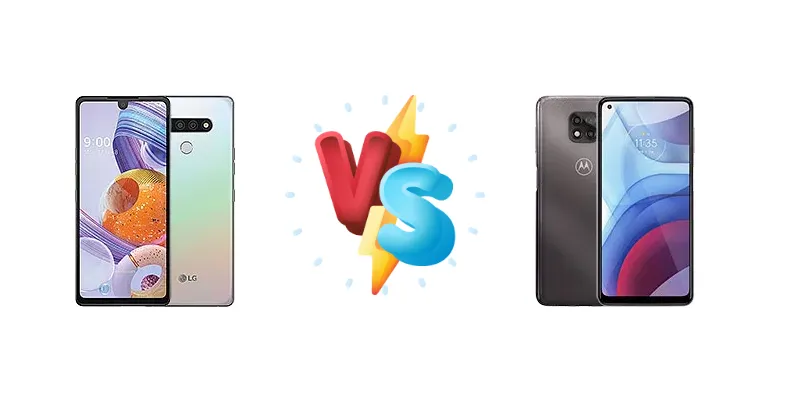
The LG K71 and Motorola Moto G Power (2021) represent two approaches to the budget smartphone market. The K71, leveraging MediaTek's Helio P35, aims for affordability, while the Moto G Power (2021) opts for Qualcomm's Snapdragon 662, prioritizing a balance of performance and efficiency. This comparison dissects their core differences to determine which device delivers the best value.
🏆 Quick Verdict
For the average user, the Motorola Moto G Power (2021) is the superior choice. Its Snapdragon 662 chipset, built on an 11nm process, offers noticeably better performance and power efficiency compared to the LG K71’s 12nm Helio P35. While both prioritize battery life, the Snapdragon’s efficiency translates to longer sustained performance.
| Network |
|---|
| 2G bands | GSM 850 / 900 / 1800 / 1900 | GSM 850 / 900 / 1800 / 1900 |
| 3G bands | HSDPA 850 / 900 / 1900 / 2100 | HSDPA 850 / 900 / 1700(AWS) / 1900 / 2100 |
| 4G bands | LTE | 1, 2, 3, 4, 5, 7, 8, 12, 13, 14, 17, 25, 26, 29, 30, 38, 41, 66, 71 |
| Speed | HSPA 42.2/5.76 Mbps, LTE (2CA) Cat6 300/50 Mbps | HSPA, LTE |
| Technology | GSM / HSPA / LTE | GSM / CDMA / HSPA / EVDO / LTE |
| | - | CDMA2000 1xEV-DO |
| Launch |
|---|
| Announced | 2020, September 21. Released 2020, September 21 | 2021, January 08 |
| Status | Discontinued | Available. Released 2021, January 14 |
| Body |
|---|
| Build | - | Glass front, plastic back, plastic frame |
| Dimensions | 171.4 x 77.7 x 8.7 mm (6.75 x 3.06 x 0.34 in) | 165.3 x 75.9 x 9.5 mm (6.51 x 2.99 x 0.37 in) |
| SIM | Nano-SIM | Nano-SIM |
| Weight | 220 g (7.76 oz) | 206.5 g (7.30 oz) |
| | Stylus | Water-repellent coating |
| Display |
|---|
| Resolution | 1080 x 2460 pixels (~395 ppi density) | 720 x 1600 pixels, 20:9 ratio (~266 ppi density) |
| Size | 6.8 inches, 109.8 cm2 (~82.5% screen-to-body ratio) | 6.6 inches, 105.2 cm2 (~83.8% screen-to-body ratio) |
| Type | IPS LCD | IPS LCD |
| Platform |
|---|
| CPU | Octa-core (4x2.3 GHz Cortex-A53 & 4x1.8 GHz Cortex-A53) | Octa-core (4x2.0 GHz Kryo 260 Gold & 4x1.8 GHz Kryo 260 Silver) |
| Chipset | Mediatek MT6765 Helio P35 (12 nm) | Qualcomm SM6115 Snapdragon 662 (11 nm) |
| GPU | PowerVR GE8320 | Adreno 610 |
| OS | Android 10 | Android 10 |
| Memory |
|---|
| Card slot | microSDXC (dedicated slot) | microSDXC (dedicated slot) |
| Internal | 128GB 4GB RAM | 32GB 3GB RAM, 64GB 4GB RAM |
| | - | eMMC 5.1 |
| Main Camera |
|---|
| Features | LED flash, panorama, HDR | LED flash, HDR, panorama |
| Triple | 48 MP, (wide), 1/2.0", 0.8µm, PDAF
5 MP, 120˚, (ultrawide)
Auxiliary lens | 48 MP, f/1.7, (wide), 1/2.0", 0.8µm, PDAF
2 MP (macro)
Auxiliary lens |
| Video | 1080p@30fps | 1080p@30/60fps, gyro-EIS |
| Selfie camera |
|---|
| Features | - | HDR |
| Single | 32 MP, (wide), 1/2.8", 0.8µm | 8 MP, f/2.0, 1.12µm |
| Video | 1080p@30fps | 1080p@30fps, gyro-EIS |
| Sound |
|---|
| 3.5mm jack | Yes | Yes |
| 35mm jack | Yes | Yes |
| Loudspeaker | Yes, with stereo speakers | Yes |
| Comms |
|---|
| Bluetooth | 5.0, A2DP, LE | 5.0, A2DP, LE |
| NFC | No | No |
| Positioning | GPS | GPS, GLONASS, GALILEO |
| Radio | No | FM radio |
| USB | USB Type-C 2.0 | USB Type-C 2.0 |
| WLAN | Wi-Fi 802.11 b/g/n, Wi-Fi Direct | Wi-Fi 802.11 a/b/g/n/ac, dual-band, Wi-Fi Direct |
| Features |
|---|
| Sensors | Fingerprint (rear-mounted), accelerometer, proximity | Fingerprint (side-mounted), accelerometer, gyro, proximity, compass, barometer |
| Battery |
|---|
| Charging | - | 15W wired |
| Type | Li-Po 4000 mAh | Li-Po 5000 mAh |
| Misc |
|---|
| Colors | White | Flash Gray, Polar Silver |
| Models | LMQ730HA, LM-Q730HA | - |
| Price | - | About 60 EUR |
LG K71
- Potentially lower initial cost
- Adequate for basic smartphone tasks
- Likely long battery life for light users
- Inferior chipset performance compared to Snapdragon 662
- Less efficient processor leading to shorter sustained performance
- Likely slower app loading times
Motorola Moto G Power (2021)
- More powerful and efficient Snapdragon 662 chipset
- 15W fast charging support
- Smoother multitasking and app performance
- Slightly higher initial cost
- May not offer significantly better camera performance
- Battery life, while good, may not be dramatically longer than K71 for very light use
Display Comparison
Neither device is known for a standout display. Both likely feature LCD panels, typical for this price bracket. However, detailed specs like resolution and brightness are missing. The focus here is on internal components. The lack of high refresh rate panels on either device means display smoothness isn't a differentiating factor. Bezels are likely comparable, given the similar target market.
Camera Comparison
Without detailed camera sensor information, a direct comparison is difficult. However, it’s safe to assume both devices feature budget-oriented camera systems. The Moto G Power (2021) likely benefits from Qualcomm’s image signal processor (ISP), which generally offers better image processing capabilities than MediaTek’s equivalent in the Helio P35. This could result in slightly improved image quality, particularly in low-light conditions. The presence of a dedicated ISP on the Snapdragon 662 allows for faster image processing and potentially better dynamic range.
Performance
The core difference lies in the chipsets. The Motorola Moto G Power (2021) utilizes the Qualcomm Snapdragon 662, fabricated on an 11nm process. This is a significant advantage over the LG K71’s MediaTek Helio P35 (12nm). The Snapdragon 662’s Kryo 260 cores, while also an octa-core configuration, benefit from Qualcomm’s architectural optimizations. The 4x2.0 GHz Kryo 260 Gold cores provide a performance boost for demanding tasks, while the 4x1.8 GHz Kryo 260 Silver cores handle background processes efficiently. The Helio P35’s Cortex-A53 cores, while adequate for basic use, will struggle with heavier applications and multitasking. This translates to a snappier experience on the Moto G Power.
Battery Life
Both phones prioritize battery life, but achieve it differently. The Moto G Power (2021) includes 15W wired charging, a feature absent from readily available information on the LG K71. While battery capacity isn’t specified, the Snapdragon 662’s superior power efficiency means the Moto G Power will likely deliver longer screen-on time for a given battery size. The 15W charging on the Moto G Power also allows for quicker top-ups when needed, a practical advantage for users on the go.
Buying Guide
Buy the LG K71 if your primary need is a very low upfront cost and you primarily engage in basic tasks like calling, texting, and light social media browsing. Buy the Motorola Moto G Power (2021) if you value smoother multitasking, occasional gaming, and a more responsive user experience, even if it means a slightly higher initial investment. The Moto G Power is the better all-rounder.
Frequently Asked Questions
❓ Will the Moto G Power (2021) handle demanding games like PUBG Mobile?
While the Snapdragon 662 isn't a gaming powerhouse, it can run PUBG Mobile at medium settings with acceptable frame rates. The Helio P35 in the LG K71 will likely struggle with consistent performance, even at lower settings. Expect more stuttering and lower frame rates on the K71.
❓ Does the LG K71 suffer from significant throttling under sustained load?
The Helio P35, built on a 12nm process, is more prone to thermal throttling than the Snapdragon 662 (11nm). This means that during prolonged gaming or video recording, the K71’s performance will likely decrease as the processor heats up, leading to a less consistent experience.
❓ Is the 15W charging on the Moto G Power (2021) a significant advantage?
Yes, the 15W charging is a practical benefit. While not the fastest charging available, it's considerably quicker than the charging speeds likely offered by the LG K71 (specifications unavailable). This reduces downtime and allows you to quickly top up the battery when needed.