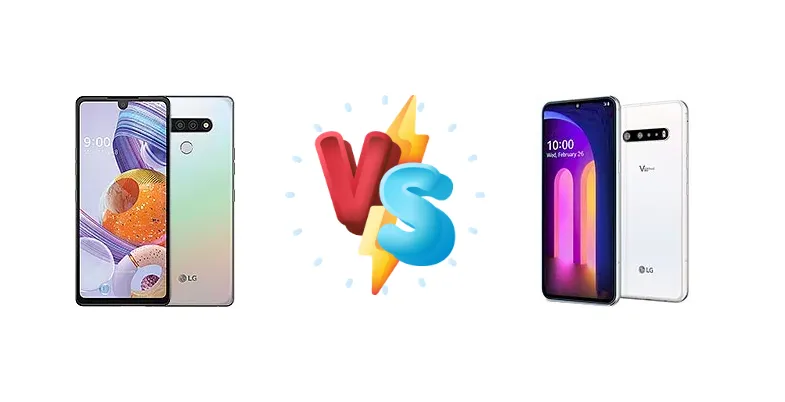
The LG V60 ThinQ 5G represented LG's 2020 flagship offering, boasting 5G connectivity and a high-end Snapdragon processor. The LG K71, released around the same time, targeted the budget-conscious consumer. This comparison dissects the core differences between these two devices, helping you determine if the V60's premium features justify its higher price tag, or if the K71 provides sufficient functionality for everyday tasks.
🏆 Quick Verdict
For most users, the LG V60 ThinQ 5G is the superior choice. Its Snapdragon 865 chipset delivers significantly faster performance and smoother multitasking, crucial for demanding applications and future-proofing. While the K71 offers a lower price, its Helio P35 struggles with intensive tasks, making the V60 a worthwhile investment for power users.
| Network |
|---|
| 2G bands | GSM 850 / 900 / 1800 / 1900 | GSM 850 / 900 / 1800 / 1900 |
| 3G bands | HSDPA 850 / 900 / 1900 / 2100 | HSDPA 850 / 900 / 1700(AWS) / 1900 / 2100 |
| 4G bands | LTE | 2, 4, 5, 12, 25, 26, 41, 46, 48, 66, 71 - USA |
| 5G bands | - | 2, 25, 41, 66, 71 SA/NSA/Sub6 |
| Speed | HSPA 42.2/5.76 Mbps, LTE (2CA) Cat6 300/50 Mbps | HSPA 42.2/5.76 Mbps, LTE (7CA) Cat22, 5G |
| Technology | GSM / HSPA / LTE | GSM / CDMA / HSPA / EVDO / LTE / 5G |
| | - | CDMA2000 1xEV-DO |
| Launch |
|---|
| Announced | 2020, September 21. Released 2020, September 21 | 2020, February 26. Released 2020, March 20 |
| Status | Discontinued | Discontinued |
| Body |
|---|
| Build | - | Glass front (Gorilla Glass 5), glass back (Gorilla Glass 6), aluminum frame |
| Dimensions | 171.4 x 77.7 x 8.7 mm (6.75 x 3.06 x 0.34 in) | 169.3 x 77.6 x 8.9 mm (6.67 x 3.06 x 0.35 in) |
| SIM | Nano-SIM | · Nano-SIM· Nano-SIM + Nano-SIM |
| Weight | 220 g (7.76 oz) | 213 g (Global)/ 218 g (Verizon) (7.51 oz) |
| | Stylus | IP68 dust/water resistant (up to 1.5m for 30 min)
MIL-STD-810G compliant*
Method 516.6, Procedure IV "Transit Drop"
*does not guarantee ruggedness or use in extreme conditions |
| Display |
|---|
| Protection | - | Corning Gorilla Glass 5 |
| Resolution | 1080 x 2460 pixels (~395 ppi density) | 1080 x 2460 pixels (~395 ppi density) |
| Size | 6.8 inches, 109.8 cm2 (~82.5% screen-to-body ratio) | 6.8 inches, 109.8 cm2 (~83.6% screen-to-body ratio) |
| Type | IPS LCD | P-OLED, HDR10+ |
| | - | Always-on display |
| Platform |
|---|
| CPU | Octa-core (4x2.3 GHz Cortex-A53 & 4x1.8 GHz Cortex-A53) | Octa-core (1x2.84 GHz Cortex-A77 & 3x2.42 GHz Cortex-A77 & 4x1.80 GHz Cortex-A55) |
| Chipset | Mediatek MT6765 Helio P35 (12 nm) | Qualcomm SM8250 Snapdragon 865 5G (7 nm+) |
| GPU | PowerVR GE8320 | Adreno 650 |
| OS | Android 10 | Android 10, upgradable to Android 13 |
| Memory |
|---|
| Card slot | microSDXC (dedicated slot) | microSDXC (uses shared SIM slot) - dual-SIM model |
| Internal | 128GB 4GB RAM | 128GB 8GB RAM, 256GB 8GB RAM |
| | - | UFS 2.1 |
| Main Camera |
|---|
| Dual | - | 64 MP, f/1.8, 27mm (standard), 1/1.72", 0.8µm, dual pixel PDAF, OIS
13 MP, f/1.9, 12mm (ultrawide), 1/3.4", 1.0µm
0.3 MP, TOF 3D, f/1.4, (depth) |
| Features | LED flash, panorama, HDR | Dual-LED dual-tone flash, HDR, panorama |
| Triple | 48 MP, (wide), 1/2.0", 0.8µm, PDAF
5 MP, 120˚, (ultrawide)
Auxiliary lens | - |
| Video | 1080p@30fps | 8K@30fps, 4K@30/60fps, 1080p, HDR10+, 24-bit/192kHz stereo sound rec., gyro-EIS |
| Selfie camera |
|---|
| Features | - | HDR |
| Single | 32 MP, (wide), 1/2.8", 0.8µm | 10 MP, f/1.9, 30mm (standard), 1/3.1", 1.22µm |
| Video | 1080p@30fps | 4K@30fps, gyro-EIS |
| Sound |
|---|
| 3.5mm jack | Yes | Yes |
| 35mm jack | Yes | Yes |
| Loudspeaker | Yes, with stereo speakers | Yes, with stereo speakers |
| | - | 32-bit/192kHz audio
24-bit/192kHz audio recording |
| Comms |
|---|
| Bluetooth | 5.0, A2DP, LE | 5.1, A2DP, LE, aptX HD |
| NFC | No | Yes |
| Positioning | GPS | GPS, GLONASS, GALILEO, BDS |
| Radio | No | FM radio (USA model only) |
| USB | USB Type-C 2.0 | USB Type-C 3.1, OTG |
| WLAN | Wi-Fi 802.11 b/g/n, Wi-Fi Direct | Wi-Fi 802.11 a/b/g/n/ac/6, dual-band, Wi-Fi Direct, DLNA |
| Features |
|---|
| Sensors | Fingerprint (rear-mounted), accelerometer, proximity | Fingerprint (under display, optical), accelerometer, gyro, proximity, compass, barometer |
| Battery |
|---|
| Charging | - | Wired, PD2.0, QC4
Wireless |
| Type | Li-Po 4000 mAh | Li-Po 5000 mAh |
| Misc |
|---|
| Colors | White | Classy Blue, Classy White |
| Models | LMQ730HA, LM-Q730HA | LM-V600, A001LG |
| Price | - | About 700 EUR |
| Tests |
|---|
| Battery life | - |
Endurance rating 103h
|
LG K71
- Highly affordable price point.
- Decent battery endurance for basic use.
- Functional for everyday tasks like calls and messaging.
- Underpowered Helio P35 chipset struggles with demanding apps.
- Likely lower-quality display compared to the V60.
- Limited camera capabilities.
LG V60 ThinQ 5G
- Flagship-level performance with Snapdragon 865.
- Fast charging with PD2.0, QC4, and wireless charging.
- Superior camera system with likely OIS and advanced processing.
- Higher price tag compared to the K71.
- May be overkill for users with basic smartphone needs.
- Potentially larger and heavier than the K71.
Display Comparison
While display specifications aren't provided, the V60, as a flagship, likely features a higher-quality panel with superior color accuracy and brightness compared to the K71. The V60 likely utilizes an OLED panel, offering deeper blacks and a higher contrast ratio. The K71, positioned in the budget segment, probably uses an LCD. The V60’s display is also expected to have a higher refresh rate, contributing to smoother scrolling and animations. Bezels on the V60 would be slimmer, offering a more immersive viewing experience.
Camera Comparison
The V60, as a flagship, is expected to have a more sophisticated camera system. While specific sensor details are missing, the V60 likely features a larger main sensor with optical image stabilization (OIS), resulting in better low-light performance and sharper images. The V60’s image processing algorithms would also be more advanced, delivering more accurate colors and dynamic range. The K71 likely relies on software processing to compensate for its less capable hardware. The inclusion of a 2MP macro camera on the K71 is a common budget tactic, offering limited practical benefit due to its low resolution and lack of detail. The V60’s video recording capabilities would also be superior, likely supporting higher resolutions and frame rates.
Performance
The performance gap between these devices is substantial. The LG V60’s Qualcomm Snapdragon 865 5G (7nm+) is a flagship-tier chipset, featuring an octa-core CPU with a prime Cortex-A77 core clocked at 2.84 GHz. This architecture, combined with the 7nm+ manufacturing process, delivers significantly higher processing power and efficiency than the LG K71’s MediaTek Helio P35 (12nm). The Helio P35’s Cortex-A53 cores, while efficient, are older and less capable. The V60’s Adreno 650 GPU will provide a far superior gaming experience, handling demanding titles with ease, while the K71’s PowerVR GE8320 will struggle with graphically intensive games. The V60 also benefits from faster RAM (likely LPDDR5) compared to the K71, further enhancing multitasking performance.
Battery Life
Both devices share an endurance rating of 103 hours, suggesting similar overall battery life despite the V60’s more powerful components. This is likely due to the V60’s more efficient chipset and optimized power management. However, the V60 offers significantly faster charging with support for PD2.0 and QC4 wired charging, as well as wireless charging, providing greater convenience. The K71 likely supports only standard wired charging, resulting in longer charging times. The V60’s faster charging capabilities are a significant advantage for users who need to quickly top up their battery.
Buying Guide
Buy the LG K71 if you prioritize affordability and basic smartphone functionality – calls, texts, social media, and light web browsing. It’s ideal for first-time smartphone owners or those on a very tight budget. Buy the LG V60 ThinQ 5G if you demand a responsive experience, enjoy mobile gaming, frequently use demanding apps, or want the benefits of 5G connectivity. It’s the better choice for users who value performance and longevity.
Frequently Asked Questions
❓ Will the LG K71 struggle with popular games like PUBG Mobile or Call of Duty Mobile?
Yes, the MediaTek Helio P35 in the LG K71 is not a gaming-focused chipset. While you might be able to run these games at low settings, expect significant frame drops, lag, and a generally subpar gaming experience. The V60’s Snapdragon 865 is far better suited for mobile gaming.
❓ Does the LG V60 ThinQ 5G support expandable storage via microSD card?
While not explicitly stated in the provided data, LG flagships of that era often included microSD card support. However, it's crucial to verify this specification before purchase, as some variants may lack this feature. The K71 is more likely to include microSD support as a cost-saving measure.
❓ How much faster is the Snapdragon 865 in the V60 compared to the Helio P35 in the K71 in real-world usage?
The Snapdragon 865 is multiple times faster than the Helio P35. This translates to significantly quicker app loading times, smoother multitasking, and a more responsive user experience overall. Tasks that might take several seconds on the K71 will complete almost instantly on the V60.