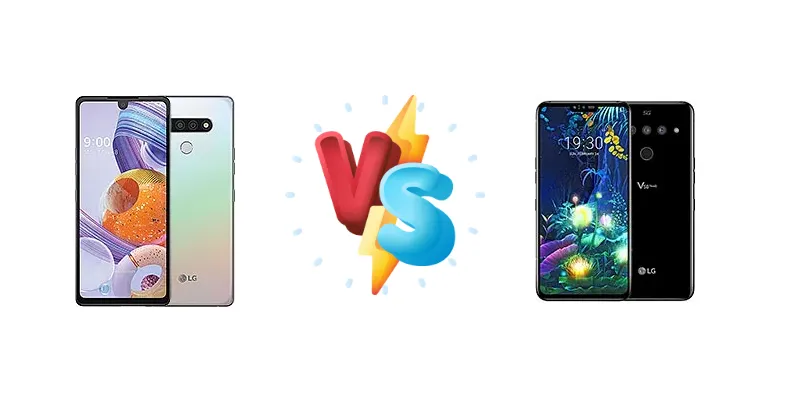
The LG V50 ThinQ 5G represented LG's foray into the early 5G market as a flagship device, while the LG K71 aimed for the budget-conscious consumer. This comparison dissects the core differences between these two LG phones, focusing on performance, display quality, and battery life to help you determine which device best suits your needs and budget.
🏆 Quick Verdict
For most users, the LG V50 ThinQ 5G is the superior choice. Its Snapdragon 855 chipset provides significantly faster performance and smoother multitasking, justifying the price difference. However, the LG K71 remains a viable option for those prioritizing affordability and basic smartphone functionality.
| Network |
|---|
| 2G bands | GSM 850 / 900 / 1800 / 1900 | GSM 850 / 900 / 1800 / 1900 |
| 3G bands | HSDPA 850 / 900 / 1900 / 2100 | HSDPA 850 / 900 / 1700(AWS) / 1900 / 2100 - USA |
| 4G bands | LTE | 1, 2, 3, 4, 5, 7, 8, 12, 13, 17, 20, 25, 26, 28, 40, 41, 46, 66, 71 - USA |
| 5G bands | - | 41, 260, 261 NSA |
| Speed | HSPA 42.2/5.76 Mbps, LTE (2CA) Cat6 300/50 Mbps | HSPA 42.2/5.76 Mbps, LTE (6CA) Cat18 1200/75 Mbps, 5G (2+ Gbps DL) |
| Technology | GSM / HSPA / LTE | GSM / CDMA / HSPA / EVDO / LTE / 5G |
| | - | CDMA2000 1xEV-DO |
| Launch |
|---|
| Announced | 2020, September 21. Released 2020, September 21 | 2019, February 24. Released 2019, April 19 |
| Status | Discontinued | Discontinued |
| Body |
|---|
| Build | - | Glass front (Gorilla Glass 5), glass back (Gorilla Glass 6), aluminum frame |
| Dimensions | 171.4 x 77.7 x 8.7 mm (6.75 x 3.06 x 0.34 in) | 159.2 x 76.1 x 8.3 mm (6.27 x 3.00 x 0.33 in) |
| SIM | Nano-SIM | · Nano-SIM· Nano-SIM + Nano-SIM |
| Weight | 220 g (7.76 oz) | 183 g (6.46 oz) |
| | Stylus | IP68 dust/water resistant (up to 1.5m for 30 min)
MIL-STD-810G compliant*
*does not guarantee ruggedness or use in extreme conditions |
| Display |
|---|
| Protection | - | Corning Gorilla Glass 5 |
| Resolution | 1080 x 2460 pixels (~395 ppi density) | 1440 x 3120 pixels, 19.5:9 ratio (~538 ppi density) |
| Size | 6.8 inches, 109.8 cm2 (~82.5% screen-to-body ratio) | 6.4 inches, 100.2 cm2 (~82.7% screen-to-body ratio) |
| Type | IPS LCD | P-OLED, HDR10 |
| | - | Always-on display |
| Platform |
|---|
| CPU | Octa-core (4x2.3 GHz Cortex-A53 & 4x1.8 GHz Cortex-A53) | Octa-core (1x2.84 GHz Kryo 485 & 3x2.42 GHz Kryo 485 & 4x1.78 GHz Kryo 485) |
| Chipset | Mediatek MT6765 Helio P35 (12 nm) | Qualcomm SM8150 Snapdragon 855 (7 nm) |
| GPU | PowerVR GE8320 | Adreno 640 |
| OS | Android 10 | Android 9.0 (Pie), upgradable to Android 11 |
| Memory |
|---|
| Card slot | microSDXC (dedicated slot) | microSDXC (dedicated slot) |
| Internal | 128GB 4GB RAM | 128GB 6GB RAM |
| | - | UFS 2.1 |
| Main Camera |
|---|
| Features | LED flash, panorama, HDR | LED flash, HDR, panorama |
| Triple | 48 MP, (wide), 1/2.0", 0.8µm, PDAF
5 MP, 120˚, (ultrawide)
Auxiliary lens | 12 MP, 27mm (wide), f/1.5, 1/2.55", 1.4µm, dual pixel PDAF, 3-axis OIS
12 MP, 52mm (telephoto), f/2.4, 1/3.4", 1.0µm, 2x optical zoom, PDAF, OIS
16 MP, 16mm (ultrawide), f/1.9, 1/3.1", 1.0µm, no AF |
| Video | 1080p@30fps | 4K@30/60fps, 1080p@30/60/240fps, 24-bit/192kHz stereo sound rec., HDR10 video, gyro-EIS |
| Selfie camera |
|---|
| Dual | - | 8 MP, f/1.9, 26mm (wide), 1/4.0", 1.12µm
5 MP, 21mm (wide), f/2.2, 1/5.0", 1.12µm |
| Features | - | HDR |
| Single | 32 MP, (wide), 1/2.8", 0.8µm | - |
| Video | 1080p@30fps | 1080p@60fps |
| Sound |
|---|
| 3.5mm jack | Yes | Yes |
| 35mm jack | Yes | Yes |
| Loudspeaker | Yes, with stereo speakers | Yes, with stereo speakers |
| | - | 32-bit/192kHz audio
24-bit/192kHz audio recording
Tuned with Meridian Audio |
| Comms |
|---|
| Bluetooth | 5.0, A2DP, LE | 5.0, A2DP, LE, aptX HD |
| NFC | No | Yes |
| Positioning | GPS | GPS, GLONASS, GALILEO |
| Radio | No | FM radio |
| USB | USB Type-C 2.0 | USB Type-C 3.1 |
| WLAN | Wi-Fi 802.11 b/g/n, Wi-Fi Direct | Wi-Fi 802.11 a/b/g/n/ac, dual-band, Wi-Fi Direct, DLNA |
| Features |
|---|
| Sensors | Fingerprint (rear-mounted), accelerometer, proximity | Fingerprint (rear-mounted), accelerometer, gyro, proximity, compass, barometer |
| Battery |
|---|
| Charging | - | 18W wired, PD2.0, QC3, 50% in 36 min
10W wireless (Qi) |
| Type | Li-Po 4000 mAh | Li-Po 4000 mAh, non-removable |
| Misc |
|---|
| Colors | White | New Aurora Black |
| Models | LMQ730HA, LM-Q730HA | LM-V500, LM-V500N, LM-V500EM, LM-V500XM, LM-V450PM, LM-V450 |
| Price | - | About 550 EUR |
| Tests |
|---|
| Audio quality | - |
Noise -92.5dB / Crosstalk -92.6dB |
| Battery life | - |
Endurance rating 96h
|
| Camera | - |
Photo / Video |
| Display | - |
Contrast ratio: 194000:1 (nominal) |
| Loudspeaker | - |
-25.2 LUFS (Very good)
|
| Performance | - |
AnTuTu: 343758 (v7), 421934 (v8)
GeekBench: 10928 (v4.4), 2672 (v5.1)
GFXBench: 22fps (ES 3.1 onscreen) |
LG K71
- Affordable price point
- Decent battery life (96h endurance)
- Functional for basic smartphone tasks
- Weak processor (Helio P35)
- Limited performance for demanding apps
- Display specifications are basic
LG V50 ThinQ 5G
- Flagship Snapdragon 855 processor
- Bright and high-contrast display
- Fast charging (18W wired, 10W wireless)
- Higher price compared to the K71
- May be difficult to find new
- Older 5G technology
Display Comparison
The LG V50 ThinQ 5G boasts a brighter display, measured at 533 nits, offering better visibility in direct sunlight compared to the K71 (brightness unspecified). While both phones feature displays for photo and video consumption, the V50’s contrast ratio of 194000:1 suggests deeper blacks and more vibrant colors. The K71’s display specifications are less detailed, indicating a more basic panel likely optimized for power efficiency rather than visual fidelity. The V50’s higher brightness and contrast will be particularly noticeable when viewing HDR content.
Camera Comparison
Both phones feature photo and video capabilities, but details are limited. The V50’s camera system, typical of flagships, likely includes features like Optical Image Stabilization (OIS) and more advanced image processing algorithms. While the K71 likely offers a serviceable camera for casual snapshots, it will lack the sophistication and image quality of the V50. Without specific sensor size or aperture information for either device, it’s difficult to make a precise comparison, but the V50’s flagship status suggests a superior camera experience.
Performance
The performance gap between these devices is substantial. The LG V50 ThinQ 5G is powered by the Qualcomm Snapdragon 855 (7nm), an octa-core processor built for flagship performance. Its CPU configuration – 1x2.84 GHz Kryo 485, 3x2.42 GHz Kryo 485, and 4x1.78 GHz Kryo 485 – delivers significantly faster processing speeds and improved multitasking capabilities. In contrast, the LG K71 utilizes the Mediatek Helio P35 (12nm) with its octa-core CPU (4x2.3 GHz Cortex-A53 & 4x1.8 GHz Cortex-A53). The 7nm process node of the Snapdragon 855 is more efficient, resulting in better thermal management and sustained performance under load. The V50 is demonstrably better suited for demanding tasks like gaming and video editing.
Battery Life
Both the LG V50 ThinQ 5G and the LG K71 achieve an endurance rating of 96 hours, suggesting comparable battery life under similar usage conditions. However, the V50 offers significantly faster charging with 18W wired charging (PD2.0, QC3) and 10W wireless charging (Qi), reaching 50% charge in just 36 minutes. The K71’s charging specifications are not provided, implying a slower charging rate. While both phones offer similar overall endurance, the V50’s faster charging capabilities provide a more convenient user experience.
Buying Guide
Buy the LG K71 if you need a functional smartphone for everyday tasks like calling, texting, and light social media use, and your budget is a primary concern. You'll appreciate its simplicity and affordability. Buy the LG V50 ThinQ 5G if you prioritize performance for gaming, demanding apps, and future-proofing with 5G connectivity. The V50 offers a significantly better user experience for power users and those who want a phone that can handle anything they throw at it.
Frequently Asked Questions
❓ Is the LG V50 ThinQ 5G still worth buying in 2024, considering it's an older 5G phone?
Despite being an older model, the LG V50 ThinQ 5G remains a viable option for users who prioritize performance and want 5G connectivity on a budget. While newer 5G technologies exist, the V50 still supports 5G networks and offers a powerful Snapdragon 855 processor that can handle most tasks effectively. However, software update support may be limited.
❓ Can the LG K71 handle popular mobile games like PUBG or Call of Duty?
The LG K71's Mediatek Helio P35 processor is not ideal for demanding games like PUBG or Call of Duty. While you might be able to run these games at the lowest settings, expect significant frame rate drops and lag, resulting in a suboptimal gaming experience. It's better suited for less graphically intensive games.
❓ Does the LG V50 ThinQ 5G support expandable storage via microSD card?
Yes, the LG V50 ThinQ 5G supports expandable storage via microSD card, allowing you to increase the phone's storage capacity beyond its internal memory. This is a useful feature for users who store a lot of photos, videos, or other files.