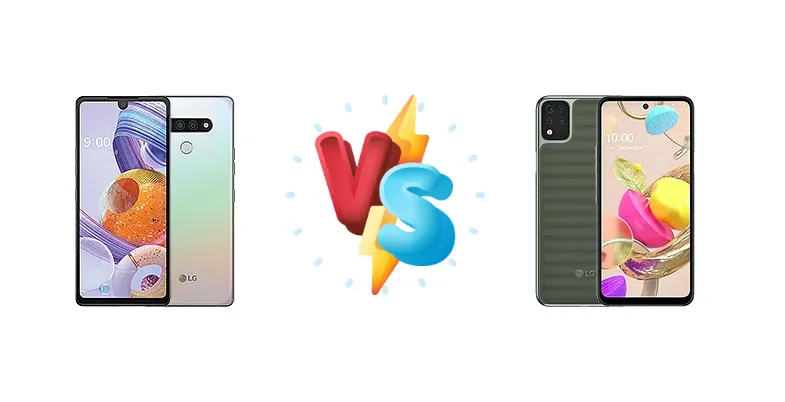
The LG K71 and K42 represent LG's entry into the highly competitive budget smartphone market. Both devices aim to deliver essential smartphone functionality at an accessible price point, but they differ significantly in their internal hardware. This comparison dives deep into those differences, focusing on the impact of their respective chipsets on performance and overall user experience.
🏆 Quick Verdict
For most users, the LG K71 offers a better overall experience due to its more powerful Mediatek Helio P35 chipset. While the K42 benefits from 10W charging, the K71’s superior processing power translates to smoother multitasking and a more responsive user interface, making it the better choice for everyday use.
| Network |
|---|
| 2G bands | GSM 850 / 900 / 1800 / 1900 | GSM 850 / 900 / 1800 / 1900 |
| 3G bands | HSDPA 850 / 900 / 1900 / 2100 | HSDPA 850 / 900 / 1900 / 2100 |
| 4G bands | LTE | 1, 3, 7, 8, 20, 28, 38 - Europe |
| Speed | HSPA 42.2/5.76 Mbps, LTE (2CA) Cat6 300/50 Mbps | Yes, 384 kbps |
| Technology | GSM / HSPA / LTE | GSM / HSPA / LTE |
| | - | 1, 3, 5, 7, 8, 20, 28, 38, 39, 40, 41 - Australia |
| Launch |
|---|
| Announced | 2020, September 21. Released 2020, September 21 | 2020, September 21. Released 2020, September 21 |
| Status | Discontinued | Discontinued |
| Body |
|---|
| Dimensions | 171.4 x 77.7 x 8.7 mm (6.75 x 3.06 x 0.34 in) | 165 x 76.7 x 8.4 mm (6.50 x 3.02 x 0.33 in) |
| SIM | Nano-SIM | Nano-SIM + Nano-SIM |
| Weight | 220 g (7.76 oz) | 182 g (6.42 oz) |
| | Stylus | MIL-STD-810G compliant*
*does not guarantee ruggedness or use in extreme conditions |
| Display |
|---|
| Resolution | 1080 x 2460 pixels (~395 ppi density) | 720 x 1600 pixels, 20:9 ratio (~266 ppi density) |
| Size | 6.8 inches, 109.8 cm2 (~82.5% screen-to-body ratio) | 6.6 inches, 105.2 cm2 (~83.1% screen-to-body ratio) |
| Type | IPS LCD | IPS LCD |
| Platform |
|---|
| CPU | Octa-core (4x2.3 GHz Cortex-A53 & 4x1.8 GHz Cortex-A53) | Octa-core 2.0 GHz Cortex-A53 |
| Chipset | Mediatek MT6765 Helio P35 (12 nm) | Mediatek MT6762 Helio P22 (12 nm) |
| GPU | PowerVR GE8320 | PowerVR GE8320 |
| OS | Android 10 | Android 10, upgradable to Android 11 |
| Memory |
|---|
| Card slot | microSDXC (dedicated slot) | microSDXC |
| Internal | 128GB 4GB RAM | 64GB 3GB RAM |
| | - | eMMC 5.1 |
| Main Camera |
|---|
| Features | LED flash, panorama, HDR | LED flash, panorama, HDR |
| Quad | - | 13 MP, 27mm (wide), 1/3.1", 1.12µm, PDAF
5 MP, f/2.2, 115˚ (ultrawide), 1/5.0", 1.12µm
2 MP (macro)
Auxiliary lens |
| Triple | 48 MP, (wide), 1/2.0", 0.8µm, PDAF
5 MP, 120˚, (ultrawide)
Auxiliary lens | - |
| Video | 1080p@30fps | 1080p@30fps |
| Selfie camera |
|---|
| Single | 32 MP, (wide), 1/2.8", 0.8µm | 8 MP, (wide) |
| Video | 1080p@30fps | 1080p@30fps |
| Sound |
|---|
| 3.5mm jack | Yes | Yes |
| 35mm jack | Yes | Yes |
| Loudspeaker | Yes, with stereo speakers | Yes |
| Comms |
|---|
| Bluetooth | 5.0, A2DP, LE | 5.0, A2DP, LE |
| NFC | No | Yes (market/region dependent) |
| Positioning | GPS | GPS |
| Radio | No | No |
| USB | USB Type-C 2.0 | USB Type-C 2.0, OTG |
| WLAN | Wi-Fi 802.11 b/g/n, Wi-Fi Direct | Wi-Fi 802.11 b/g/n, Wi-Fi Direct |
| Features |
|---|
| Sensors | Fingerprint (rear-mounted), accelerometer, proximity | Fingerprint (side-mounted), accelerometer, proximity, compass |
| Battery |
|---|
| Charging | - | 10W wired |
| Type | Li-Po 4000 mAh | Li-Po 4000 mAh |
| Misc |
|---|
| Colors | White | Gray, Green |
| Models | LMQ730HA, LM-Q730HA | LMK420, LM-K420, LMK420H, LM-K420H, LMK420E, LM-K420E, LMK420Y, LM-K420Y |
| Price | - | About 140 EUR |
LG K71
- More powerful Helio P35 chipset for smoother performance
- Potentially better multitasking capabilities
- May offer slightly faster image processing
- Likely slower charging speeds compared to the K42
- Battery capacity not specified
LG K42
- 10W wired charging for faster top-ups
- Lower price point (likely)
- Adequate for basic smartphone tasks
- Less powerful Helio P22 chipset
- Noticeably slower performance under load
- Limited multitasking capabilities
Display Comparison
Neither LG provides detailed display specifications beyond resolution. However, both utilize IPS LCD panels, common in this price bracket. The lack of high refresh rates or advanced features like HDR is expected. The real difference lies in the processing power driving the display, which we'll cover in the performance section. Bezels are likely comparable, given the similar target market.
Camera Comparison
Detailed camera specifications are unavailable. However, given the market segment, both phones likely feature similar camera setups focused on affordability rather than image quality. It's reasonable to assume both will include a primary camera, potentially an ultrawide, and a depth sensor. The image processing capabilities will be limited by the chipsets. The K71’s slightly more powerful processor *may* allow for marginally faster image processing, but the difference will likely be minimal. Avoid expecting flagship-level camera performance from either device.
Performance
The core difference between these two phones is their chipsets. The LG K71 features the Mediatek Helio P35, an octa-core processor with a heterogeneous core configuration – four Cortex-A53 cores clocked at 2.3 GHz and four at 1.8 GHz. This contrasts with the LG K42’s Helio P22, which utilizes eight Cortex-A53 cores all clocked at 2.0 GHz. While both are 12nm chips, the P35’s higher clock speeds on its performance cores provide a tangible advantage in CPU-intensive tasks. This translates to faster app loading times, smoother scrolling, and improved multitasking. The K71 will handle more demanding apps and light gaming more effectively. The K42, while adequate for basic use, will exhibit more noticeable slowdowns under load.
Battery Life
Battery capacity is not specified in the provided data. However, the LG K42 includes 10W wired charging, while the K71’s charging speed is unknown but likely slower. This means the K42 will reach a full charge slightly faster, a benefit for users who prioritize quick top-ups. However, the more efficient Helio P35 in the K71 *could* offset a potentially smaller battery capacity, resulting in comparable real-world battery life, depending on usage patterns.
Buying Guide
Buy the LG K71 if you prioritize a smoother, more responsive user experience and anticipate running multiple apps or engaging in light gaming. Its Helio P35 chipset provides a noticeable performance advantage. Buy the LG K42 if your primary concern is a slightly faster charging experience and you primarily use your phone for basic tasks like calls, texts, and light social media browsing. The K42 is a viable option for those on an extremely tight budget.
Frequently Asked Questions
❓ Will the LG K71 struggle with popular social media apps like TikTok or Instagram?
While the Helio P35 can handle these apps, expect some occasional slowdowns or stutters, especially when multitasking. The K71 is not designed for intensive social media use, but it should be functional for casual browsing and posting.
❓ Is the 10W charging on the LG K42 significantly faster than a standard 5W charger?
Yes, 10W charging will noticeably reduce charging times compared to a standard 5W charger. While not fast charging by modern standards, it will provide a quicker top-up when you need it.
❓ Can either of these phones handle basic mobile games like Candy Crush or Subway Surfers?
Both phones can handle less demanding games like Candy Crush or Subway Surfers, but the LG K71 will provide a smoother and more consistent gaming experience due to its more powerful processor. Expect lower graphics settings and potential frame rate drops on the K42.
❓ What type of storage does each phone use, and is it expandable?
Storage type is not specified. However, budget phones in this class typically use eMMC storage. Both phones likely feature a microSD card slot for expandable storage, allowing you to increase the available space for photos, videos, and apps.