
Google Pixel 4 vs. LG K62: A Detailed Comparison of Performance, Camera, and Value
| Phones Images | |||||
|---|---|---|---|---|---|
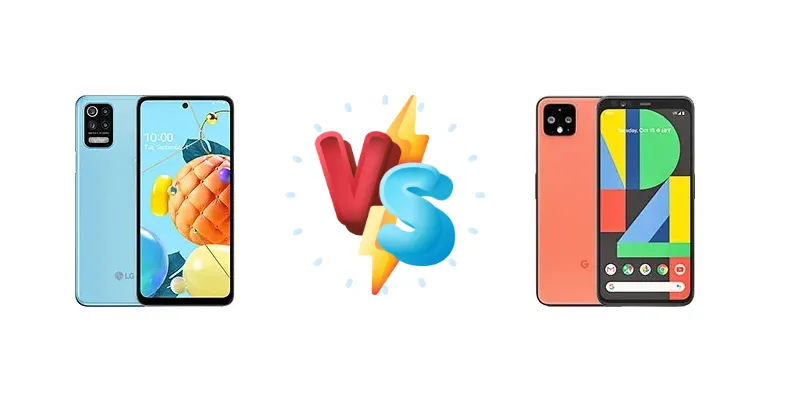
|
🏆 Quick Verdict
For users prioritizing camera quality and a smooth software experience, the Google Pixel 4 is the clear winner, despite its age. However, the LG K62 offers significantly better battery endurance and represents a compelling value proposition for those on a tight budget.
| PHONES | ||
|---|---|---|
| Phone Names | LG K62 | Google Pixel 4 |
| Network | ||
|---|---|---|
| 2G bands | GSM 850 / 900 / 1800 / 1900 | GSM 850 / 900 / 1800 / 1900 |
| 3G bands | HSDPA 850 / 900 / 1900 / 2100 | HSDPA 850 / 900 / 1700(AWS) / 1900 / 2100 |
| 4G bands | 1, 2, 3, 4, 5, 7, 8, 12, 13, 17, 28, 38, 66 - North America | 1, 2, 3, 4, 5, 7, 8, 12, 13, 17, 20, 25, 26, 28, 32, 38, 39, 40, 41, 66, 71 - Global |
| Speed | HSPA 42.2/5.76 Mbps, LTE (2CA) Cat6 300/50 Mbps | HSPA 42.2/5.76 Mbps, LTE (5CA) Cat18 1200/150 Mbps |
| Technology | GSM / HSPA / LTE | GSM / CDMA / HSPA / EVDO / LTE |
| 1, 3, 5, 7, 28, 40 - Brazil | 1, 2, 3, 4, 5, 7, 8, 12, 13, 14, 17, 18, 19, 20, 25, 26, 28, 29, 30, 38, 39, 40, 41, 46, 48, 66, 71 - USA | |
| Launch | ||
|---|---|---|
| Announced | 2020, September 23. Released 2020, November 27 | 2019, October 15 |
| Status | Discontinued | Available. Released 2019, October 22 |
| Body | ||
|---|---|---|
| Build | - | Glass front (Gorilla Glass 5), glass back (Gorilla Glass 5), aluminum frame |
| Dimensions | 165 x 76.7 x 8.4 mm (6.50 x 3.02 x 0.33 in) | 147.1 x 68.8 x 8.2 mm (5.79 x 2.71 x 0.32 in) |
| SIM | Nano-SIM + Nano-SIM | Nano-SIM + eSIM |
| Weight | 186 g (6.56 oz) | 162 g (5.71 oz) |
| MIL-STD-810G compliant* *does not guarantee ruggedness or use in extreme conditions | IP68 dust/water resistant (up to 1.5m for 30 min) | |
| Display | ||
|---|---|---|
| Protection | - | Corning Gorilla Glass 5 |
| Resolution | 720 x 1600 pixels, 20:9 ratio (~266 ppi density) | 1080 x 2280 pixels, 19:9 ratio (~444 ppi density) |
| Size | 6.6 inches, 105.2 cm2 (~83.1% screen-to-body ratio) | 5.7 inches, 80.7 cm2 (~79.8% screen-to-body ratio) |
| Type | IPS LCD | P-OLED, 90Hz, HDR |
| - | Always-on display | |
| Platform | ||
|---|---|---|
| CPU | Octa-core (4x2.3 GHz Cortex-A53 & 4x1.8 GHz Cortex-A53) | Octa-core (1x2.84 GHz Kryo 485 & 3x2.42 GHz Kryo 485 & 4x1.78 GHz Kryo 485) |
| Chipset | Mediatek MT6765 Helio P35 (12 nm) | Qualcomm SM8150 Snapdragon 855 (7 nm) |
| GPU | PowerVR GE8320 | Adreno 640 |
| OS | Android 10 | Android 10, upgradable to Android 13 |
| Memory | ||
|---|---|---|
| Card slot | microSDXC | No |
| Internal | 64GB 4GB RAM, 128GB 4GB RAM | 64GB 6GB RAM, 128GB 6GB RAM |
| - | UFS 2.1 | |
| Main Camera | ||
|---|---|---|
| Dual | - | 12.2 MP, f/1.7, 27mm (wide), 1/2.55", 1.4µm, dual pixel PDAF, OIS 16 MP, f/2.4, 50mm (telephoto), 1/3.6", 1.0µm, PDAF, OIS, 2x optical zoom |
| Features | Dual-LED flash, panorama, HDR | Dual-LED flash, Pixel Shift, Auto-HDR, panorama |
| Quad | 48 MP, f/1.8, (wide), 1/2.0", 0.8µm, PDAF 5 MP, f/2.2, 115˚ (ultrawide), 1/5.0", 1.12µm 2 MP (macro) Auxiliary lens | - |
| Video | 1080p@30fps | 4K@30fps, 1080p@30/60/120fps, 1080p@30fps (gyro-EIS) |
| Selfie camera | ||
|---|---|---|
| Features | - | HDR |
| Single | 28 MP | 8 MP, f/2.0, 22mm (wide), 1.22µm, no AF TOF 3D, (depth/biometrics sensor) |
| Video | 1080p@30fps | 1080p@30fps |
| Sound | ||
|---|---|---|
| 3.5mm jack | Yes | No |
| 35mm jack | Yes | No |
| Loudspeaker | Yes | Yes, with stereo speakers |
| Comms | ||
|---|---|---|
| Bluetooth | 5.0, A2DP, LE | 5.0, A2DP, LE, aptX HD |
| NFC | Yes | Yes |
| Positioning | GPS | GPS, GLONASS, BDS, GALILEO |
| Radio | No | No |
| USB | USB Type-C 3.1 | USB Type-C 3.1 |
| WLAN | Wi-Fi 802.11 a/b/g/n/ac, dual-band, Wi-Fi Direct | Wi-Fi 802.11 a/b/g/n/ac, dual-band, Wi-Fi Direct, DLNA |
| Features | ||
|---|---|---|
| Sensors | Fingerprint (side-mounted), accelerometer, proximity, compass | Face ID, accelerometer, gyro, proximity, compass, barometer |
| Battery | ||
|---|---|---|
| Charging | - | 18W wired, PD2.0 Wireless |
| Type | Li-Po 4000 mAh | Li-Po 2800 mAh, non-removable |
| Misc | ||
|---|---|---|
| Colors | White, Sky Blue, Red | Clearly White, Just Black, Oh So Orange |
| Models | LMK525H, LMK525, LM-K525H, LM-K525 | G020M, G020I, GA01188-US, GA01187-US, GA01189-US, GA01191-US, GA01189-US |
| Price | About 290 EUR | About 200 EUR |
| Tests | ||
|---|---|---|
| Audio quality | - | Noise -71.5dB / Crosstalk -69.8dB |
| Battery life | - | Endurance rating 62h |
| Camera | - | Photo / Video |
| Display | - | Contrast ratio: Infinite (nominal) |
| Loudspeaker | - | Voice 79dB / Noise 71dB / Ring 83dB |
| Performance | - | AnTuTu: 395351 (v8) GeekBench: 2542 (v5.1) GFXBench: 31fps (ES 3.1 onscreen) |
LG K62
- Exceptional camera quality, especially in low light
- Smooth and responsive user experience thanks to the Snapdragon 855
- Clean Android software with timely updates (at launch)
- Battery life is average and requires more frequent charging
- Older device, potentially limited long-term software support
- Smaller screen size may not appeal to all users
Google Pixel 4
- Excellent battery life, lasting well beyond a full day
- More affordable price point
- Larger display size (likely, based on market positioning)
- Significantly slower performance compared to the Pixel 4
- Inferior camera quality, especially in low light
- Less refined software experience
Display Comparison
The Google Pixel 4 boasts a display capable of 423 nits of peak brightness, offering good visibility outdoors, while the LG K62’s display specifications are not provided. The Pixel 4’s ‘Infinite’ contrast ratio (nominal) suggests a true OLED panel, delivering deep blacks and vibrant colors, a feature likely absent in the K62. This difference in panel technology significantly impacts the viewing experience, particularly for media consumption. The Pixel 4’s smaller size (assumed, based on Pixel 4 market positioning) also contributes to a higher pixel density, resulting in a sharper image.
Camera Comparison
Both devices offer photo and video capabilities, but the Pixel 4’s camera system is renowned for its computational photography prowess. While specific sensor details are missing for both, the Pixel 4’s reputation suggests a larger, higher-quality sensor and superior image processing algorithms. The Pixel 4’s software optimizations, like Night Sight and Super Res Zoom, provide a significant advantage in low-light conditions and image detail. The LG K62 likely relies more on hardware limitations and less on software enhancements, resulting in less impressive image quality, particularly in challenging lighting scenarios. The absence of OIS information for the K62 further suggests a less sophisticated camera system.
Performance
The core difference lies in the chipsets: the Google Pixel 4 utilizes the Qualcomm Snapdragon 855 (7nm), while the LG K62 is powered by the Mediatek Helio P35 (12nm). The Snapdragon 855’s 7nm process and Kryo 485 architecture (1x2.84 GHz, 3x2.42 GHz, 4x1.78 GHz) deliver significantly higher performance than the Helio P35’s Cortex-A53 cores (4x2.3 GHz & 4x1.8 GHz). This translates to faster app loading times, smoother multitasking, and a more responsive overall experience on the Pixel 4. The Snapdragon 855 also features a more capable GPU, enabling better gaming performance. The larger process node of the Helio P35 suggests lower efficiency and potentially more heat generation under sustained load.
Battery Life
Both the LG K62 and Google Pixel 4 share an endurance rating of 62 hours, but this metric doesn't tell the whole story. The Pixel 4’s 18W charging with PD2.0 and wireless charging capabilities offer greater convenience, allowing for quicker top-ups. The K62’s charging specifications are not provided, but it likely lacks these faster charging options. While both have similar endurance ratings, the Pixel 4’s more efficient chipset and optimized software likely contribute to more consistent performance throughout the day, despite the smaller battery capacity (assumed, based on Pixel 4 size).
Buying Guide
Buy the LG K62 if you need a phone that can reliably last a full day (and beyond) on a single charge, and your primary use cases are basic communication, social media, and light media consumption. Buy the Google Pixel 4 if you prioritize exceptional photo and video quality, a responsive user experience, and access to Google’s software features, even if it means more frequent charging.