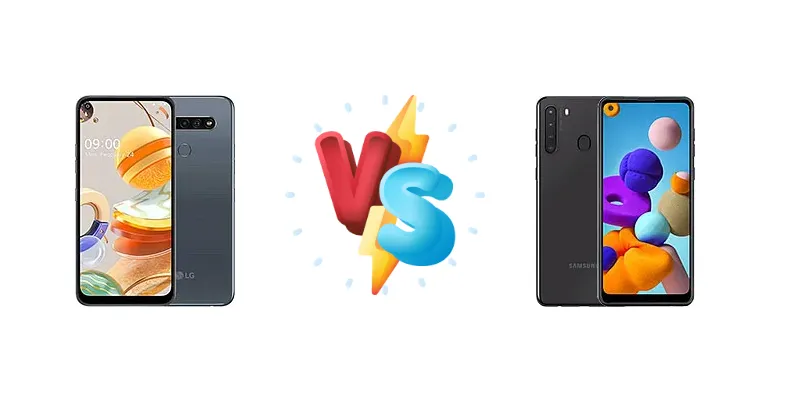
The LG K61 and Samsung Galaxy A21 represent a crowded segment of the smartphone market: affordable devices aiming to deliver essential functionality. Both phones share the same Mediatek Helio P35 chipset, making a direct comparison crucial for consumers seeking the best value. This analysis will dissect their subtle differences, focusing on charging, and potential real-world performance implications.
🏆 Quick Verdict
For the average user, the Samsung Galaxy A21 edges out the LG K61 due to its inclusion of 15W wired charging. While performance is virtually identical thanks to the shared Helio P35 chipset, the faster charging provides a tangible benefit in daily usability, reducing downtime and improving convenience.
| Network |
|---|
| 2G bands | GSM 850 / 900 / 1800 / 1900 | GSM 850 / 900 / 1800 / 1900 |
| 3G bands | HSDPA 850 / 900 / 1900 / 2100 | HSDPA 850 / 900 / 1700(AWS) / 1900 / 2100 - USA |
| 4G bands | 1, 3, 5, 7, 8, 20, 28, 38, 39, 40 | 1, 2, 3, 4, 5, 7, 8, 12, 13, 17, 20, 25, 26, 28, 38, 39, 40, 41, 66, 71 - USA |
| Speed | HSPA 42.2/5.76 Mbps, LTE (2CA) Cat6 300/50 Mbps | HSPA 42.2/5.76 Mbps, LTE Cat4 150/50 Mbps |
| Technology | GSM / HSPA / LTE | GSM / CDMA / HSPA / EVDO / LTE |
| | - | CDMA2000 1xEV-DO |
| Launch |
|---|
| Announced | 2020, February 18. Released 2020, April 27 | 2020, April 08. Released 2020, June 26 |
| Status | Discontinued | Discontinued |
| Body |
|---|
| Build | - | Glass front, plastic back, plastic frame |
| Dimensions | 164.5 x 77.5 x 8.4 mm (6.48 x 3.05 x 0.33 in) | 167.8 x 76.7 x 8.1 mm (6.61 x 3.02 x 0.32 in) |
| SIM | · Nano-SIM· Nano-SIM + Nano-SIM | · Nano-SIM· Nano-SIM + Nano-SIM |
| Weight | 191 g (6.74 oz) | 193 g (6.81 oz) |
| | MIL-STD-810G compliant*
*does not guarantee ruggedness or use in extreme conditions | - |
| Display |
|---|
| Protection | Scratch-resistant glass | - |
| Resolution | 1080 x 2340 pixels, 19.5:9 ratio (~394 ppi density) | 720 x 1600 pixels, 20:9 ratio (~270 ppi density) |
| Size | 6.53 inches, 105.2 cm2 (~82.5% screen-to-body ratio) | 6.5 inches, 102.0 cm2 (~79.3% screen-to-body ratio) |
| Type | IPS LCD | IPS LCD |
| Platform |
|---|
| CPU | Octa-core (4x2.3 GHz Cortex-A53 & 4x1.8 GHz Cortex-A53) | Octa-core (4x2.35 GHz Cortex-A53 & 4x1.8 GHz Cortex-A53) |
| Chipset | Mediatek MT6765 Helio P35 (12 nm) | Mediatek MT6765 Helio P35 (12 nm) |
| GPU | PowerVR GE8320 | PowerVR GE8320 |
| OS | Android 9.0 (Pie) | Android 10, One UI 2.0 |
| Memory |
|---|
| Card slot | microSDXC (dedicated slot) | microSDXC (dedicated slot) |
| Internal | 64GB 4GB RAM, 128GB 4GB RAM | 32GB 3GB RAM |
| | - | eMMC 5.1 |
| Main Camera |
|---|
| Features | LED flash, panorama, HDR | LED flash, panorama, HDR |
| Quad | 48 MP, f/1.8, 26mm (wide), 1/2.0", 0.8µm, PDAF
8 MP, f/2.2, 118˚, (ultrawide)
2 MP (macro)
Auxiliary lens | 16 MP, f/1.8, (wide), 1/3.06", 1.0µm, PDAF
8 MP, f/2.2, (ultrawide), 1/4.0", 1.12µm
2 MP (macro)
Auxiliary lens |
| Video | 1080p@30fps | 1080p@30fps |
| Selfie camera |
|---|
| Single | 16 MP | 13 MP, f/2.0, (wide), 1/3.1", 1.12µm |
| Video | 1080p@30fps | 1080p@30fps |
| Sound |
|---|
| 3.5mm jack | Yes | Yes |
| 35mm jack | Yes | Yes |
| Loudspeaker | Yes | Yes |
| Comms |
|---|
| Bluetooth | 5.0, A2DP, LE | 5.0, A2DP, LE |
| NFC | Yes | Yes (market/region dependent) |
| Positioning | GPS | GPS, GLONASS, BDS |
| Radio | No | FM radio |
| USB | USB Type-C 2.0 | USB Type-C 2.0 |
| WLAN | Wi-Fi 802.11 b/g/n, Wi-Fi Direct, DLNAorWi-Fi 802.11 a/b/g/n/ac, dual-band, Wi-Fi Direct, DNLA | Wi-Fi 802.11 a/b/g/n/ac, dual-band, Wi-Fi Direct |
| Features |
|---|
| Sensors | Fingerprint (rear-mounted), accelerometer, gyro, proximity, compass | Fingerprint (rear-mounted), accelerometer, gyro, proximity, compass |
| Battery |
|---|
| Charging | - | 15W wired |
| Type | Li-Po 4000 mAh | Li-Po 4000 mAh |
| Misc |
|---|
| Colors | Titanium, White, Blue | Black |
| Models | LMQ630EAW, LM-Q630EAW, LM-Q630 | SM-A215U, SM-A215U1, SM-S215DL, SM-A215W |
| Price | About 300 EUR | $ 69.88 / C$ 155.00 / £ 54.99 / € 73.89 |
| SAR | - | 1.27 W/kg (head) 0.60 W/kg (body) |
LG K61
- Potentially lower purchase price
- Identical CPU performance to the A21
- May offer a larger battery capacity (unconfirmed)
- Likely slower charging speeds
- Missing charging specification
- Potentially less refined software experience
Samsung Galaxy A21
- 15W wired charging for faster power-ups
- Samsung’s brand recognition and software support
- Potentially better display calibration
- May be slightly more expensive than the K61
- Identical CPU performance to the K61
- Likely similar camera performance
Display Comparison
Neither LG nor Samsung provided display specifications beyond the basic panel type. Given the price point, both likely utilize IPS LCD panels. Without data on brightness (nits), color gamut coverage, or resolution, it's difficult to definitively declare a winner. However, Samsung historically employs more aggressive display calibration, potentially offering slightly more vibrant colors, though this is speculative. Bezels are expected to be substantial on both devices, typical for this market segment.
Camera Comparison
Detailed camera specifications are absent from the provided data. It's highly probable both phones feature a multi-camera setup with a primary sensor and supporting lenses (likely depth and macro). Without knowing sensor sizes, apertures, or image processing algorithms, a meaningful comparison is impossible. The presence of a 2MP macro camera on either device is unlikely to provide significant photographic value; these sensors typically lack detail and dynamic range. Image quality will likely be similar, leaning towards acceptable in good lighting conditions and struggling in low light.
Performance
Both the LG K61 and Samsung Galaxy A21 are powered by the Mediatek MT6765 Helio P35 (12 nm). The CPU configuration is identical: an octa-core setup with 4x2.3 GHz Cortex-A53 cores and 4x1.8 GHz Cortex-A53 cores. This means CPU-bound tasks, like web browsing and app loading, will perform nearly identically on both devices. The GPU performance will also be virtually the same. Thermal management is a potential differentiator, but without testing data, it's impossible to say which phone will sustain peak performance for longer under load. The 12nm process node suggests neither will be a thermal powerhouse.
Battery Life
Battery capacity is not specified for the LG K61, but the Samsung Galaxy A21’s charging capabilities are. The A21 supports 15W wired charging, a significant advantage over a potentially slower charging solution on the K61. While battery life will depend on usage patterns, the faster charging speed of the A21 translates to less time tethered to a wall outlet. A larger mAh battery on the K61 could offset the slower charging, but without that data, the A21’s 15W charging is the clear advantage.
Buying Guide
Buy the LG K61 if you prioritize a potentially lower purchase price and are comfortable with slower charging speeds. Buy the Samsung Galaxy A21 if you value faster charging and are willing to pay a slight premium for the convenience of quicker power-ups. Both phones are suitable for basic tasks like calling, texting, and light social media use.
Frequently Asked Questions
❓ Will I be able to play demanding games like PUBG Mobile on either of these phones?
While the Helio P35 can technically run PUBG Mobile, expect to play at low to medium settings with reduced frame rates. The chipset is not designed for intensive gaming, and you may experience lag or stuttering, especially during intense firefights. Both phones will likely struggle with sustained performance due to thermal limitations.
❓ How long will it take to fully charge the Samsung Galaxy A21 with the 15W charger?
Assuming a battery capacity around 4000-5000 mAh (typical for this class), a full charge from 0% with the 15W charger will likely take between 2.5 to 3.5 hours. This is significantly faster than the charging time expected on the LG K61, which likely uses a slower charging standard.
❓ Is the software experience significantly different between LG and Samsung?
Samsung's One UI is generally considered more polished and feature-rich than LG's software. Samsung also typically provides longer software support with more frequent updates. However, both interfaces are built on Android and offer similar core functionality.