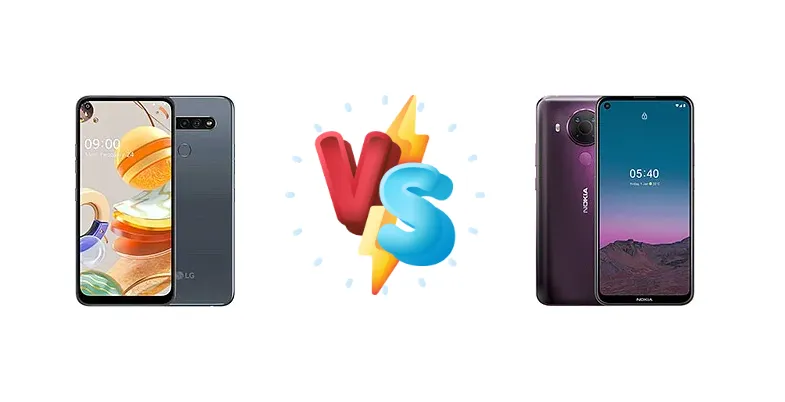
The LG K61 and Nokia 5.4 represent two approaches to the budget smartphone market. The K61, released earlier, relies on MediaTek's Helio P35, while the Nokia 5.4 adopts Qualcomm's Snapdragon 662. This comparison dissects the architectural differences and real-world implications of these chipsets, helping you determine which device delivers the best experience for your needs.
🏆 Quick Verdict
For most users, the Nokia 5.4 is the superior choice. The Snapdragon 662, built on an 11nm process, offers a noticeable performance advantage over the LG K61’s 12nm Helio P35, translating to smoother multitasking and a more responsive user experience. While both phones target the budget segment, the Nokia 5.4 provides a more future-proof platform.
| Network |
|---|
| 2G bands | GSM 850 / 900 / 1800 / 1900 | GSM 850 / 900 / 1800 / 1900 |
| 3G bands | HSDPA 850 / 900 / 1900 / 2100 | HSDPA 850 / 900 / 1900 / 2100 - International |
| 4G bands | 1, 3, 5, 7, 8, 20, 28, 38, 39, 40 | 1, 3, 5, 7, 8, 20, 28, 38, 40, 41 - International |
| Speed | HSPA 42.2/5.76 Mbps, LTE (2CA) Cat6 300/50 Mbps | HSPA 42.2/5.76 Mbps, LTE Cat4 150/50 Mbps |
| Technology | GSM / HSPA / LTE | GSM / HSPA / LTE |
| | - | 1, 2, 3, 4, 5, 7, 8, 12, 13, 17, 28, 66 - NA, LATAM |
| Launch |
|---|
| Announced | 2020, February 18. Released 2020, April 27 | 2020, December 15. Released 2020, December 25 |
| Status | Discontinued | Discontinued |
| Body |
|---|
| Dimensions | 164.5 x 77.5 x 8.4 mm (6.48 x 3.05 x 0.33 in) | 161 x 76 x 8.7 mm (6.34 x 2.99 x 0.34 in) |
| SIM | · Nano-SIM· Nano-SIM + Nano-SIM | · Nano-SIM· Nano-SIM + Nano-SIM |
| Weight | 191 g (6.74 oz) | 181 g (6.38 oz) |
| | MIL-STD-810G compliant*
*does not guarantee ruggedness or use in extreme conditions | - |
| Display |
|---|
| Protection | Scratch-resistant glass | - |
| Resolution | 1080 x 2340 pixels, 19.5:9 ratio (~394 ppi density) | 720 x 1560 pixels, 19.5:9 ratio (~269 ppi density) |
| Size | 6.53 inches, 105.2 cm2 (~82.5% screen-to-body ratio) | 6.39 inches, 100.2 cm2 (~81.9% screen-to-body ratio) |
| Type | IPS LCD | IPS LCD, 400 nits (typ) |
| Platform |
|---|
| CPU | Octa-core (4x2.3 GHz Cortex-A53 & 4x1.8 GHz Cortex-A53) | Octa-core (4x2.0 GHz Kryo 260 Gold & 4x1.8 GHz Kryo 260 Silver) |
| Chipset | Mediatek MT6765 Helio P35 (12 nm) | Qualcomm SM6115 Snapdragon 662 (11 nm) |
| GPU | PowerVR GE8320 | Adreno 610 |
| OS | Android 9.0 (Pie) | Android 10, upgradable to Android 12 |
| Memory |
|---|
| Card slot | microSDXC (dedicated slot) | microSDXC (dedicated slot) |
| Internal | 64GB 4GB RAM, 128GB 4GB RAM | 64GB 4GB RAM, 64GB 6GB RAM, 128GB 4GB RAM |
| Main Camera |
|---|
| Features | LED flash, panorama, HDR | LED flash, HDR, panorama |
| Quad | 48 MP, f/1.8, 26mm (wide), 1/2.0", 0.8µm, PDAF
8 MP, f/2.2, 118˚, (ultrawide)
2 MP (macro)
Auxiliary lens | 48 MP, f/1.8, (wide), PDAF
5 MP, 13mm (ultrawide)
2 MP (macro)
Auxiliary lens |
| Video | 1080p@30fps | 1080p@30fps |
| Selfie camera |
|---|
| Single | 16 MP | 16 MP, f/2.0, (wide) |
| Video | 1080p@30fps | 1080p@30fps |
| Sound |
|---|
| 3.5mm jack | Yes | Yes |
| 35mm jack | Yes | Yes |
| Loudspeaker | Yes | Yes |
| Comms |
|---|
| Bluetooth | 5.0, A2DP, LE | 4.2, A2DP, aptX Adaptive |
| NFC | Yes | Yes (market/region dependent) |
| Positioning | GPS | GPS, GLONASS, GALILEO, BDS |
| Radio | No | FM radio |
| USB | USB Type-C 2.0 | USB Type-C 2.0, OTG |
| WLAN | Wi-Fi 802.11 b/g/n, Wi-Fi Direct, DLNAorWi-Fi 802.11 a/b/g/n/ac, dual-band, Wi-Fi Direct, DNLA | Wi-Fi 802.11 b/g/n |
| Features |
|---|
| Sensors | Fingerprint (rear-mounted), accelerometer, gyro, proximity, compass | Fingerprint (rear-mounted), accelerometer, gyro, proximity |
| Battery |
|---|
| Charging | - | 10W wired |
| Type | Li-Po 4000 mAh | Li-Po 4000 mAh |
| Misc |
|---|
| Colors | Titanium, White, Blue | Polar Night, Dusk |
| Models | LMQ630EAW, LM-Q630EAW, LM-Q630 | TA-1333, TA-1340, TA-1337, TA-1328, TA-1325 |
| Price | About 300 EUR | About 90 EUR |
| SAR | - | 0.68 W/kg (head) 1.02 W/kg (body) |
| SAR EU | - | 0.99 W/kg (head) 0.96 W/kg (body) |
LG K61
- Potentially lower purchase price
- Simple and straightforward user experience
- May have slightly faster peak CPU clock speeds (though not impactful)
- Less powerful and efficient chipset
- Slower app loading times and multitasking
- Inferior camera image processing
Nokia 5.4
- More powerful and efficient Snapdragon 662 chipset
- Smoother multitasking and app performance
- Better camera image processing capabilities
- Potentially longer battery life
- May be slightly more expensive
- 10W charging is relatively slow
- Software updates may be less frequent than some competitors
Display Comparison
Neither LG nor Nokia provided display specs beyond resolution in the source data. However, given the price points, both likely utilize IPS LCD panels. The key difference lies under the hood. The Snapdragon 662’s ISP supports better image signal processing, potentially improving camera performance even with similar sensors. The Nokia 5.4’s chipset is more capable of handling higher refresh rates, though neither phone is confirmed to have this feature. Bezels are likely comparable, typical of this market segment.
Camera Comparison
Without sensor details, a direct camera comparison is difficult. However, the Snapdragon 662’s image signal processor (ISP) provides a distinct advantage. Qualcomm’s ISP excels at noise reduction, dynamic range optimization, and faster image processing speeds. This means the Nokia 5.4 will likely produce more detailed and vibrant photos, especially in challenging lighting conditions. The LG K61’s Helio P35 ISP is less sophisticated, potentially resulting in softer images and less accurate colors. The presence of a more capable ISP in the Nokia 5.4 also suggests better video recording capabilities.
Performance
The Qualcomm Snapdragon 662 (11nm) in the Nokia 5.4 represents a significant architectural leap over the MediaTek Helio P35 (12nm) found in the LG K61. The Snapdragon 662 utilizes Kryo 260 Gold and Silver cores, offering a more efficient and balanced approach to performance. While both are octa-core CPUs, the Snapdragon’s cores are clocked slightly higher (2.0 GHz vs 2.3 GHz on the K61’s faster cores) and benefit from a smaller manufacturing process, resulting in better power efficiency and sustained performance. The Helio P35’s Cortex-A53 cores, while adequate for basic tasks, will struggle with more demanding applications and multitasking. This translates to a noticeably snappier experience on the Nokia 5.4.
Battery Life
Battery capacity isn't specified for either device. However, the Snapdragon 662’s 11nm process offers superior power efficiency compared to the Helio P35’s 12nm process. This means the Nokia 5.4 will likely achieve longer battery life on a single charge, even with a similar battery capacity. The Nokia 5.4 includes 10W wired charging, which is standard for this price range. The LG K61’s charging speed is unknown, but is likely similar. The efficiency gains of the Snapdragon 662 will be more noticeable during prolonged use, such as video streaming or gaming.
Buying Guide
Buy the LG K61 if you prioritize a potentially lower upfront cost and are primarily focused on basic smartphone tasks like calling, texting, and light social media use. Buy the Nokia 5.4 if you value smoother performance, a more efficient chipset, and a slightly more modern software experience, even if it means spending a bit more. The Nokia 5.4 is the better option for users who occasionally play mobile games or use demanding applications.
Frequently Asked Questions
❓ Will the Nokia 5.4 handle popular games like PUBG Mobile smoothly?
The Snapdragon 662 in the Nokia 5.4 is capable of running PUBG Mobile, but likely at medium graphics settings. The Helio P35 in the LG K61 will struggle with consistent frame rates, even on the lowest settings. Expect a more enjoyable gaming experience on the Nokia 5.4.
❓ How much of a difference will the chipset make for everyday tasks like browsing and social media?
The difference will be noticeable. The Snapdragon 662’s more efficient architecture will result in faster app loading times, smoother scrolling, and a more responsive overall experience when browsing the web or using social media apps. The LG K61’s Helio P35 may exhibit occasional lag or stuttering.
❓ Is the 10W charging on the Nokia 5.4 a significant drawback?
10W charging is relatively slow by today’s standards, but it’s typical for phones in this price range. The Nokia 5.4’s more efficient chipset will help offset the slower charging speed by maximizing battery life, meaning you won’t need to charge it as frequently.