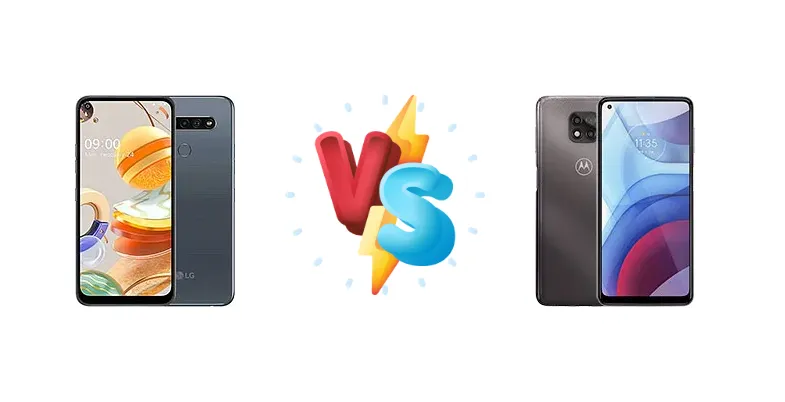
The LG K61 and Motorola Moto G Power (2021) represent two approaches to the budget smartphone market. The K61, released earlier, aimed for a balance of features at a competitive price. The Moto G Power (2021) doubled down on battery life and a more modern chipset, making a direct comparison crucial for budget-conscious buyers.
🏆 Quick Verdict
For the average user, the Motorola Moto G Power (2021) is the better choice. Its Qualcomm Snapdragon 662 chipset, built on an 11nm process, offers a noticeable performance and efficiency advantage over the LG K61’s MediaTek Helio P35, resulting in smoother multitasking and potentially longer battery life despite similar capacities.
| Network |
|---|
| 2G bands | GSM 850 / 900 / 1800 / 1900 | GSM 850 / 900 / 1800 / 1900 |
| 3G bands | HSDPA 850 / 900 / 1900 / 2100 | HSDPA 850 / 900 / 1700(AWS) / 1900 / 2100 |
| 4G bands | 1, 3, 5, 7, 8, 20, 28, 38, 39, 40 | 1, 2, 3, 4, 5, 7, 8, 12, 13, 14, 17, 25, 26, 29, 30, 38, 41, 66, 71 |
| Speed | HSPA 42.2/5.76 Mbps, LTE (2CA) Cat6 300/50 Mbps | HSPA, LTE |
| Technology | GSM / HSPA / LTE | GSM / CDMA / HSPA / EVDO / LTE |
| | - | CDMA2000 1xEV-DO |
| Launch |
|---|
| Announced | 2020, February 18. Released 2020, April 27 | 2021, January 08 |
| Status | Discontinued | Available. Released 2021, January 14 |
| Body |
|---|
| Build | - | Glass front, plastic back, plastic frame |
| Dimensions | 164.5 x 77.5 x 8.4 mm (6.48 x 3.05 x 0.33 in) | 165.3 x 75.9 x 9.5 mm (6.51 x 2.99 x 0.37 in) |
| SIM | · Nano-SIM· Nano-SIM + Nano-SIM | Nano-SIM |
| Weight | 191 g (6.74 oz) | 206.5 g (7.30 oz) |
| | MIL-STD-810G compliant*
*does not guarantee ruggedness or use in extreme conditions | Water-repellent coating |
| Display |
|---|
| Protection | Scratch-resistant glass | - |
| Resolution | 1080 x 2340 pixels, 19.5:9 ratio (~394 ppi density) | 720 x 1600 pixels, 20:9 ratio (~266 ppi density) |
| Size | 6.53 inches, 105.2 cm2 (~82.5% screen-to-body ratio) | 6.6 inches, 105.2 cm2 (~83.8% screen-to-body ratio) |
| Type | IPS LCD | IPS LCD |
| Platform |
|---|
| CPU | Octa-core (4x2.3 GHz Cortex-A53 & 4x1.8 GHz Cortex-A53) | Octa-core (4x2.0 GHz Kryo 260 Gold & 4x1.8 GHz Kryo 260 Silver) |
| Chipset | Mediatek MT6765 Helio P35 (12 nm) | Qualcomm SM6115 Snapdragon 662 (11 nm) |
| GPU | PowerVR GE8320 | Adreno 610 |
| OS | Android 9.0 (Pie) | Android 10 |
| Memory |
|---|
| Card slot | microSDXC (dedicated slot) | microSDXC (dedicated slot) |
| Internal | 64GB 4GB RAM, 128GB 4GB RAM | 32GB 3GB RAM, 64GB 4GB RAM |
| | - | eMMC 5.1 |
| Main Camera |
|---|
| Features | LED flash, panorama, HDR | LED flash, HDR, panorama |
| Quad | 48 MP, f/1.8, 26mm (wide), 1/2.0", 0.8µm, PDAF
8 MP, f/2.2, 118˚, (ultrawide)
2 MP (macro)
Auxiliary lens | - |
| Triple | - | 48 MP, f/1.7, (wide), 1/2.0", 0.8µm, PDAF
2 MP (macro)
Auxiliary lens |
| Video | 1080p@30fps | 1080p@30/60fps, gyro-EIS |
| Selfie camera |
|---|
| Features | - | HDR |
| Single | 16 MP | 8 MP, f/2.0, 1.12µm |
| Video | 1080p@30fps | 1080p@30fps, gyro-EIS |
| Sound |
|---|
| 3.5mm jack | Yes | Yes |
| 35mm jack | Yes | Yes |
| Loudspeaker | Yes | Yes |
| Comms |
|---|
| Bluetooth | 5.0, A2DP, LE | 5.0, A2DP, LE |
| NFC | Yes | No |
| Positioning | GPS | GPS, GLONASS, GALILEO |
| Radio | No | FM radio |
| USB | USB Type-C 2.0 | USB Type-C 2.0 |
| WLAN | Wi-Fi 802.11 b/g/n, Wi-Fi Direct, DLNAorWi-Fi 802.11 a/b/g/n/ac, dual-band, Wi-Fi Direct, DNLA | Wi-Fi 802.11 a/b/g/n/ac, dual-band, Wi-Fi Direct |
| Features |
|---|
| Sensors | Fingerprint (rear-mounted), accelerometer, gyro, proximity, compass | Fingerprint (side-mounted), accelerometer, gyro, proximity, compass, barometer |
| Battery |
|---|
| Charging | - | 15W wired |
| Type | Li-Po 4000 mAh | Li-Po 5000 mAh |
| Misc |
|---|
| Colors | Titanium, White, Blue | Flash Gray, Polar Silver |
| Models | LMQ630EAW, LM-Q630EAW, LM-Q630 | - |
| Price | About 300 EUR | About 60 EUR |
LG K61
- Potentially lower price point
- LG's color science may appeal to some users
- May be easier to find on clearance
- Inferior chipset performance (Helio P35)
- Less efficient processor leading to shorter battery life
- Likely slower software updates and support
Motorola Moto G Power (2021)
- More powerful and efficient Snapdragon 662 chipset
- 15W fast charging support
- Better long-term software support from Motorola
- May be slightly more expensive than the LG K61
- Motorola's software can include bloatware
- Display quality is likely similar to the LG K61
Display Comparison
Neither device boasts a standout display. Both likely utilize IPS LCD panels, common in this price bracket. However, detailed specs like resolution and peak brightness are missing. The K61’s display is likely tuned for vibrant colors, typical of LG’s displays, while Motorola generally aims for more accurate color reproduction. Without specific nit ratings, it’s difficult to determine which offers better outdoor visibility. Bezels are expected to be relatively thick on both devices, reflecting their budget positioning.
Camera Comparison
Camera performance is difficult to assess without detailed sensor information. Both phones likely feature a multi-camera setup, but the quality will depend heavily on the primary sensor and image processing. Given the market segment, we can assume both will struggle in low-light conditions. The Moto G Power (2021) *may* have a slight edge due to Qualcomm’s image signal processor (ISP) capabilities, which are generally more advanced than MediaTek’s offerings at this price point. Any 2MP macro or depth sensors on either device should be considered marketing features rather than significant contributors to image quality.
Performance
The core difference lies in the chipsets. The Motorola Moto G Power (2021) features the Qualcomm Snapdragon 662 (11nm), a significant upgrade over the LG K61’s MediaTek Helio P35 (12nm). The Snapdragon 662’s Kryo 260 cores, while also utilizing an octa-core configuration, benefit from Qualcomm’s architectural advantages and the more efficient 11nm manufacturing process. This translates to better sustained performance under load and improved power efficiency. The Helio P35, while capable for basic tasks, will struggle with demanding applications and multitasking. The Snapdragon 662 will provide a smoother experience for gaming and app switching.
Battery Life
Both devices likely feature batteries in the 5000mAh range, a common capacity for maximizing battery life in budget phones. However, the Snapdragon 662’s superior efficiency in the Moto G Power (2021) will likely result in longer real-world usage. The Moto G Power (2021) also includes 15W wired charging, a feature absent or slower on the LG K61, allowing for faster top-ups when needed. While both will easily last a full day for moderate users, the Moto G Power (2021) offers a more comfortable buffer and quicker charging.
Buying Guide
Buy the LG K61 if you prioritize finding the absolute lowest price and are willing to accept compromises in performance and software support. It's a viable option for basic tasks like calling, texting, and light social media. Buy the Motorola Moto G Power (2021) if you value a more responsive user experience, better long-term software support from Motorola, and the peace of mind that comes with a more efficient chipset and 15W charging.
Frequently Asked Questions
❓ Will the Moto G Power (2021) handle demanding games like PUBG Mobile?
The Snapdragon 662 in the Moto G Power (2021) can run PUBG Mobile, but you'll likely need to lower the graphics settings to medium or low for a smooth experience. The Helio P35 in the LG K61 will struggle significantly with PUBG, even on the lowest settings.
❓ How much faster is the charging on the Moto G Power (2021) compared to the LG K61?
The Moto G Power (2021) supports 15W charging, while the LG K61 likely has slower charging speeds (potentially 10W or less). This means the Moto G Power (2021) will charge significantly faster, reducing downtime and getting you back up and running quicker.
❓ Does the Snapdragon 662 offer noticeable improvements in multitasking compared to the Helio P35?
Yes, the Snapdragon 662 provides a substantial improvement in multitasking. The more efficient CPU architecture and better memory management will allow you to switch between apps more smoothly and run more apps in the background without slowdowns, something the Helio P35 will struggle with.