
Google Pixel 4a 5G vs. LG K61: A Performance and Value Showdown
| Phones Images | |||||
|---|---|---|---|---|---|
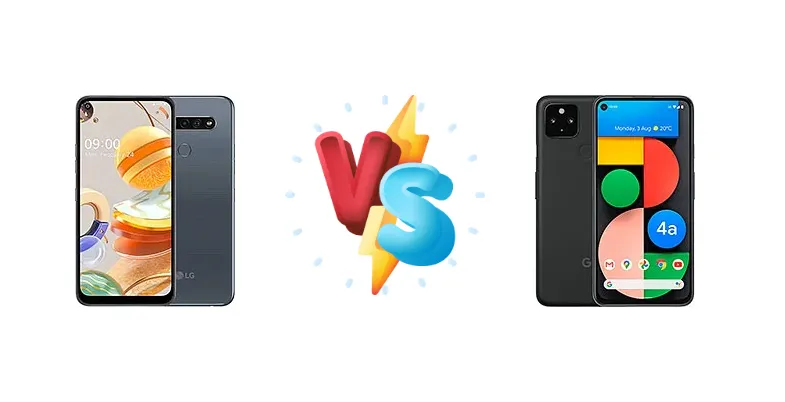
|
🏆 Quick Verdict
For most users, the Google Pixel 4a 5G is the clear winner. Its Snapdragon 765G chipset delivers significantly superior performance, a better camera experience, and 5G connectivity, justifying the price premium over the LG K61's aging Helio P35. The K61 remains an option for extremely budget-conscious buyers.
| PHONES | ||
|---|---|---|
| Phone Names | LG K61 | Google Pixel 4a 5G |
| Network | ||
|---|---|---|
| 2G bands | GSM 850 / 900 / 1800 / 1900 | GSM 850 / 900 / 1800 / 1900 |
| 3G bands | HSDPA 850 / 900 / 1900 / 2100 | HSDPA 850 / 900 / 1700(AWS) / 1900 / 2100 |
| 4G bands | 1, 3, 5, 7, 8, 20, 28, 38, 39, 40 | 1, 2, 3, 4, 5, 7, 8, 12, 13, 14, 17, 18, 19, 20, 25, 26, 28, 29, 30, 32, 38, 39, 40, 41, 42, 46, 48, 66, 71 |
| 5G bands | - | 1, 2, 3, 5, 7, 8, 12, 28, 41, 66, 71, 77, 78 Sub6, mmWave (market dependant) |
| Speed | HSPA 42.2/5.76 Mbps, LTE (2CA) Cat6 300/50 Mbps | HSPA, LTE, 5G |
| Technology | GSM / HSPA / LTE | GSM / HSPA / LTE / 5G |
| Launch | ||
|---|---|---|
| Announced | 2020, February 18. Released 2020, April 27 | 2020, September 30 |
| Status | Discontinued | Available. Released 2020, November 05 |
| Body | ||
|---|---|---|
| Build | - | Glass front (Gorilla Glass 3), plastic back, plastic frame |
| Dimensions | 164.5 x 77.5 x 8.4 mm (6.48 x 3.05 x 0.33 in) | 153.9 x 74 x 8.2 mm (Sub-6) or 8.5 mm (Sub-6 and mmWave) |
| SIM | · Nano-SIM· Nano-SIM + Nano-SIM | Nano-SIM + eSIM |
| Weight | 191 g (6.74 oz) | 168 g (5G Sub-6); 171 g ( 5G Sub-6 and mmWave) (5.93 oz) |
| MIL-STD-810G compliant* *does not guarantee ruggedness or use in extreme conditions | - | |
| Display | ||
|---|---|---|
| Protection | Scratch-resistant glass | Corning Gorilla Glass 3 |
| Resolution | 1080 x 2340 pixels, 19.5:9 ratio (~394 ppi density) | 1080 x 2340 pixels, 19.5:9 ratio (~413 ppi density) |
| Size | 6.53 inches, 105.2 cm2 (~82.5% screen-to-body ratio) | 6.2 inches, 95.7 cm2 (~84.1% screen-to-body ratio) |
| Type | IPS LCD | OLED, HDR |
| - | Always-on display | |
| Platform | ||
|---|---|---|
| CPU | Octa-core (4x2.3 GHz Cortex-A53 & 4x1.8 GHz Cortex-A53) | Octa-core (1x2.4 GHz Kryo 475 Prime & 1x2.2 GHz Kryo 475 Gold & 6x1.8 GHz Kryo 475 Silver) |
| Chipset | Mediatek MT6765 Helio P35 (12 nm) | Qualcomm SM7250 Snapdragon 765G 5G (7 nm) |
| GPU | PowerVR GE8320 | Adreno 620 |
| OS | Android 9.0 (Pie) | Android 11, upgradable to Android 14 |
| Memory | ||
|---|---|---|
| Card slot | microSDXC (dedicated slot) | No |
| Internal | 64GB 4GB RAM, 128GB 4GB RAM | 128GB 6GB RAM |
| - | UFS 2.1 | |
| Main Camera | ||
|---|---|---|
| Dual | - | 12.2 MP, f/1.7, 27mm (wide), 1/2.55", 1.4µm, dual pixel PDAF, OIS 16 MP, f/2.2, 107˚ (ultrawide), 1.0µm |
| Features | LED flash, panorama, HDR | LED flash, Pixel Shift, Auto-HDR, panorama |
| Quad | 48 MP, f/1.8, 26mm (wide), 1/2.0", 0.8µm, PDAF 8 MP, f/2.2, 118˚, (ultrawide) 2 MP (macro) Auxiliary lens | - |
| Video | 1080p@30fps | 4K@30/60fps, 1080p@30/60/120/240fps; gyro-EIS |
| Selfie camera | ||
|---|---|---|
| Features | - | HDR |
| Single | 16 MP | 8 MP, f/2.0, 24mm (wide), 1/4.0", 1.12µm |
| Video | 1080p@30fps | 1080p@30fps |
| Sound | ||
|---|---|---|
| 3.5mm jack | Yes | Yes |
| 35mm jack | Yes | Yes |
| Loudspeaker | Yes | Yes, with stereo speakers |
| Comms | ||
|---|---|---|
| Bluetooth | 5.0, A2DP, LE | 5.0, A2DP, LE, aptX HD |
| NFC | Yes | Yes |
| Positioning | GPS | GPS, GLONASS, GALILEO, QZSS, BDS |
| Radio | No | No |
| USB | USB Type-C 2.0 | USB Type-C 3.1 |
| WLAN | Wi-Fi 802.11 b/g/n, Wi-Fi Direct, DLNAorWi-Fi 802.11 a/b/g/n/ac, dual-band, Wi-Fi Direct, DNLA | Wi-Fi 802.11 a/b/g/n/ac, dual-band, Wi-Fi Direct |
| Features | ||
|---|---|---|
| Sensors | Fingerprint (rear-mounted), accelerometer, gyro, proximity, compass | Fingerprint (rear-mounted), accelerometer, gyro, proximity, compass, barometer |
| Battery | ||
|---|---|---|
| Charging | - | 18W wired, PD2.0 |
| Type | Li-Po 4000 mAh | Li-Po 3885 mAh |
| Misc | ||
|---|---|---|
| Colors | Titanium, White, Blue | Just Black, Clearly White |
| Models | LMQ630EAW, LM-Q630EAW, LM-Q630 | GD1YQ, G025I, G025E, G025H, G6QU3 |
| Price | About 300 EUR | About 140 EUR |
LG K61
- Significantly faster performance with Snapdragon 765G
- Superior camera quality and image processing
- 5G connectivity for faster data speeds
- Faster charging with 18W PD2.0
- Higher price point than the LG K61
- May not have expandable storage (data not provided)
Google Pixel 4a 5G
- More affordable price
- Potentially larger battery capacity (estimated)
- Simple and straightforward user experience
- May include a headphone jack (market assumption)
- Slow performance with Helio P35 chipset
- Inferior camera quality
- Lacks 5G connectivity
- Limited software support and updates
Display Comparison
While both devices likely feature LCD panels (data not provided), the overall experience will differ. The LG K61's display resolution is unknown, but given its price point, it's likely 1080p or lower. The Pixel 4a 5G boasts a 6.6-inch FHD+ display. More importantly, the Pixel 4a 5G benefits from the superior image processing capabilities of the Snapdragon 765G, resulting in more accurate colors and better contrast. The K61's Helio P35 lacks the processing power for advanced display enhancements.
Camera Comparison
The Pixel 4a 5G is expected to excel in camera performance, leveraging Google’s renowned computational photography. While specific sensor details aren't provided, the Snapdragon 765G’s image signal processor (ISP) is far more capable than the ISP found in the Helio P35. The Pixel’s ISP enables features like Night Sight and HDR+, delivering excellent low-light performance and dynamic range. The LG K61 will likely produce acceptable photos in good lighting conditions, but will struggle in challenging scenarios. The Pixel 4a 5G also benefits from 5G connectivity for faster cloud uploads of high-resolution images.
Performance
The performance gap is the most significant differentiator. The Google Pixel 4a 5G’s Qualcomm Snapdragon 765G (7nm) is a substantial upgrade over the LG K61’s MediaTek Helio P35 (12nm). The 7nm process node allows for greater transistor density and improved power efficiency. The Snapdragon 765G’s octa-core CPU, with its Kryo 475 cores (1x2.4 GHz Prime, 1x2.2 GHz Gold, 6x1.8 GHz Silver), offers a more sophisticated architecture than the K61’s Cortex-A53 based CPU (4x2.3 GHz & 4x1.8 GHz). This translates to faster app loading times, smoother multitasking, and a more responsive user interface on the Pixel. The K61 will struggle with demanding applications and games.
Battery Life
Battery life is a complex equation. While the LG K61 may have a larger battery capacity (data not provided, but likely in the 4000mAh range based on market segment), the Pixel 4a 5G’s more efficient Snapdragon 765G chipset and 18W PD2.0 charging will likely result in comparable, or even better, real-world battery performance. The 7nm process node of the Snapdragon contributes to lower power consumption. The Pixel 4a 5G’s faster charging will also reduce downtime.
Buying Guide
Buy the LG K61 if you prioritize absolute affordability and basic smartphone functionality, and are willing to compromise on performance and future-proofing. You'll be satisfied with calls, texts, and light social media use. Buy the Google Pixel 4a 5G if you value a smooth user experience, capable camera, 5G connectivity, and longer software support, even if it means spending a bit more upfront.