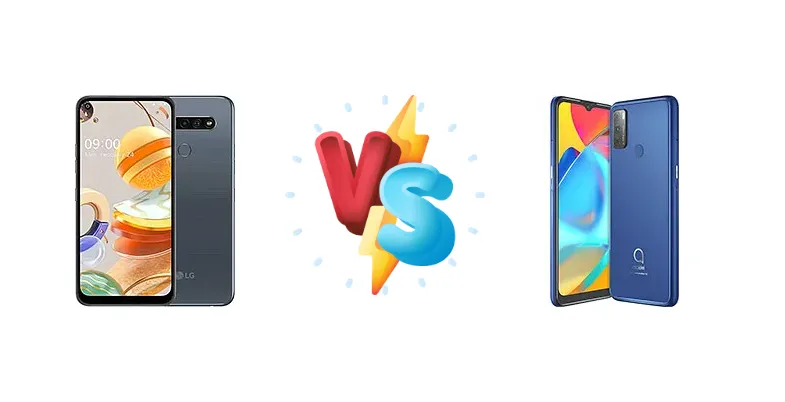
The LG K61 and the alcatel 3L (2021) represent the lower end of the Android smartphone market, targeting users prioritizing affordability. However, even within this segment, key differences exist. This comparison focuses on the core performance and usability distinctions stemming from their respective Mediatek Helio P35 and Helio P22 chipsets, helping you determine which device delivers the most value.
🏆 Quick Verdict
For the average user, the LG K61 emerges as the slightly better choice. Its Helio P35 chipset, with higher CPU clock speeds, provides a noticeable performance edge in everyday tasks and light multitasking, making it more responsive than the alcatel 3L (2021). While both phones are budget-focused, the K61 offers a smoother user experience.
| Network |
|---|
| 2G bands | GSM 850 / 900 / 1800 / 1900 | GSM 850 / 900 / 1800 / 1900 |
| 3G bands | HSDPA 850 / 900 / 1900 / 2100 | HSDPA 850 / 900 / 1900 / 2100 |
| 4G bands | 1, 3, 5, 7, 8, 20, 28, 38, 39, 40 | 1, 3, 7, 8, 20, 28 |
| Speed | HSPA 42.2/5.76 Mbps, LTE (2CA) Cat6 300/50 Mbps | HSPA 42.2/5.76 Mbps, LTE Cat4 150/50 Mbps |
| Technology | GSM / HSPA / LTE | GSM / HSPA / LTE |
| Launch |
|---|
| Announced | 2020, February 18. Released 2020, April 27 | 2021, January 12 |
| Status | Discontinued | Available. Released 2021, April 26 |
| Body |
|---|
| Build | - | Glass front, plastic back, plastic frame |
| Dimensions | 164.5 x 77.5 x 8.4 mm (6.48 x 3.05 x 0.33 in) | 165.6 x 75.6 x 8.7 mm (6.52 x 2.98 x 0.34 in) |
| SIM | · Nano-SIM· Nano-SIM + Nano-SIM | · Nano-SIM· Nano-SIM + Nano-SIM |
| Weight | 191 g (6.74 oz) | 194 g (6.84 oz) |
| | MIL-STD-810G compliant*
*does not guarantee ruggedness or use in extreme conditions | - |
| Display |
|---|
| Protection | Scratch-resistant glass | - |
| Resolution | 1080 x 2340 pixels, 19.5:9 ratio (~394 ppi density) | 720 x 1600 pixels, 20:9 ratio (~269 ppi density) |
| Size | 6.53 inches, 105.2 cm2 (~82.5% screen-to-body ratio) | 6.52 inches, 102.6 cm2 (~82.0% screen-to-body ratio) |
| Type | IPS LCD | IPS LCD |
| Platform |
|---|
| CPU | Octa-core (4x2.3 GHz Cortex-A53 & 4x1.8 GHz Cortex-A53) | Octa-core (4x1.8 GHz Cortex-A53 & 4x1.5 GHz Cortex-A53) |
| Chipset | Mediatek MT6765 Helio P35 (12 nm) | Mediatek MT6762D Helio P22 (12 nm) |
| GPU | PowerVR GE8320 | PowerVR GE8320 |
| OS | Android 9.0 (Pie) | Android 11 |
| Memory |
|---|
| Card slot | microSDXC (dedicated slot) | microSDXC (only single sim model) |
| Internal | 64GB 4GB RAM, 128GB 4GB RAM | 64GB 4GB RAM |
| | - | eMMC 5.1 |
| Main Camera |
|---|
| Features | LED flash, panorama, HDR | LED flash, HDR, panorama |
| Quad | 48 MP, f/1.8, 26mm (wide), 1/2.0", 0.8µm, PDAF
8 MP, f/2.2, 118˚, (ultrawide)
2 MP (macro)
Auxiliary lens | - |
| Triple | - | 48 MP, f/1.8, 26mm (wide), 1/2.0", 0.8µm, PDAF
2 MP (macro)
Auxiliary lens |
| Video | 1080p@30fps | 1080p@30fps |
| Selfie camera |
|---|
| Features | - | HDR |
| Single | 16 MP | 8 MP, f/2.0, 26mm (wide), 1/4.0", 1.12µm |
| Video | 1080p@30fps | 1080p@30fps |
| Sound |
|---|
| 3.5mm jack | Yes | Yes |
| 35mm jack | Yes | Yes |
| Loudspeaker | Yes | Yes |
| Comms |
|---|
| Bluetooth | 5.0, A2DP, LE | 5.0, A2DP, LE |
| NFC | Yes | Yes |
| Positioning | GPS | GPS, GLONASS, GALILEO, BDS |
| Radio | No | FM radio |
| USB | USB Type-C 2.0 | microUSB 2.0, OTG |
| WLAN | Wi-Fi 802.11 b/g/n, Wi-Fi Direct, DLNAorWi-Fi 802.11 a/b/g/n/ac, dual-band, Wi-Fi Direct, DNLA | Wi-Fi 802.11 b/g/n, Wi-Fi Direct |
| Features |
|---|
| Sensors | Fingerprint (rear-mounted), accelerometer, gyro, proximity, compass | Fingerprint (rear-mounted), accelerometer, proximity, compass |
| Battery |
|---|
| Charging | - | 10W wired |
| Type | Li-Po 4000 mAh | Li-Po 4000 mAh |
| Misc |
|---|
| Colors | Titanium, White, Blue | Jewelry Blue, Jewelry Black |
| Models | LMQ630EAW, LM-Q630EAW, LM-Q630 | 6056D |
| Price | About 300 EUR | About 330 EUR |
LG K61
- More powerful Helio P35 chipset for smoother performance
- Higher CPU clock speeds for faster app loading
- Potentially better image processing capabilities
- Charging speed is unknown
- Likely similar display quality to the alcatel 3L
alcatel 3L (2021)
- 10W wired charging for consistent power replenishment
- Extremely affordable price point
- Simple and straightforward user experience
- Less powerful Helio P22 chipset
- Lower CPU clock speeds resulting in slower performance
- Similar camera performance to the LG K61
Display Comparison
Neither LG nor Alcatel provide detailed display specifications for these models. Given their price point, it's safe to assume both utilize IPS LCD panels with 720p+ resolutions. The focus here isn't display quality, but rather the impact of the chipset on rendering UI elements smoothly. The K61's more powerful GPU, derived from the Helio P35, will likely contribute to slightly smoother scrolling and animations, even if the panels themselves are similar.
Camera Comparison
Detailed camera specs are scarce for both devices. However, given their market positioning, image quality will likely be similar. Both will struggle in low-light conditions. The K61 *may* benefit from slightly better image signal processing (ISP) capabilities within the Helio P35, potentially leading to marginally better dynamic range and noise reduction. However, this is speculative without detailed camera sensor information. The presence of a 2MP macro lens on both devices is largely a marketing gimmick and shouldn't be a deciding factor.
Performance
The core difference lies in the chipsets. The LG K61’s Mediatek Helio P35 features an octa-core CPU clocked up to 2.3 GHz, utilizing four Cortex-A53 cores at this speed and another four at 1.8 GHz. The alcatel 3L (2021) uses the Helio P22, also octa-core, but with a lower peak clock speed of 1.8 GHz and 1.5 GHz for its respective core groupings. This 500 MHz difference in peak clock speed translates to a tangible performance advantage for the K61 in CPU-bound tasks. While both use the same Cortex-A53 architecture, the higher clock speeds on the K61 allow it to process instructions faster. The P35 also has a slightly more capable IMG PowerVR GE8320 GPU compared to the P22’s GE8320, further enhancing the K61’s graphical performance.
Battery Life
Battery capacity is not specified for either device. However, the alcatel 3L (2021) supports 10W wired charging, while the LG K61’s charging speed is unknown but likely similar. Given the lower processing demands of typical usage scenarios for these phones, battery life will likely be comparable – a full day of light use is achievable on both. The 10W charging on the alcatel 3L provides a consistent, if slow, charging experience, while the K61’s charging speed remains a question mark.
Buying Guide
Buy the LG K61 if you need a phone that feels a bit more responsive for daily use, such as browsing, social media, and light app usage. The slightly more powerful processor will translate to fewer stutters and a more fluid experience. Buy the alcatel 3L (2021) if your primary concern is absolute affordability and you primarily need a device for basic communication – calls, texts, and minimal app usage. The 10W charging is a plus for those who prioritize consistent, albeit slow, power replenishment.
Frequently Asked Questions
❓ Will the LG K61 handle popular social media apps like Facebook and Instagram without significant lag?
Yes, the LG K61’s Helio P35 chipset should provide a reasonably smooth experience with social media apps. While not a powerhouse, the higher clock speeds compared to the alcatel 3L’s P22 will minimize lag during scrolling and app switching.
❓ Is the alcatel 3L (2021) suitable for playing mobile games?
The alcatel 3L (2021) is not ideal for gaming. The Helio P22 chipset is entry-level and will struggle with graphically demanding games. Simple, 2D games may be playable at low settings, but expect significant frame rate drops and lag in more complex titles.
❓ Does either phone support fast charging beyond 10W?
Neither phone officially supports fast charging beyond 10W. While the LG K61 *might* support slightly faster charging with a compatible charger, it's unlikely to be a significant improvement. Both are designed for slow and steady charging.