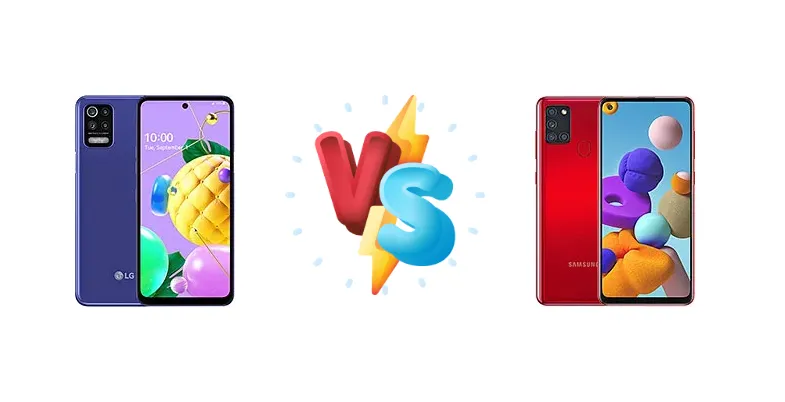
The LG K52 and Samsung Galaxy A21s represent two compelling options in the crowded budget smartphone market. While both aim to deliver essential features at an accessible price point, they take different approaches to achieving this. The K52 leans on a more established, if older, Mediatek chipset, while the A21s opts for Samsung’s in-house Exynos 850. This comparison will dissect the key differences to determine which device offers the best value.
🏆 Quick Verdict
For the average user prioritizing sustained performance and a slightly brighter display, the Samsung Galaxy A21s emerges as the better choice. Its Exynos 850, built on an 8nm process, offers a noticeable efficiency advantage over the K52’s 12nm Helio P35, translating to smoother multitasking and potentially longer gaming sessions. However, the K52 remains a viable option for basic usage.
| Network |
|---|
| 2G bands | GSM 850 / 900 / 1800 / 1900 | GSM 850 / 900 / 1800 / 1900 |
| 3G bands | HSDPA 850 / 900 / 1700(AWS) / 1900 / 2100 - International | HSDPA 850 / 900 / 1900 / 2100 |
| 4G bands | 1, 2, 3, 4, 5, 7, 8, 12, 13, 17, 28, 38, 66 - International | 1, 2, 3, 5, 7, 8, 20, 28, 38, 40, 41 |
| Speed | HSPA, LTE | HSPA, LTE |
| Technology | GSM / HSPA / LTE | GSM / HSPA / LTE |
| | 1, 3, 5, 7, 8, 20, 28, 38, 39, 40, 41 - Australia | - |
| Launch |
|---|
| Announced | 2020, September 23. Released 2020, November 23 | 2020, May 15. Released 2020, June 02 |
| Status | Discontinued | Discontinued |
| Body |
|---|
| Build | - | Glass front, plastic frame, plastic back |
| Dimensions | 165 x 76.7 x 8.4 mm (6.50 x 3.02 x 0.33 in) | 163.7 x 75.3 x 8.9 mm (6.44 x 2.96 x 0.35 in) |
| SIM | Nano-SIM + Nano-SIM | · Nano-SIM· Nano-SIM + Nano-SIM |
| Weight | 188 g (6.63 oz) | 192 g (6.77 oz) |
| | MIL-STD-810G compliant*
*does not guarantee ruggedness or use in extreme conditions | - |
| Display |
|---|
| Resolution | 720 x 1600 pixels, 20:9 ratio (~266 ppi density) | 720 x 1600 pixels, 20:9 ratio (~270 ppi density) |
| Size | 6.6 inches, 105.2 cm2 (~83.1% screen-to-body ratio) | 6.5 inches, 102.0 cm2 (~82.8% screen-to-body ratio) |
| Type | IPS LCD | PLS LCD |
| Platform |
|---|
| CPU | Octa-core (4x2.3 GHz Cortex-A53 & 4x1.8 GHz Cortex-A53) | Octa-core (4x2.0 GHz Cortex-A55 & 4x2.0 GHz Cortex-A55) |
| Chipset | Mediatek MT6765 Helio P35 (12 nm) | Exynos 850 (8 nm) |
| GPU | PowerVR GE8320 | Mali-G52 |
| OS | Android 10 | Android 10, upgradable to Android 12, One UI 4.1 |
| Memory |
|---|
| Card slot | microSDXC | microSDXC (dedicated slot) |
| Internal | 64GB 4GB RAM | 32GB 2GB RAM, 32GB 3GB RAM, 32GB 4GB RAM, 64GB 3GB RAM, 64GB 4GB RAM, 64GB 6GB RAM, 128GB 2GB RAM, 128GB 3GB RAM, 128GB 4/6GB RAM |
| | eMMC 5.1 | eMMC 5.1 |
| Main Camera |
|---|
| Features | Dual-LED flash, panorama, HDR | LED flash, panorama, HDR |
| Quad | 48 MP, f/1.8, 26mm (wide), 1/2.0", 0.8µm, PDAF
5 MP, f/2.2, 115˚ (ultrawide), 1/5.0", 1.12µm
2 MP (macro)
Auxiliary lens | 48 MP, f/2.0, 26mm (wide), 1/2.0", 0.8µm, PDAF
8 MP, f/2.2, 123˚ (ultrawide), 1/4.0", 1.12µm
2 MP (macro)
Auxiliary lens |
| Video | 1080p@30fps | 1080p@30fps |
| Selfie camera |
|---|
| Single | 13 MP, f/2.0, 27mm (wide), 1/3.1", 1.12µm | 13 MP, f/2.2, (wide), 1/3.1", 1.12µm |
| Video | 1080p@30fps | 1080p@30fps |
| Sound |
|---|
| 3.5mm jack | Yes | Yes |
| 35mm jack | Yes | Yes |
| Loudspeaker | Yes | Yes |
| Comms |
|---|
| Bluetooth | 5.0, A2DP, LE | 5.0, A2DP, LE |
| NFC | Yes | Yes (market/region dependent) |
| Positioning | GPS | GPS, GLONASS, GALILEO, BDS |
| Radio | No | FM radio, RDS, recording |
| USB | USB Type-C 3.1, OTG | USB Type-C 2.0 |
| WLAN | Wi-Fi 802.11 b/g/n or Wi-Fi 802.11 a/b/g/n/ac, dual-band | Wi-Fi 802.11 a/b/g/n/ac, dual-band, Wi-Fi Direct |
| Features |
|---|
| Sensors | Fingerprint (side-mounted), accelerometer, proximity, compass | Fingerprint (rear-mounted), accelerometer, gyro, proximity, compass |
| Battery |
|---|
| Charging | - | 15W wired |
| Type | Li-Po 4000 mAh | Li-Po 5000 mAh |
| Misc |
|---|
| Colors | White, Blue, Red | Black, White, Blue, Red |
| Models | LMK520, LM-K520, LMK520E, LM-K520E, LMK520Y, LM-K520Y, LMK520H, LM-K520H | SM-A217F, SM-A217F/DS, SM-A217F/DSN, SM-A217M, SM-A217M/DS, SM-A217N |
| Price | About 220 EUR | About 220 EUR |
| SAR EU | - | 0.42 W/kg (head) 1.54 W/kg (body) |
| Tests |
|---|
| Battery life | - | Endurance rating 119h |
| Camera | - |
Photo / Video |
| Display | - |
Contrast ratio: 1287:1 (nominal) |
| Loudspeaker | - |
-30.0 LUFS (Average) |
| Performance | - |
AnTuTu: 107157 (v8)
GeekBench: 1100 (v5.1)
GFXBench: 11fps (ES 3.1 onscreen) |
LG K52
- Potentially lower initial cost
- Decent battery endurance (119h)
- Suitable for basic smartphone tasks
- Older, less efficient chipset (Helio P35)
- Likely lower peak display brightness
- Potentially slower app loading times
Samsung Galaxy A21s
- More efficient chipset (Exynos 850)
- Brighter display (490 nits)
- Faster charging (15W)
- Smoother multitasking experience
- May be slightly more expensive
- Battery endurance rating is the same as K52
- Camera quality dependent on software processing
Display Comparison
The Samsung Galaxy A21s boasts a measured peak brightness of 490 nits, a significant advantage over the LG K52’s unspecified brightness. Both displays share a contrast ratio of 1287:1 (nominal), suggesting similar color reproduction capabilities. However, the A21s’ higher brightness makes it more usable outdoors in direct sunlight. While neither phone is expected to feature high refresh rate panels, the A21s’ superior brightness provides a more visually engaging experience overall.
Camera Comparison
Both devices offer 'Photo / Video' capabilities, but lack detailed camera specifications in the provided data. Given the market positioning, it’s reasonable to assume both feature a primary camera and potentially multiple secondary sensors. However, without sensor size or aperture information, a direct comparison is difficult. The presence of a 2MP macro camera on either device is unlikely to significantly impact image quality, serving primarily as a marketing feature. Image processing algorithms will likely be the differentiating factor, and Samsung generally offers more refined image processing in its A-series.
Performance
The core difference lies in the chipsets. The Samsung Galaxy A21s’ Exynos 850, fabricated on an 8nm process, offers a clear architectural advantage over the LG K52’s Mediatek Helio P35 (12nm). The Exynos 850 utilizes newer Cortex-A55 cores in its octa-core configuration (4x2.0 GHz), compared to the K52’s older Cortex-A53 cores (4x2.3 GHz & 4x1.8 GHz). While the K52’s cores have a slightly higher clock speed, the newer architecture and smaller process node of the Exynos 850 result in better performance per watt and improved sustained performance under load. This translates to smoother app switching and a more responsive user experience on the A21s.
Battery Life
Both the LG K52 and Samsung Galaxy A21s share an endurance rating of 119 hours, indicating comparable battery life under similar usage conditions. The A21s supports 15W wired charging, while the K52’s charging speed is unspecified. The Exynos 850’s superior efficiency may contribute to slightly longer real-world battery life on the A21s, despite the identical endurance rating, as it consumes less power during typical tasks. The 15W charging on the A21s also provides a faster path to a full charge.
Buying Guide
Buy the LG K52 if you need a phone primarily for basic communication – calls, texts, and light social media – and prioritize a potentially lower initial cost. Buy the Samsung Galaxy A21s if you prefer a device capable of handling moderate multitasking, streaming video, and casual gaming with better efficiency, and appreciate a slightly brighter and more vibrant display.
Frequently Asked Questions
❓ Does the Exynos 850 in the A21s tend to overheat during prolonged gaming sessions?
The Exynos 850 is built on an 8nm process, which inherently offers better thermal efficiency than the 12nm Helio P35 in the K52. While it won't deliver flagship-level gaming performance, the A21s is less likely to experience significant throttling during extended gaming sessions, providing a more consistent frame rate.
❓ Is the 2MP macro camera on either phone worth using for detailed close-up shots?
Generally, 2MP macro cameras on budget phones offer limited detail and image quality. They are often included as a marketing feature rather than a genuinely useful camera component. Expect soft images with limited clarity when using the macro mode on either the LG K52 or the Samsung Galaxy A21s.
❓ Can the Samsung Galaxy A21s handle popular games like PUBG Mobile at acceptable frame rates?
The A21s can run PUBG Mobile, but expect to play at medium graphics settings to maintain a stable frame rate. The Exynos 850 is capable of handling the game, but pushing the settings too high will likely result in noticeable lag and stuttering. The K52 would likely struggle even at lower settings.