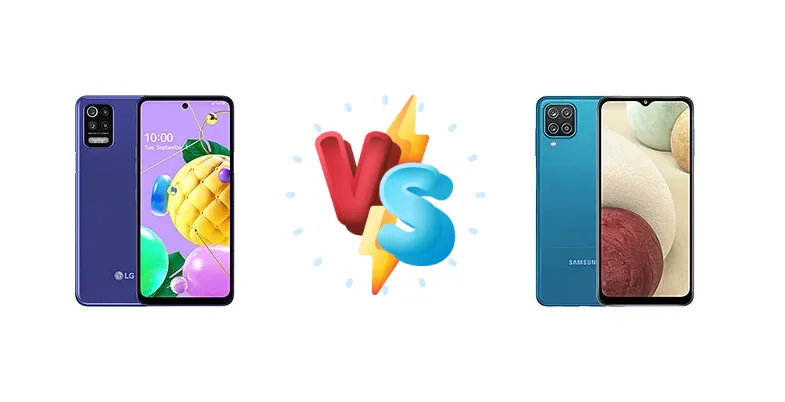
The LG K52 and Samsung Galaxy A12 represent the fiercely competitive sub-$200 smartphone market. Both devices target first-time smartphone buyers and those seeking a reliable secondary device. While sharing a common chipset, nuanced differences in display characteristics and battery endurance separate these contenders.
🏆 Quick Verdict
For the average user prioritizing a slightly brighter display and a well-established brand ecosystem, the Samsung Galaxy A12 emerges as the better choice. However, the LG K52 remains a viable option if found at a significantly lower price point, offering comparable core functionality.
| Network |
|---|
| 2G bands | GSM 850 / 900 / 1800 / 1900 | GSM 850 / 900 / 1800 / 1900 |
| 3G bands | HSDPA 850 / 900 / 1700(AWS) / 1900 / 2100 - International | HSDPA 850 / 900 / 2100 |
| 4G bands | 1, 2, 3, 4, 5, 7, 8, 12, 13, 17, 28, 38, 66 - International | 1, 3, 5, 7, 8, 20, 28, 38, 40, 41 |
| Speed | HSPA, LTE | HSPA 42.2/5.76 Mbps, LTE Cat4 150/50 Mbps |
| Technology | GSM / HSPA / LTE | GSM / HSPA / LTE |
| | 1, 3, 5, 7, 8, 20, 28, 38, 39, 40, 41 - Australia | - |
| Launch |
|---|
| Announced | 2020, September 23. Released 2020, November 23 | 2020, November 24. Released 2020, December 21 |
| Status | Discontinued | Discontinued |
| Body |
|---|
| Build | - | Glass front, plastic back, plastic frame |
| Dimensions | 165 x 76.7 x 8.4 mm (6.50 x 3.02 x 0.33 in) | 164 x 75.8 x 8.9 mm (6.46 x 2.98 x 0.35 in) |
| SIM | Nano-SIM + Nano-SIM | · Nano-SIM· Nano-SIM + Nano-SIM |
| Weight | 188 g (6.63 oz) | 205 g (7.23 oz) |
| | MIL-STD-810G compliant*
*does not guarantee ruggedness or use in extreme conditions | - |
| Display |
|---|
| Resolution | 720 x 1600 pixels, 20:9 ratio (~266 ppi density) | 720 x 1600 pixels, 20:9 ratio (~270 ppi density) |
| Size | 6.6 inches, 105.2 cm2 (~83.1% screen-to-body ratio) | 6.5 inches, 102.0 cm2 (~82.1% screen-to-body ratio) |
| Type | IPS LCD | PLS LCD |
| Platform |
|---|
| CPU | Octa-core (4x2.3 GHz Cortex-A53 & 4x1.8 GHz Cortex-A53) | Octa-core (4x2.35 GHz Cortex-A53 & 4x1.8 GHz Cortex-A53) |
| Chipset | Mediatek MT6765 Helio P35 (12 nm) | Mediatek MT6765 Helio P35 (12 nm) |
| GPU | PowerVR GE8320 | PowerVR GE8320 |
| OS | Android 10 | Android 10, upgradable to Android 12, One UI 4.1 |
| Memory |
|---|
| Card slot | microSDXC | microSDXC (dedicated slot) |
| Internal | 64GB 4GB RAM | 32GB 2GB RAM, 32GB 3GB RAM, 32GB 4GB RAM, 64GB 2GB RAM, 64GB 4GB RAM, 128GB 2GB RAM, 128GB 3GB RAM, 128GB 4GB RAM, 128GB 6GB RAM |
| | eMMC 5.1 | eMMC 5.1 |
| Main Camera |
|---|
| - | Go |
| Features | Dual-LED flash, panorama, HDR | LED flash, panorama, HDR |
| Quad | 48 MP, f/1.8, 26mm (wide), 1/2.0", 0.8µm, PDAF
5 MP, f/2.2, 115˚ (ultrawide), 1/5.0", 1.12µm
2 MP (macro)
Auxiliary lens | 48 MP, f/2.0, 26mm (wide), AF
5 MP, f/2.2, 123˚ (ultrawide)
2 MP (macro)
Auxiliary lens |
| Video | 1080p@30fps | 1080p@30fps |
| Selfie camera |
|---|
| Single | 13 MP, f/2.0, 27mm (wide), 1/3.1", 1.12µm | 8 MP, f/2.2 |
| Video | 1080p@30fps | 1080p@30fps |
| Sound |
|---|
| 3.5mm jack | Yes | Yes |
| 35mm jack | Yes | Yes |
| Loudspeaker | Yes | Yes |
| Comms |
|---|
| Bluetooth | 5.0, A2DP, LE | 5.0, A2DP, LE |
| NFC | Yes | Yes (market/region dependent) |
| Positioning | GPS | GPS, GLONASS, GALILEO, BDS |
| Radio | No | FM radio, RDS, recording |
| USB | USB Type-C 3.1, OTG | USB Type-C 2.0 |
| WLAN | Wi-Fi 802.11 b/g/n or Wi-Fi 802.11 a/b/g/n/ac, dual-band | Wi-Fi 802.11 b/g/n, Wi-Fi Direct |
| Features |
|---|
| Sensors | Fingerprint (side-mounted), accelerometer, proximity, compass | Fingerprint (side-mounted), accelerometer |
| | - | Virtual proximity sensing |
| Battery |
|---|
| Charging | - | 15W wired |
| Type | Li-Po 4000 mAh | Li-Po 5000 mAh |
| Misc |
|---|
| Colors | White, Blue, Red | Black, White, Blue, Red |
| Models | LMK520, LM-K520, LMK520E, LM-K520E, LMK520Y, LM-K520Y, LMK520H, LM-K520H | SM-A125F/DSN, SM-A125F/DS, SM-A125F, SM-A125M, SM-A125U, SM-A125U1, SM-A125N, SM-A125W |
| Price | About 220 EUR | € 78.89 / $ 60.00 / £ 69.99 |
| SAR EU | - | 0.67 W/kg (head) 1.38 W/kg (body) |
| Tests |
|---|
| Battery life | - | Endurance rating 123h |
| Camera | - |
Photo / Video |
| Display | - |
Contrast ratio: 1363:1 (nominal) |
| Loudspeaker | - |
-30.4 LUFS (Below average) |
| Performance | - |
AnTuTu: 107189 (v8)
GeekBench: 1034 (v5.1)
GFXBench: 5fps (ES 3.1 onscreen) |
LG K52
- Potentially lower price point
- Comparable performance to the A12
- Similar battery endurance
- Likely slower charging speeds
- Less brand recognition
- Potentially shorter software support
Samsung Galaxy A12
- Brighter display for better outdoor visibility
- Faster 15W charging
- Stronger brand reputation and support
- Slightly higher price
- Similar performance to the K52
- 2MP macro camera is largely ineffective
Display Comparison
Both the LG K52 and Samsung Galaxy A12 feature displays with a 1363:1 contrast ratio, suggesting similar levels of black depth. However, the Samsung Galaxy A12 boasts a measured peak brightness of 472 nits, providing a noticeably more visible screen outdoors or in brightly lit environments. While both likely utilize LCD panels, the A12’s higher brightness is a tangible advantage for everyday usability. The nominal contrast ratio suggests neither display will offer exceptional color vibrancy.
Camera Comparison
Both devices are listed as having 'Photo / Video' capabilities, but lack specific details regarding sensor size, aperture, or image processing. Given the price point, it’s safe to assume both rely on basic camera modules. The inclusion of a 2MP macro camera on the A12 is largely a marketing gimmick, offering limited practical benefit due to the low resolution and lack of optical image stabilization. Without further information, it’s difficult to definitively declare a camera winner; image quality will likely be similar in most scenarios.
Performance
At the heart of both devices lies the Mediatek MT6765 Helio P35 (12 nm) chipset, paired with an octa-core CPU configuration of 4x2.3 GHz Cortex-A53 and 4x1.8 GHz Cortex-A53 cores. The Samsung Galaxy A12’s CPU clocks slightly higher at 2.35 GHz, but this difference is unlikely to translate into a significant real-world performance boost given the identical core architecture. Both phones will handle basic tasks like web browsing, social media, and light app usage adequately, but will struggle with demanding games or multitasking.
Battery Life
Both the LG K52 and Samsung Galaxy A12 achieve an endurance rating of 123 hours, indicating comparable battery life under similar usage conditions. The Samsung Galaxy A12 supports 15W wired charging, offering a slightly faster recharge rate compared to the LG K52’s likely slower charging speed (spec not provided). While both will comfortably last a full day for moderate users, the A12’s faster charging provides a convenience advantage.
Buying Guide
Buy the LG K52 if you need a functional smartphone at the absolute lowest possible price and aren't heavily invested in the Samsung ecosystem. Buy the Samsung Galaxy A12 if you prefer a slightly brighter display, a more recognizable brand, and a longer-term software support expectation, even if it means paying a small premium.
Frequently Asked Questions
❓ Will the Helio P35 chipset struggle with popular mobile games like PUBG or Call of Duty?
Yes, the Mediatek Helio P35 is an entry-level chipset. While it can run these games, expect low graphics settings and potential frame rate drops, especially during intense action. These phones are not designed for serious gaming.
❓ How long will software updates be available for the Samsung Galaxy A12?
Samsung typically provides a few years of security updates for its A-series devices. While not guaranteed, the Galaxy A12 is likely to receive at least two years of security patches, offering better long-term support than the LG K52, given LG's exit from the smartphone market.
❓ Is the 15W charging on the Galaxy A12 a significant improvement over a potentially slower charger for the K52?
Yes, 15W charging will noticeably reduce the time it takes to fully charge the Galaxy A12 compared to a standard 5W or 10W charger. This is a practical benefit for users who need to quickly top up their battery.