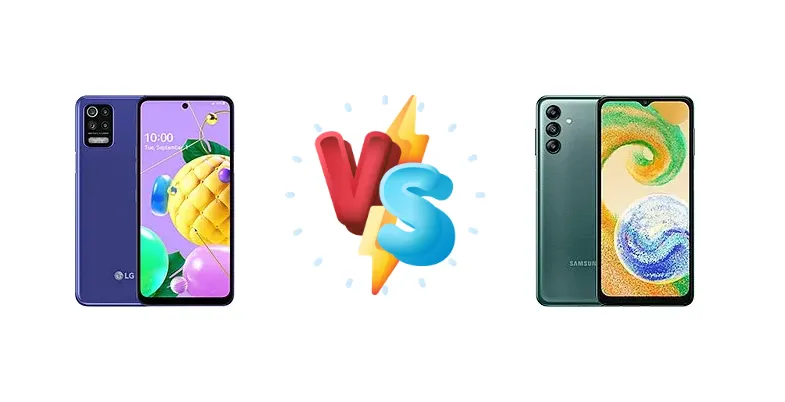
The LG K52 and Samsung Galaxy A04s represent two distinct approaches to the ultra-budget smartphone market. The K52, while older, offers a different chipset architecture than the newer A04s. This comparison dives deep into their specifications to determine which device delivers the best value for users prioritizing performance, battery life, or display quality.
🏆 Quick Verdict
For most users, the Samsung Galaxy A04s is the better choice. Its Exynos 850 chipset, built on an 8nm process, provides a noticeable performance advantage over the LG K52’s 12nm Helio P35, despite similar CPU core counts. While both offer comparable battery endurance, the A04s benefits from 15W charging.
| Network |
|---|
| 2G bands | GSM 850 / 900 / 1800 / 1900 | GSM 850 / 900 / 1800 / 1900 |
| 3G bands | HSDPA 850 / 900 / 1700(AWS) / 1900 / 2100 - International | HSDPA 850 / 900 / 2100 |
| 4G bands | 1, 2, 3, 4, 5, 7, 8, 12, 13, 17, 28, 38, 66 - International | 1, 3, 5, 7, 8, 20, 28, 38, 40, 41 |
| Speed | HSPA, LTE | HSPA, LTE |
| Technology | GSM / HSPA / LTE | GSM / HSPA / LTE |
| | 1, 3, 5, 7, 8, 20, 28, 38, 39, 40, 41 - Australia | - |
| Launch |
|---|
| Announced | 2020, September 23. Released 2020, November 23 | 2022, August 31 |
| Status | Discontinued | Available. Released 2022, September 22 |
| Body |
|---|
| Build | - | Glass front, plastic back, plastic frame |
| Dimensions | 165 x 76.7 x 8.4 mm (6.50 x 3.02 x 0.33 in) | 164.7 x 76.7 x 9.1 mm (6.48 x 3.02 x 0.36 in) |
| SIM | Nano-SIM + Nano-SIM | Nano-SIM + Nano-SIM |
| Weight | 188 g (6.63 oz) | 195 g (6.88 oz) |
| | MIL-STD-810G compliant*
*does not guarantee ruggedness or use in extreme conditions | - |
| Display |
|---|
| Resolution | 720 x 1600 pixels, 20:9 ratio (~266 ppi density) | 720 x 1600 pixels, 20:9 ratio (~270 ppi density) |
| Size | 6.6 inches, 105.2 cm2 (~83.1% screen-to-body ratio) | 6.5 inches, 102.0 cm2 (~80.7% screen-to-body ratio) |
| Type | IPS LCD | PLS LCD, 90Hz, 400 nits (peak) |
| Platform |
|---|
| CPU | Octa-core (4x2.3 GHz Cortex-A53 & 4x1.8 GHz Cortex-A53) | Octa-core (4x2.0 GHz Cortex-A55 & 4x2.0 GHz Cortex-A55) |
| Chipset | Mediatek MT6765 Helio P35 (12 nm) | Exynos 850 (8 nm) |
| GPU | PowerVR GE8320 | Mali-G52 |
| OS | Android 10 | Android 12, upgradable to Android 14, One UI 6.1 |
| Memory |
|---|
| Card slot | microSDXC | microSDXC (dedicated slot) |
| Internal | 64GB 4GB RAM | 32GB 3GB RAM, 32GB 4GB RAM, 64GB 3GB RAM, 64GB 4GB RAM, 128GB 3GB RAM, 128GB 4GB RAM |
| | eMMC 5.1 | eMMC 5.1 |
| Main Camera |
|---|
| Features | Dual-LED flash, panorama, HDR | LED flash, panorama, HDR |
| Quad | 48 MP, f/1.8, 26mm (wide), 1/2.0", 0.8µm, PDAF
5 MP, f/2.2, 115˚ (ultrawide), 1/5.0", 1.12µm
2 MP (macro)
Auxiliary lens | - |
| Triple | - | 50 MP, f/1.8, 26mm (wide), 1/2.76", 0.64µm, PDAF
2 MP (macro)
Auxiliary lens |
| Video | 1080p@30fps | 1080p@30fps |
| Selfie camera |
|---|
| Single | 13 MP, f/2.0, 27mm (wide), 1/3.1", 1.12µm | 5 MP, f/2.2, (wide) |
| Video | 1080p@30fps | 720p@30fps |
| Sound |
|---|
| 3.5mm jack | Yes | Yes |
| 35mm jack | Yes | Yes |
| Loudspeaker | Yes | Yes |
| Comms |
|---|
| Bluetooth | 5.0, A2DP, LE | 5.0, A2DP, LE |
| NFC | Yes | Yes (market/region dependent) |
| Positioning | GPS | GPS, GLONASS, BDS, GALILEO, QZSS |
| Radio | No | No |
| USB | USB Type-C 3.1, OTG | USB Type-C 2.0 |
| WLAN | Wi-Fi 802.11 b/g/n or Wi-Fi 802.11 a/b/g/n/ac, dual-band | Wi-Fi 802.11 a/b/g/n/ac, dual-band, Wi-Fi Direct |
| Features |
|---|
| Sensors | Fingerprint (side-mounted), accelerometer, proximity, compass | Fingerprint (side-mounted), accelerometer |
| | - | Virtual Proximity Sensing |
| Battery |
|---|
| Charging | - | 15W wired |
| Type | Li-Po 4000 mAh | Li-Po 5000 mAh |
| Misc |
|---|
| Colors | White, Blue, Red | Black, Green, White, Copper |
| Models | LMK520, LM-K520, LMK520E, LM-K520E, LMK520Y, LM-K520Y, LMK520H, LM-K520H | SM-A047F, SM-A047F/DS, SM-A047F/DSN, SM-A047M |
| Price | About 220 EUR | € 133.89 |
| SAR EU | - | 0.52 W/kg (head) 1.23 W/kg (body) |
| Tests |
|---|
| Battery life | - |
Endurance rating 114h
|
| Camera | - |
Photo / Video |
| Display | - |
Contrast ratio: 1614:1 |
| Loudspeaker | - |
-30.3 LUFS (Below average)
|
| Performance | - |
AnTuTu: 145123(v9)
GeekBench: 1100 (v5.1)
GFXBench: 11fps (ES 3.1 onscreen) |
LG K52
- Potentially lower price point
- Decent battery endurance
- Reliable for basic tasks
- Older, less efficient chipset
- Likely lower display brightness
- Slower performance
Samsung Galaxy A04s
- More powerful and efficient Exynos 850 chipset
- Faster 15W charging
- Brighter display for outdoor visibility
- May be slightly more expensive
- 2MP macro camera is largely ineffective
- Similar battery endurance to K52 despite efficiency gains
Display Comparison
The Samsung Galaxy A04s boasts a measured peak brightness of 389 nits and a 1614:1 contrast ratio. While the LG K52’s display specifications are not provided, it’s reasonable to assume it falls behind in brightness. The A04s’ higher brightness translates to better visibility outdoors. Both share the same contrast ratio, suggesting similar panel technology, but the A04s’ measured data provides a concrete advantage for users in bright environments.
Camera Comparison
Both devices are listed as having 'Photo / Video' capabilities, lacking specific details. Without sensor size or aperture information, a direct comparison is difficult. However, given the market positioning, it’s likely both rely on budget sensors. The presence of a 2MP macro camera on the A04s is unlikely to significantly enhance the photography experience, and should be considered a marketing feature rather than a substantial improvement. Image processing algorithms will likely be the differentiating factor, and Samsung generally offers more refined software.
Performance
The core difference lies in the chipsets. The Samsung Galaxy A04s utilizes the Exynos 850, fabricated on an 8nm process, while the LG K52 features the Mediatek Helio P35 (12nm). The smaller node size of the Exynos 850 generally leads to improved power efficiency and thermal performance. Both CPUs are octa-core with a similar core configuration (4x2.0 GHz Cortex-A55 & 4x2.0 GHz Cortex-A55 vs 4x2.3 GHz Cortex-A53 & 4x1.8 GHz Cortex-A53), but the newer Cortex-A55 architecture in the A04s offers incremental performance gains. The A04s will handle multitasking and app loading more smoothly.
Battery Life
Both the LG K52 and Samsung Galaxy A04s achieve an endurance rating of 114 hours, indicating similar real-world battery life. However, the A04s supports 15W wired charging, while the K52’s charging speed is unknown. This faster charging capability on the A04s means less time tethered to a wall outlet, a significant convenience factor for many users. The 8nm process of the Exynos 850 also contributes to better power efficiency, potentially offsetting any minor capacity differences.
Buying Guide
Buy the LG K52 if you prioritize a potentially lower price point and are primarily focused on basic smartphone tasks like calls, texts, and light social media. Buy the Samsung Galaxy A04s if you prefer a more responsive user experience, slightly better display brightness, and faster charging, even if it means spending a bit more.
Frequently Asked Questions
❓ Does the Exynos 850 in the Galaxy A04s get hot during extended gaming sessions?
The Exynos 850, built on an 8nm process, is relatively efficient. While it will warm up during prolonged gaming, it's unlikely to experience significant throttling compared to the LG K52's Helio P35. The larger process node of the Helio P35 makes it more prone to overheating under sustained load.
❓ Is the 2MP macro camera on the Samsung Galaxy A04s worth using?
Generally, 2MP macro cameras on budget phones offer limited utility. The low resolution results in images lacking detail. It's best to rely on the main camera for most photography, and consider the macro lens a novelty feature rather than a significant upgrade.
❓ Can the Samsung Galaxy A04s handle popular games like PUBG Mobile?
The Exynos 850 can run PUBG Mobile, but you'll likely need to use lower graphics settings to maintain a stable frame rate. Expect playable performance at medium settings, but don't anticipate a high-end gaming experience. The LG K52 will struggle more with demanding titles.
❓ How long does it take to fully charge the Samsung Galaxy A04s with the 15W charger?
While a precise time isn't available, a full charge from 0% to 100% with the 15W charger is estimated to take around 2-3 hours. This is significantly faster than the LG K52, which lacks information on its charging speed and likely charges much slower.