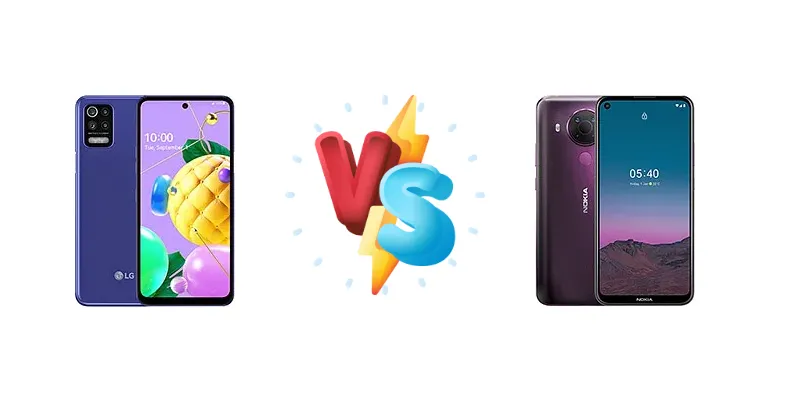
The LG K52 and Nokia 5.4 represent two approaches to the budget smartphone market. The K52, while older, offers a larger display, while the Nokia 5.4 aims for a more modern experience with a Qualcomm Snapdragon chipset. This comparison dives deep into the specifications to determine which device provides the best value for money.
🏆 Quick Verdict
For most users, the Nokia 5.4 emerges as the better choice. Its Snapdragon 662 chipset, fabricated on an 11nm process, delivers noticeably smoother performance than the LG K52’s Helio P35. While the K52 has a larger screen, the Nokia 5.4’s efficiency and more modern architecture provide a superior overall experience.
| Network |
|---|
| 2G bands | GSM 850 / 900 / 1800 / 1900 | GSM 850 / 900 / 1800 / 1900 |
| 3G bands | HSDPA 850 / 900 / 1700(AWS) / 1900 / 2100 - International | HSDPA 850 / 900 / 1900 / 2100 - International |
| 4G bands | 1, 2, 3, 4, 5, 7, 8, 12, 13, 17, 28, 38, 66 - International | 1, 3, 5, 7, 8, 20, 28, 38, 40, 41 - International |
| Speed | HSPA, LTE | HSPA 42.2/5.76 Mbps, LTE Cat4 150/50 Mbps |
| Technology | GSM / HSPA / LTE | GSM / HSPA / LTE |
| | 1, 3, 5, 7, 8, 20, 28, 38, 39, 40, 41 - Australia | 1, 2, 3, 4, 5, 7, 8, 12, 13, 17, 28, 66 - NA, LATAM |
| Launch |
|---|
| Announced | 2020, September 23. Released 2020, November 23 | 2020, December 15. Released 2020, December 25 |
| Status | Discontinued | Discontinued |
| Body |
|---|
| Dimensions | 165 x 76.7 x 8.4 mm (6.50 x 3.02 x 0.33 in) | 161 x 76 x 8.7 mm (6.34 x 2.99 x 0.34 in) |
| SIM | Nano-SIM + Nano-SIM | · Nano-SIM· Nano-SIM + Nano-SIM |
| Weight | 188 g (6.63 oz) | 181 g (6.38 oz) |
| | MIL-STD-810G compliant*
*does not guarantee ruggedness or use in extreme conditions | - |
| Display |
|---|
| Resolution | 720 x 1600 pixels, 20:9 ratio (~266 ppi density) | 720 x 1560 pixels, 19.5:9 ratio (~269 ppi density) |
| Size | 6.6 inches, 105.2 cm2 (~83.1% screen-to-body ratio) | 6.39 inches, 100.2 cm2 (~81.9% screen-to-body ratio) |
| Type | IPS LCD | IPS LCD, 400 nits (typ) |
| Platform |
|---|
| CPU | Octa-core (4x2.3 GHz Cortex-A53 & 4x1.8 GHz Cortex-A53) | Octa-core (4x2.0 GHz Kryo 260 Gold & 4x1.8 GHz Kryo 260 Silver) |
| Chipset | Mediatek MT6765 Helio P35 (12 nm) | Qualcomm SM6115 Snapdragon 662 (11 nm) |
| GPU | PowerVR GE8320 | Adreno 610 |
| OS | Android 10 | Android 10, upgradable to Android 12 |
| Memory |
|---|
| Card slot | microSDXC | microSDXC (dedicated slot) |
| Internal | 64GB 4GB RAM | 64GB 4GB RAM, 64GB 6GB RAM, 128GB 4GB RAM |
| | eMMC 5.1 | - |
| Main Camera |
|---|
| Features | Dual-LED flash, panorama, HDR | LED flash, HDR, panorama |
| Quad | 48 MP, f/1.8, 26mm (wide), 1/2.0", 0.8µm, PDAF
5 MP, f/2.2, 115˚ (ultrawide), 1/5.0", 1.12µm
2 MP (macro)
Auxiliary lens | 48 MP, f/1.8, (wide), PDAF
5 MP, 13mm (ultrawide)
2 MP (macro)
Auxiliary lens |
| Video | 1080p@30fps | 1080p@30fps |
| Selfie camera |
|---|
| Single | 13 MP, f/2.0, 27mm (wide), 1/3.1", 1.12µm | 16 MP, f/2.0, (wide) |
| Video | 1080p@30fps | 1080p@30fps |
| Sound |
|---|
| 3.5mm jack | Yes | Yes |
| 35mm jack | Yes | Yes |
| Loudspeaker | Yes | Yes |
| Comms |
|---|
| Bluetooth | 5.0, A2DP, LE | 4.2, A2DP, aptX Adaptive |
| NFC | Yes | Yes (market/region dependent) |
| Positioning | GPS | GPS, GLONASS, GALILEO, BDS |
| Radio | No | FM radio |
| USB | USB Type-C 3.1, OTG | USB Type-C 2.0, OTG |
| WLAN | Wi-Fi 802.11 b/g/n or Wi-Fi 802.11 a/b/g/n/ac, dual-band | Wi-Fi 802.11 b/g/n |
| Features |
|---|
| Sensors | Fingerprint (side-mounted), accelerometer, proximity, compass | Fingerprint (rear-mounted), accelerometer, gyro, proximity |
| Battery |
|---|
| Charging | - | 10W wired |
| Type | Li-Po 4000 mAh | Li-Po 4000 mAh |
| Misc |
|---|
| Colors | White, Blue, Red | Polar Night, Dusk |
| Models | LMK520, LM-K520, LMK520E, LM-K520E, LMK520Y, LM-K520Y, LMK520H, LM-K520H | TA-1333, TA-1340, TA-1337, TA-1328, TA-1325 |
| Price | About 220 EUR | About 90 EUR |
| SAR | - | 0.68 W/kg (head) 1.02 W/kg (body) |
| SAR EU | - | 0.99 W/kg (head) 0.96 W/kg (body) |
LG K52
- Larger display size (potentially better for media consumption)
- May offer a lower price point (depending on retailer)
- Simple and straightforward Android experience
- Less powerful Helio P35 chipset
- Less efficient 12nm fabrication process
- Potentially slower app loading and multitasking
Nokia 5.4
- More powerful Snapdragon 662 chipset
- More efficient 11nm fabrication process
- Smoother performance for gaming and multitasking
- 10W charging support
- Smaller display size
- May be slightly more expensive
- Limited fast charging capabilities
Display Comparison
Neither device boasts a particularly impressive display. The LG K52’s larger screen size is its primary advantage, but specifics like panel type and resolution are not provided. The Nokia 5.4 also lacks detailed display specifications. Without knowing the peak brightness or color accuracy of either panel, it’s difficult to declare a clear winner. However, the Nokia 5.4’s more recent release suggests a potentially more refined display experience, even if it’s smaller.
Camera Comparison
Without detailed camera specifications beyond the chipsets, a direct comparison is challenging. Both phones likely feature a multi-camera setup geared towards budget consumers. The absence of information regarding sensor size, aperture, or optical image stabilization (OIS) makes it difficult to assess image quality. However, Qualcomm’s image signal processor (ISP) within the Snapdragon 662 generally offers superior image processing capabilities compared to MediaTek’s ISP in the Helio P35, potentially resulting in better dynamic range and low-light performance on the Nokia 5.4.
Performance
The Nokia 5.4’s Qualcomm Snapdragon 662 (11nm) represents a clear advantage over the LG K52’s MediaTek Helio P35 (12nm). The 11nm fabrication process is more efficient, leading to better thermal management and potentially longer battery life. Furthermore, the Snapdragon 662’s Kryo 260 cores, while still utilizing an octa-core configuration, are architecturally more advanced than the Cortex-A53 cores found in the Helio P35. This translates to faster app loading times, smoother multitasking, and a more responsive user interface. The Nokia 5.4 is the better choice for users who play mobile games or use demanding applications.
Battery Life
Battery capacity isn’t specified for either device. However, the Nokia 5.4’s Snapdragon 662, built on an 11nm process, is more power-efficient than the Helio P35 (12nm) in the LG K52. This efficiency, combined with the Nokia 5.4’s 10W wired charging, suggests it will likely offer comparable or better battery life despite potentially having a smaller battery capacity. The K52’s larger size might allow for a larger battery, but the less efficient chipset could negate that advantage.
Buying Guide
Buy the LG K52 if you prioritize a larger screen size and are primarily focused on basic tasks like calling, texting, and light social media use. The K52’s larger display may be preferable for media consumption, even if the performance isn’t top-tier. Buy the Nokia 5.4 if you value smoother performance for everyday tasks, occasional gaming, and a more responsive user experience. The Snapdragon 662 offers a significant upgrade in processing power and efficiency, making it ideal for users who demand more from their smartphone.
Frequently Asked Questions
❓ Will the Nokia 5.4 struggle with demanding games like PUBG Mobile?
While the Snapdragon 662 isn’t a flagship chipset, it’s capable of running PUBG Mobile at medium settings with reasonable frame rates. Expect some occasional frame drops during intense action, but the experience should be playable. The LG K52’s Helio P35 will likely struggle more significantly with demanding titles.
❓ Does the Nokia 5.4’s 10W charging feel slow in 2024?
Yes, 10W charging is relatively slow by today’s standards. Expect a full charge to take around 2-3 hours. However, the Snapdragon 662’s efficiency means you won’t be constantly needing to top up the battery, mitigating the impact of the slow charging speed.
❓ Is the LG K52 a good option for someone who primarily uses their phone for calls and texts?
Yes, the LG K52 is a perfectly adequate choice for basic communication. Its larger screen might be beneficial for readability, and the Helio P35 is sufficient for handling calls, texts, and light social media use. However, if you anticipate using your phone for anything more demanding, the Nokia 5.4 is a better investment.