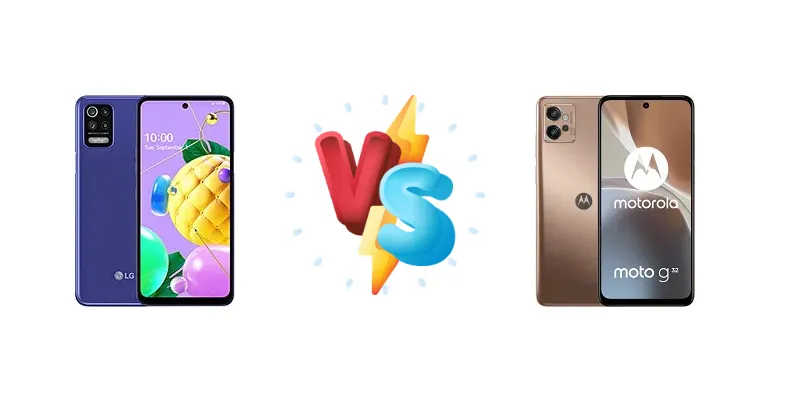
The LG K52 and Motorola Moto G32 represent different approaches to the budget smartphone market. The K52, released earlier, aims for affordability with a focus on basic functionality. The Moto G32, a more recent entrant, leverages newer chipset technology to deliver improved performance and efficiency, making it a compelling alternative for users seeking a smoother experience.
🏆 Quick Verdict
For the average user, the Motorola Moto G32 is the clear winner. Its Snapdragon 680, built on a 6nm process, provides a noticeable performance boost and superior power efficiency compared to the LG K52’s older Helio P35. The addition of 30W charging further solidifies its advantage.
| Network |
|---|
| 2G bands | GSM 850 / 900 / 1800 / 1900 | GSM 850 / 900 / 1800 / 1900 |
| 3G bands | HSDPA 850 / 900 / 1700(AWS) / 1900 / 2100 - International | HSDPA 850 / 900 / 1900 / 2100 |
| 4G bands | 1, 2, 3, 4, 5, 7, 8, 12, 13, 17, 28, 38, 66 - International | 1, 3, 5, 7, 8, 20, 28, 38, 40, 41 |
| Speed | HSPA, LTE | HSPA, LTE |
| Technology | GSM / HSPA / LTE | GSM / HSPA / LTE |
| | 1, 3, 5, 7, 8, 20, 28, 38, 39, 40, 41 - Australia | - |
| Launch |
|---|
| Announced | 2020, September 23. Released 2020, November 23 | 2022, July 28 |
| Status | Discontinued | Available. Released 2022, August 16 |
| Body |
|---|
| Build | - | Glass front, plastic frame, plastic back |
| Dimensions | 165 x 76.7 x 8.4 mm (6.50 x 3.02 x 0.33 in) | 161.8 x 73.8 x 8.5 mm (6.37 x 2.91 x 0.33 in) |
| SIM | Nano-SIM + Nano-SIM | · Nano-SIM· Nano-SIM + Nano-SIM |
| Weight | 188 g (6.63 oz) | 184 g (6.49 oz) |
| | MIL-STD-810G compliant*
*does not guarantee ruggedness or use in extreme conditions | Water-repellent design |
| Display |
|---|
| Resolution | 720 x 1600 pixels, 20:9 ratio (~266 ppi density) | 1080 x 2400 pixels, 20:9 ratio (~405 ppi density) |
| Size | 6.6 inches, 105.2 cm2 (~83.1% screen-to-body ratio) | 6.5 inches, 102.0 cm2 (~85.4% screen-to-body ratio) |
| Type | IPS LCD | IPS LCD, 90Hz |
| Platform |
|---|
| CPU | Octa-core (4x2.3 GHz Cortex-A53 & 4x1.8 GHz Cortex-A53) | Octa-core (4x2.4 GHz Kryo 265 Gold & 4x1.9 GHz Kryo 265 Silver) |
| Chipset | Mediatek MT6765 Helio P35 (12 nm) | Qualcomm SM6225 Snapdragon 680 4G (6 nm) |
| GPU | PowerVR GE8320 | Adreno 610 |
| OS | Android 10 | Android 12, upgradable to Android 13 |
| Memory |
|---|
| Card slot | microSDXC | microSDXC (dedicated slot) |
| Internal | 64GB 4GB RAM | 64GB 4GB RAM, 128GB 4GB RAM, 128GB 6GB RAM, 128GB 8GB RAM, 256GB 8GB RAM |
| | eMMC 5.1 | - |
| Main Camera |
|---|
| Features | Dual-LED flash, panorama, HDR | LED flash, HDR, panorama |
| Quad | 48 MP, f/1.8, 26mm (wide), 1/2.0", 0.8µm, PDAF
5 MP, f/2.2, 115˚ (ultrawide), 1/5.0", 1.12µm
2 MP (macro)
Auxiliary lens | - |
| Triple | - | 50 MP, f/1.8 (wide), 1/2.76", 0.64µm, PDAF
8 MP, f/2.2, 118˚ (ultrawide), 1/4.0", 1.12µm
2 MP, f/2.4, (macro/depth) |
| Video | 1080p@30fps | 1080p@30fps |
| Selfie camera |
|---|
| Single | 13 MP, f/2.0, 27mm (wide), 1/3.1", 1.12µm | 16 MP, f/2.4, (wide), 1.0µm |
| Video | 1080p@30fps | 1080p@30fps |
| Sound |
|---|
| 3.5mm jack | Yes | Yes |
| 35mm jack | Yes | Yes |
| Loudspeaker | Yes | Yes, with stereo speakers |
| Comms |
|---|
| Bluetooth | 5.0, A2DP, LE | 5.2, A2DP, LE |
| NFC | Yes | Yes (market/region dependent) |
| Positioning | GPS | GPS, GLONASS, GALILEO |
| Radio | No | FM radio |
| USB | USB Type-C 3.1, OTG | USB Type-C 2.0 |
| WLAN | Wi-Fi 802.11 b/g/n or Wi-Fi 802.11 a/b/g/n/ac, dual-band | Wi-Fi 802.11 a/b/g/n/ac, dual-band, Wi-Fi Direct |
| Features |
|---|
| Sensors | Fingerprint (side-mounted), accelerometer, proximity, compass | Fingerprint (side-mounted), accelerometer, gyro, proximity, compass |
| Battery |
|---|
| Charging | - | 30W wired |
| Type | Li-Po 4000 mAh | Li-Po 5000 mAh |
| Misc |
|---|
| Colors | White, Blue, Red | Mineral Grey, Satin Silver, Rose Gold |
| Models | LMK520, LM-K520, LMK520E, LM-K520E, LMK520Y, LM-K520Y, LMK520H, LM-K520H | XT2235-2, XT2235-3 |
| Price | About 220 EUR | ₹ 8,990 |
LG K52
- Potentially lower price point
- Simple and straightforward user experience
- May be readily available in some markets
- Outdated Helio P35 chipset
- Less efficient 12nm process
- Slower charging speeds
- Likely inferior camera performance
Motorola Moto G32
- More powerful Snapdragon 680 chipset
- Efficient 6nm process
- 30W fast charging
- Improved camera performance (likely)
- Better long-term software support (potentially)
- May be slightly more expensive
- Availability may be limited in some regions
Display Comparison
Neither device is known for a standout display. Both likely utilize LCD panels, common in this price bracket. However, display specs beyond panel type are unavailable. The K52’s age suggests a potentially lower peak brightness and less accurate color reproduction. The Moto G32 benefits from a more modern manufacturing process, potentially leading to slightly improved display quality, though this is speculative without further data.
Camera Comparison
Without detailed camera specifications, a direct comparison is difficult. However, the age of the K52 suggests its camera system will be less advanced. The Moto G32 likely benefits from Qualcomm’s image signal processor (ISP), which offers improved noise reduction and dynamic range. It’s reasonable to assume the Moto G32 will deliver better image quality, particularly in low-light conditions. The prevalence of 2MP macro lenses on both devices suggests they offer limited practical value.
Performance
The core difference lies in the chipsets. The Motorola Moto G32’s Qualcomm Snapdragon 680 (6nm) is a significant upgrade over the LG K52’s MediaTek Helio P35 (12nm). The 6nm process node allows for greater transistor density and improved power efficiency, resulting in less heat generation and sustained performance. While both are octa-core CPUs, the Snapdragon 680’s Kryo 265 Gold cores, clocked at 2.4 GHz, offer a performance advantage over the Helio P35’s Cortex-A53 cores at 2.3 GHz. This translates to faster app launches, smoother multitasking, and a more responsive user interface on the Moto G32.
Battery Life
Battery capacity is not specified for either device. However, the Moto G32’s 30W wired charging is a major advantage. The K52 likely supports slower charging speeds, meaning significantly longer times to reach a full charge. The Snapdragon 680’s superior power efficiency also contributes to longer battery life on the Moto G32, even if the battery capacities are similar. Users who frequently top up their phones will greatly appreciate the Moto G32’s faster charging.
Buying Guide
Buy the LG K52 if you prioritize extreme affordability and are willing to compromise on performance and efficiency for basic tasks like calls, texts, and light social media use. Buy the Motorola Moto G32 if you value a smoother user experience, faster app loading times, and longer battery life, even if it means spending slightly more. The G32 is the better choice for anyone who occasionally plays mobile games or uses demanding applications.
Frequently Asked Questions
❓ Will the Snapdragon 680 in the Moto G32 handle demanding games like PUBG Mobile?
The Snapdragon 680 is capable of running PUBG Mobile, but likely at medium settings to maintain a stable frame rate. While not a gaming powerhouse, it offers a significantly better gaming experience than the Helio P35 in the LG K52, which would struggle with even lower settings.
❓ How much faster is the charging on the Motorola Moto G32 compared to the LG K52?
The Moto G32’s 30W charging is substantially faster. While the K52’s charging speed is unknown, it’s likely limited to 10W or 15W. This means the Moto G32 can go from 0-100% in approximately 60-90 minutes, while the K52 could take over 3 hours.
❓ Does the Moto G32's 6nm process node make a noticeable difference in battery life?
Yes, the 6nm process node is more power-efficient than the K52's 12nm node. This means the Moto G32 will consume less power for the same tasks, resulting in longer battery life and less heat generation, especially during prolonged use.