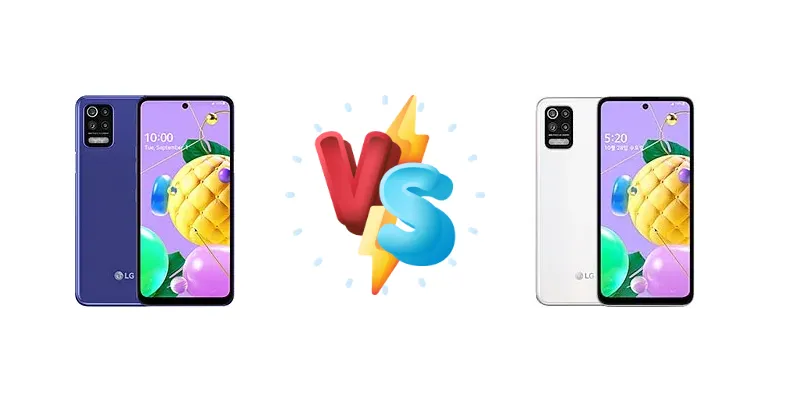
The LG K52 and Q52 represent LG's foray into the ultra-budget smartphone market. While appearing as distinct models, a closer examination reveals a startling similarity: they both utilize the Mediatek Helio P35 chipset. This comparison dissects the nuances between these two devices, focusing on where potential differences might impact the user experience, despite their shared core hardware.
🏆 Quick Verdict
For the average user, the LG Q52 emerges as the slightly better choice, primarily due to its potentially wider availability and the possibility of more consistent software updates. However, given the identical core specifications, price will be the ultimate deciding factor.
| Network |
|---|
| 2G bands | GSM 850 / 900 / 1800 / 1900 | GSM 850 / 900 / 1800 / 1900 |
| 3G bands | HSDPA 850 / 900 / 1700(AWS) / 1900 / 2100 - International | HSDPA 850 / 900 / 1900 / 2100 |
| 4G bands | 1, 2, 3, 4, 5, 7, 8, 12, 13, 17, 28, 38, 66 - International | LTE |
| Speed | HSPA, LTE | HSPA, LTE |
| Technology | GSM / HSPA / LTE | GSM / HSPA / LTE |
| | 1, 3, 5, 7, 8, 20, 28, 38, 39, 40, 41 - Australia | - |
| Launch |
|---|
| Announced | 2020, September 23. Released 2020, November 23 | 2020, September 26. Released 2020, October 26 |
| Status | Discontinued | Discontinued |
| Body |
|---|
| Dimensions | 165 x 76.7 x 8.4 mm (6.50 x 3.02 x 0.33 in) | 165 x 76.7 x 8.4 mm (6.50 x 3.02 x 0.33 in) |
| SIM | Nano-SIM + Nano-SIM | Nano-SIM + Nano-SIM |
| Weight | 188 g (6.63 oz) | 186 g (6.56 oz) |
| | MIL-STD-810G compliant*
*does not guarantee ruggedness or use in extreme conditions | MIL-STD-810G compliant*
*does not guarantee ruggedness or use in extreme conditions |
| Display |
|---|
| Resolution | 720 x 1600 pixels, 20:9 ratio (~266 ppi density) | 720 x 1600 pixels, 20:9 ratio (~266 ppi density) |
| Size | 6.6 inches, 105.2 cm2 (~83.1% screen-to-body ratio) | 6.6 inches, 105.2 cm2 (~83.1% screen-to-body ratio) |
| Type | IPS LCD | IPS LCD |
| Platform |
|---|
| CPU | Octa-core (4x2.3 GHz Cortex-A53 & 4x1.8 GHz Cortex-A53) | Octa-core (4x2.3 GHz Cortex-A53 & 4x1.8 GHz Cortex-A53) |
| Chipset | Mediatek MT6765 Helio P35 (12 nm) | Mediatek MT6765 Helio P35 (12 nm) |
| GPU | PowerVR GE8320 | PowerVR GE8320 |
| OS | Android 10 | Android 10 |
| Memory |
|---|
| Card slot | microSDXC | microSDXC |
| Internal | 64GB 4GB RAM | 64GB 4GB RAM |
| | eMMC 5.1 | eMMC 5.1 |
| Main Camera |
|---|
| Features | Dual-LED flash, panorama, HDR | Dual-LED flash, panorama, HDR |
| Quad | 48 MP, f/1.8, 26mm (wide), 1/2.0", 0.8µm, PDAF
5 MP, f/2.2, 115˚ (ultrawide), 1/5.0", 1.12µm
2 MP (macro)
Auxiliary lens | 48 MP, f/1.8, (wide), 1/2.0", 0.8µm, PDAF
5 MP, f/2.2, 115˚ (ultrawide), 1/5.0", 1.12µm
2 MP (macro)
Auxiliary lens |
| Video | 1080p@30fps | 1080p@30fps |
| Selfie camera |
|---|
| Single | 13 MP, f/2.0, 27mm (wide), 1/3.1", 1.12µm | 13 MP, (wide), 1/3.1", 1.12µm |
| Video | 1080p@30fps | 1080p@30fps |
| Sound |
|---|
| 3.5mm jack | Yes | Yes |
| 35mm jack | Yes | Yes |
| Loudspeaker | Yes | Yes |
| Comms |
|---|
| Bluetooth | 5.0, A2DP, LE | 5.0, A2DP, LE |
| NFC | Yes | Yes |
| Positioning | GPS | GPS |
| Radio | No | No |
| USB | USB Type-C 3.1, OTG | USB Type-C 3.1 |
| WLAN | Wi-Fi 802.11 b/g/n or Wi-Fi 802.11 a/b/g/n/ac, dual-band | Wi-Fi 802.11 a/b/g/n/ac, dual-band, Wi-Fi Direct |
| Features |
|---|
| Sensors | Fingerprint (side-mounted), accelerometer, proximity, compass | Fingerprint (side-mounted), accelerometer, proximity, compass |
| Battery |
|---|
| Type | Li-Po 4000 mAh | Li-Po 4000 mAh |
| Misc |
|---|
| Colors | White, Blue, Red | Silky White, Silky Red |
| Models | LMK520, LM-K520, LMK520E, LM-K520E, LMK520Y, LM-K520Y, LMK520H, LM-K520H | LM-Q520N |
| Price | About 220 EUR | About 240 EUR |
LG K52
- Potentially lower price point
- Identical performance to Q52
- Same core features as Q52
- Potentially limited software support
- May be harder to find accessories
LG Q52
- Potentially wider availability
- Possible better software update schedule
- Identical performance to K52
- May be slightly more expensive
- Same core features as K52
Display Comparison
Both the LG K52 and Q52 are expected to feature similar LCD panels, given their market positioning. While specific details like screen resolution and peak brightness are not provided, the shared chipset suggests comparable display capabilities. The absence of high refresh rate technology or advanced panel features like LTPO is typical for this price segment. Bezels are likely to be substantial on both devices, prioritizing affordability over an immersive viewing experience. Color accuracy will likely be standard for LCDs in this class, leaning towards acceptable rather than exceptional.
Camera Comparison
Camera specifications are not detailed enough to draw significant distinctions. Both devices likely feature a multi-camera setup, but the absence of information regarding sensor sizes, apertures, or optical image stabilization (OIS) makes a detailed comparison impossible. It's reasonable to assume both will include a primary camera, potentially an ultrawide, and a depth sensor. The inclusion of a 2MP macro camera is probable, but its utility is limited due to the small sensor size and lack of detail. Image processing will likely be similar, focusing on basic enhancements rather than advanced computational photography techniques.
Performance
The heart of both devices is the Mediatek MT6765 Helio P35, an octa-core processor built on a 12nm process. This chipset features four Cortex-A53 cores clocked at 2.3 GHz and another four at 1.8 GHz. This configuration is geared towards efficient multitasking for everyday tasks. Given the identical chipset and likely similar RAM configurations (though not specified), performance will be virtually indistinguishable between the K52 and Q52. Thermal management will also be comparable, with both devices likely throttling under sustained heavy loads, such as prolonged gaming sessions. The Helio P35 is not a powerhouse, but it's adequate for basic smartphone functions.
Battery Life
Battery capacity and charging wattage are not specified. However, given the Helio P35's efficiency and the target market, both devices likely feature batteries in the 4000-5000 mAh range. Charging speeds will likely be limited to 10W or 15W, resulting in relatively slow 0-100% charge times. The actual battery life will depend on usage patterns, but both devices should comfortably last a full day with moderate use. The efficiency of the 12nm Helio P35 contributes to reasonable standby times.
Buying Guide
Buy the LG K52 if you find it significantly cheaper than the Q52 and prioritize absolute cost savings. It will deliver the same core performance. Buy the LG Q52 if you value potential long-term software support and a slightly higher chance of finding accessories, even if it means paying a small premium. Both are suited for basic smartphone tasks like calling, texting, and light social media use.
Frequently Asked Questions
❓ Will the Helio P35 struggle with modern apps?
The Helio P35 is a budget chipset and will show its limitations with demanding apps and games. Expect slower loading times and potential lag when running resource-intensive applications. It's best suited for basic tasks like web browsing, social media, and calling.
❓ How long will software updates be supported on these devices?
LG has historically provided limited software support for its budget devices. While the Q52 *might* receive one major Android update, don't expect extensive long-term support. Security patches may also be infrequent. This is a key consideration for users prioritizing software security.
❓ Is the camera quality acceptable for casual snapshots?
The camera quality will be adequate for casual snapshots in good lighting conditions. However, expect limited performance in low-light environments. The absence of OIS and advanced image processing means photos may appear soft and lack detail.