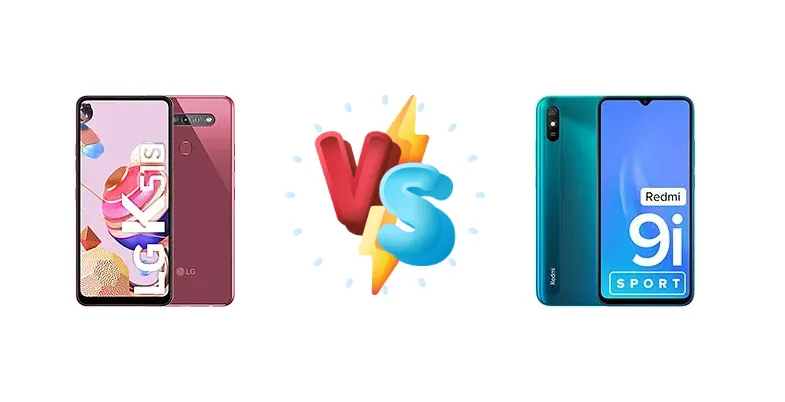
The LG K51S and Xiaomi Redmi 9i Sport represent the fiercely competitive entry-level smartphone market. Both aim to deliver essential functionality at an incredibly affordable price point, but they achieve this with different approaches to chipset selection and feature sets. This comparison dives deep into the specifications to determine which device offers the best overall experience for the budget-conscious consumer.
🏆 Quick Verdict
For most users, the Xiaomi Redmi 9i Sport emerges as the slightly better choice. While both phones utilize Mediatek's Helio series, the Helio G25's marginally higher clock speeds and inclusion of 10W charging provide a small but noticeable advantage in everyday performance and usability. However, the K51S remains a viable option if found at a significantly lower price.
| Network |
|---|
| 2G bands | GSM 850 / 900 / 1800 / 1900 | GSM 850 / 900 / 1800 / 1900 |
| 3G bands | HSDPA 850 / 900 / 1900 / 2100 | HSDPA 850 / 900 / 2100 |
| 4G bands | 1, 3, 7, 8, 20, 28, 38 | 1, 3, 5, 8, 40, 41 |
| Speed | HSPA 42.2/5.76 Mbps, LTE (2CA) Cat6 300/50 Mbps | HSPA, LTE |
| Technology | GSM / HSPA / LTE | GSM / HSPA / LTE |
| Launch |
|---|
| Announced | 2020, February 18. Released 2020, April 27 | 2021, September 28 |
| Status | Discontinued | Available. Released 2021, September 28 |
| Body |
|---|
| Dimensions | 165.2 x 76.7 x 8.3 mm (6.50 x 3.02 x 0.33 in) | 164.9 x 77.1 x 9 mm (6.49 x 3.04 x 0.35 in) |
| SIM | · Nano-SIM· Nano-SIM + Nano-SIM | Nano-SIM + Nano-SIM |
| Weight | 194.5 g (6.88 oz) | 194 g (6.84 oz) |
| | MIL-STD-810G compliant*
*does not guarantee ruggedness or use in extreme conditions | Water-repellent coating |
| Display |
|---|
| Protection | Scratch-resistant glass | - |
| Resolution | 720 x 1600 pixels, 20:9 ratio (~282 ppi density) | 720 x 1600 pixels, 20:9 ratio (~269 ppi density) |
| Size | 6.55 inches, 93.6 cm2 (~73.8% screen-to-body ratio) | 6.53 inches, 102.9 cm2 (~81.0% screen-to-body ratio) |
| Type | IPS LCD | IPS LCD, 400 nits (typ) |
| Platform |
|---|
| CPU | Octa-core (4x2.3 GHz Cortex-A53 & 4x1.8 GHz Cortex-A53) | Octa-core (4x2.0 GHz Cortex-A53 & 4x1.5 GHz Cortex-A53) |
| Chipset | Mediatek MT6765 Helio P35 (12 nm) | Mediatek MT6762G Helio G25 (12 nm) |
| GPU | PowerVR GE8320 | PowerVR GE8320 |
| OS | Android 9.0 (Pie) | Android 10, MIUI 12 |
| Memory |
|---|
| Card slot | microSDXC (dedicated slot) | microSDXC (dedicated slot) |
| Internal | 64GB 3GB RAM | 64GB 4GB RAM, 128GB 4GB RAM |
| | eMMC 5.1 | eMMC 5.1 |
| Main Camera |
|---|
| Features | LED flash, panorama, HDR | LED flash, HDR |
| Quad | 32 MP, (wide), PDAF
5 MP, f/2.2, 115˚, (ultrawide)
2 MP (macro)
Auxiliary lens | - |
| Single | - | 13 MP, f/2.2, 28mm (wide), 1.0µm, PDAF |
| Video | 1080p@30fps | 1080p@30fps |
| Selfie camera |
|---|
| Features | - | HDR |
| Single | 13 MP, 1/3.1", 1.12µm | 5 MP, f/2.2, (wide), 1.12µm |
| Video | 1080p@30fps | 1080p@30fps |
| Sound |
|---|
| 3.5mm jack | Yes | Yes |
| 35mm jack | Yes | Yes |
| Loudspeaker | Yes | Yes |
| Comms |
|---|
| Bluetooth | 5.0, A2DP, LE | 5.0, A2DP, LE |
| NFC | Yes | No |
| Positioning | GPS | GPS, GLONASS, BDS |
| Radio | No | FM radio |
| USB | USB Type-C 2.0, OTG | microUSB 2.0, OTG |
| WLAN | Wi-Fi 802.11 a/b/g/n, Wi-Fi Direct, DLNAorWi-Fi 802.11 b/g/n, Wi-Fi Direct, DLNA | Wi-Fi 802.11 а/b/g/n, Wi-Fi Direct |
| Features |
|---|
| Sensors | Fingerprint (rear-mounted), accelerometer, proximity, compass | Accelerometer, proximity, compass |
| Battery |
|---|
| Charging | - | 10W wired |
| Type | Li-Po 4000 mAh | Li-Po 5000 mAh |
| Misc |
|---|
| Colors | Titanium, Pink, Blue, Red | Carbon Black, Coral Green, Metallic Blue |
| Models | LMK510EMW, LM-K510EMW, LM-K510 | - |
| Price | About 200 EUR | About 100 EUR |
LG K51S
- Potentially lower price point
- Helio P35's higher peak CPU clock speed
- Simple, straightforward user experience
- No specified charging support (likely very slow)
- Older chipset architecture
- Potentially less optimized software
Xiaomi Redmi 9i Sport
- Helio G25 offers slightly better GPU performance
- 10W wired charging support for faster top-ups
- More recent chipset generation
- Slightly lower peak CPU clock speed
- May be slightly more expensive than the K51S
- Basic camera system
Display Comparison
Neither device boasts a standout display. Both likely feature LCD panels, typical for this price bracket. Detailed display specs (resolution, brightness) are unavailable, but we can infer similar performance. The focus here isn't on visual fidelity, but rather basic readability. Bezels are expected to be substantial on both, maximizing screen real estate within a compact form factor. Color accuracy is unlikely to be a strong point on either device.
Camera Comparison
Camera performance is expected to be basic on both devices. Without detailed sensor information, it's difficult to make a definitive judgment. Both likely feature a primary camera alongside depth and macro sensors (the latter often being of limited utility). Image processing will be crucial, and Xiaomi's software generally offers more aggressive scene optimization. The aperture of the main sensor will be a key factor, but without that data, we can only assume similar low-light performance. Focusing on the primary sensor is key, as the 2MP macro lenses found on phones in this segment rarely deliver usable results.
Performance
The core difference lies in the chipsets. The LG K51S utilizes the Mediatek Helio P35, featuring an octa-core CPU clocked up to 2.3 GHz. The Redmi 9i Sport counters with the Helio G25, clocked slightly lower at 2.0 GHz. While the P35 has a higher peak clock speed, the G25 is a newer generation chip, potentially offering improved efficiency and slightly better GPU performance. Both CPUs share the same Cortex-A53 architecture, meaning the performance gap won't be massive, but the G25's architecture is optimized for gaming, giving it a slight edge. Both phones will struggle with demanding games, but the Redmi 9i Sport will likely handle them a bit smoother.
Battery Life
Battery capacity is not specified for either device. However, given the target market, both likely house batteries in the 4000-5000 mAh range. The Redmi 9i Sport gains a significant advantage with its 10W wired charging support. The LG K51S lacks any specified charging capability, implying a significantly slower charging time, potentially requiring several hours to reach a full charge. This difference in charging convenience is a major factor for many users.
Buying Guide
Buy the LG K51S if you prioritize a potentially lower upfront cost and are comfortable with slower charging speeds. It's a reasonable choice for users who primarily need a phone for basic communication and light tasks. Buy the Xiaomi Redmi 9i Sport if you value slightly improved performance for multitasking and gaming, and appreciate the convenience of even basic wired charging support. This phone is better suited for users who want a more responsive experience and don't want to be tethered to a wall for extended periods.
Frequently Asked Questions
❓ Will the Redmi 9i Sport handle popular games like PUBG Mobile?
The Helio G25 in the Redmi 9i Sport is designed with gaming in mind, but don't expect a high-framerate experience. You'll likely need to play at the lowest graphics settings and potentially reduce the frame rate to achieve playable performance. The LG K51S will struggle even more with demanding titles.
❓ How long will it take to fully charge the Redmi 9i Sport?
With 10W charging, a full charge from 0% will likely take around 3-4 hours. While not fast charging by modern standards, it's a significant improvement over the LG K51S, which lacks specified charging support and will likely take considerably longer.
❓ Is the LG K51S a good option for elderly users who need a simple phone?
The LG K51S's simplicity could be beneficial for users who are less tech-savvy. However, the slow charging and potentially sluggish performance might be frustrating. The Redmi 9i Sport offers a slightly more responsive experience without being overly complex.
❓ What type of storage does the Redmi 9i Sport use?
While not explicitly stated, phones in this price range typically use eMMC storage. This is slower than UFS storage found in higher-end devices, but it's sufficient for basic app usage and media storage.