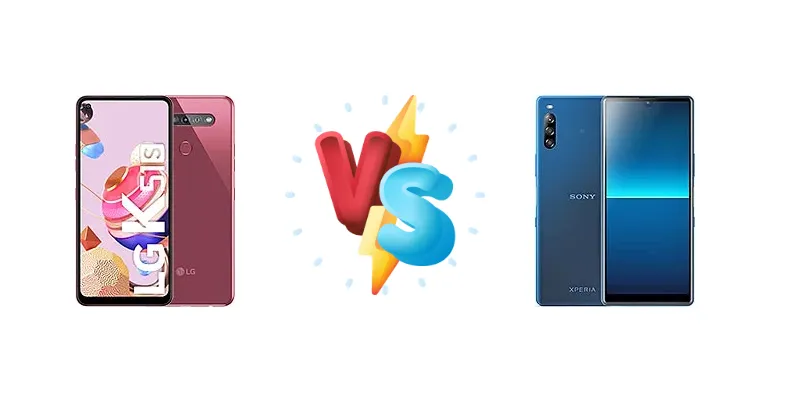
The LG K51S and Sony Xperia L4 represent two approaches to the ultra-budget smartphone market. The K51S aims for a balance of features, while the Xperia L4 focuses on Sony’s established brand and inclusion of USB Power Delivery for charging. This comparison dissects their core components to determine which offers the best value for users prioritizing performance and everyday usability.
🏆 Quick Verdict
For the average user, the LG K51S emerges as the slightly better choice. Its Helio P35 chipset, with its higher clocked Cortex-A53 cores, provides a noticeable performance edge over the Xperia L4’s Helio P22, making it more responsive for daily tasks and light multitasking. While both are entry-level devices, the K51S offers a smoother experience.
| Network |
|---|
| 2G bands | GSM 850 / 900 / 1800 / 1900 | GSM 850 / 900 / 1800 / 1900 |
| 3G bands | HSDPA 850 / 900 / 1900 / 2100 | HSDPA 850 / 900 / 1900 / 2100 |
| 4G bands | 1, 3, 7, 8, 20, 28, 38 | 1, 2, 3, 5, 7, 8, 20, 40 |
| Speed | HSPA 42.2/5.76 Mbps, LTE (2CA) Cat6 300/50 Mbps | HSPA 42.2/5.76 Mbps, LTE (2CA) Cat6 300/50 Mbps |
| Technology | GSM / HSPA / LTE | GSM / HSPA / LTE |
| Launch |
|---|
| Announced | 2020, February 18. Released 2020, April 27 | 2020, February 20. Released 2020, April 28 |
| Status | Discontinued | Discontinued |
| Body |
|---|
| Build | - | Glass front, plastic back, plastic frame |
| Dimensions | 165.2 x 76.7 x 8.3 mm (6.50 x 3.02 x 0.33 in) | 159 x 71 x 8.7 mm (6.26 x 2.80 x 0.34 in) |
| SIM | · Nano-SIM· Nano-SIM + Nano-SIM | · Nano-SIM· Nano-SIM + Nano-SIM |
| Weight | 194.5 g (6.88 oz) | 178 g (6.28 oz) |
| | MIL-STD-810G compliant*
*does not guarantee ruggedness or use in extreme conditions | - |
| Display |
|---|
| Protection | Scratch-resistant glass | - |
| Resolution | 720 x 1600 pixels, 20:9 ratio (~282 ppi density) | 720 x 1680 pixels, 21:9 ratio (~295 ppi density) |
| Size | 6.55 inches, 93.6 cm2 (~73.8% screen-to-body ratio) | 6.2 inches, 89.8 cm2 (~79.5% screen-to-body ratio) |
| Type | IPS LCD | IPS LCD |
| Platform |
|---|
| CPU | Octa-core (4x2.3 GHz Cortex-A53 & 4x1.8 GHz Cortex-A53) | Octa-core 2.0 GHz Cortex-A53 |
| Chipset | Mediatek MT6765 Helio P35 (12 nm) | Mediatek MT6762 Helio P22 (12 nm) |
| GPU | PowerVR GE8320 | PowerVR GE8320 |
| OS | Android 9.0 (Pie) | Android 9.0 (Pie) |
| Memory |
|---|
| Card slot | microSDXC (dedicated slot) | microSDXC (uses shared SIM slot) |
| Internal | 64GB 3GB RAM | 64GB 3GB RAM |
| | eMMC 5.1 | eMMC 5.1 |
| Main Camera |
|---|
| Features | LED flash, panorama, HDR | LED flash, HDR, panorama |
| Quad | 32 MP, (wide), PDAF
5 MP, f/2.2, 115˚, (ultrawide)
2 MP (macro)
Auxiliary lens | - |
| Triple | - | 13 MP, f/2.0, 26mm (wide), 1/3.0", PDAF
5 MP, f/2.2, 17mm (ultrawide), 1/5.0", 1.12µm
Auxiliary lens |
| Video | 1080p@30fps | 1080p@30fps |
| Selfie camera |
|---|
| Single | 13 MP, 1/3.1", 1.12µm | 8 MP, f/2.0, 27mm (wide), 1/4.0", 1.12µm |
| Video | 1080p@30fps | 1080p@30fps |
| Sound |
|---|
| 3.5mm jack | Yes | Yes |
| 35mm jack | Yes | Yes |
| Loudspeaker | Yes | Yes |
| Comms |
|---|
| Bluetooth | 5.0, A2DP, LE | 5.0, A2DP, LE |
| NFC | Yes | Yes |
| Positioning | GPS | GPS, GLONASS |
| Radio | No | FM radio |
| USB | USB Type-C 2.0, OTG | USB Type-C 2.0 |
| WLAN | Wi-Fi 802.11 a/b/g/n, Wi-Fi Direct, DLNAorWi-Fi 802.11 b/g/n, Wi-Fi Direct, DLNA | Wi-Fi 802.11 a/b/g/n, dual-band, Wi-Fi Direct |
| Features |
|---|
| Sensors | Fingerprint (rear-mounted), accelerometer, proximity, compass | Fingerprint (side-mounted), accelerometer, proximity, compass |
| Battery |
|---|
| Charging | - | USB Power Delivery |
| Type | Li-Po 4000 mAh | Li-Ion 3580 mAh |
| Misc |
|---|
| Colors | Titanium, Pink, Blue, Red | Black, Blue |
| Models | LMK510EMW, LM-K510EMW, LM-K510 | XQ-AD52, XQ-AD51 |
| Price | About 200 EUR | About 200 EUR |
LG K51S
- More powerful Helio P35 processor
- Higher CPU clock speeds for better responsiveness
- Potentially better gaming performance
- Likely more affordable
- Uses Micro-USB for charging
- Limited information on display quality
Sony Xperia L4
- USB Power Delivery for versatile charging
- Sony brand reputation for audio/visual quality
- Potentially more refined software experience
- Slightly more modern charging standard
- Less powerful Helio P22 processor
- Lower CPU clock speeds
- Potentially slower performance in demanding tasks
- Likely higher price point
Display Comparison
Neither LG nor Sony provide detailed display specifications for these models. Given their price points, both likely utilize IPS LCD panels. However, the lack of information makes a direct comparison impossible. We can infer that both will offer adequate viewing angles and color reproduction for basic use, but don't expect vibrant colors or high brightness levels. Bezels are likely to be substantial on both devices, reflecting their budget status.
Camera Comparison
Camera details are sparse for both devices. Both are expected to feature a multi-camera setup, but the quality will be heavily reliant on software processing. Without sensor size or aperture information, it’s difficult to make a definitive judgment. It’s safe to assume that both phones will struggle in low-light conditions. The presence of a 2MP macro lens on either device is largely a marketing gimmick, offering limited practical benefit due to the small sensor size and lack of autofocus. Image processing will likely favor natural colors on the Sony, aligning with their brand aesthetic, while LG’s processing may lean towards more saturated images.
Performance
The core difference lies in the chipsets. The LG K51S boasts the Mediatek Helio P35, featuring an octa-core CPU with four cores clocked at 2.3 GHz and four at 1.8 GHz. The Sony Xperia L4 uses the Helio P22, an octa-core CPU clocked uniformly at 2.0 GHz. While both utilize the Cortex-A53 architecture, the higher clock speeds on the K51S’s cores translate to faster processing speeds. This means quicker app launches, smoother scrolling, and a more responsive overall experience. The P35 also has a slightly more capable GPU, offering a marginal improvement in graphics performance. Neither chipset is designed for demanding games, but the K51S will handle simpler titles more effectively.
Battery Life
Battery capacity is not specified in the provided data. However, given the budget nature of these phones, both likely house batteries in the 3000-4000 mAh range. The Sony Xperia L4’s inclusion of USB Power Delivery is a key differentiator. While the included charger may be limited in wattage, USB PD allows for compatibility with a wider range of chargers, potentially enabling faster charging speeds with a higher-wattage adapter. The LG K51S relies on standard Micro-USB charging, which is slower and less versatile.
Buying Guide
Buy the LG K51S if you need a phone that feels more responsive for everyday tasks like browsing, social media, and light gaming. Its slightly more powerful processor will translate to a less frustrating user experience. Buy the Sony Xperia L4 if you prioritize a brand with a strong audio/visual reputation and value the convenience of USB Power Delivery for potentially faster and more versatile charging with compatible adapters, even if the core performance is lower.
Frequently Asked Questions
❓ Will the LG K51S struggle with popular apps like Facebook and WhatsApp?
While the Helio P35 isn't a powerhouse, it's sufficient for running common social media apps like Facebook and WhatsApp without significant lag. However, running multiple apps simultaneously might cause slowdowns due to the limited RAM typically found in this price range.
❓ Can the Sony Xperia L4 take advantage of fast charging with a USB-PD charger?
Yes, the Xperia L4 supports USB Power Delivery. However, the charging speed will depend on the wattage supported by the charger and the phone itself. While it won't reach the speeds of flagship devices, it will likely charge faster than with a standard Micro-USB charger.
❓ Is either phone suitable for playing demanding mobile games like PUBG or Call of Duty?
Neither the LG K51S nor the Sony Xperia L4 are ideal for playing graphically intensive games like PUBG or Call of Duty. While you might be able to run them at the lowest settings, expect significant frame rate drops and a generally poor gaming experience. These phones are better suited for casual gaming.