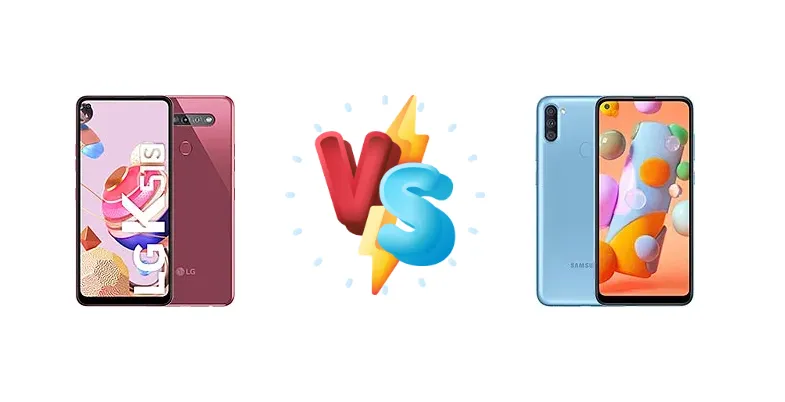
The LG K51S and Samsung Galaxy A11 represent the lower end of the smartphone market, targeting users prioritizing affordability. However, beneath the similar price points lie significant differences in their core components, particularly the chipsets. This comparison dissects those differences to determine which device delivers the best value for everyday tasks and light usage.
🏆 Quick Verdict
For the average user, the LG K51S emerges as the slightly better choice. Its Mediatek Helio P35, built on a more modern 12nm process, offers a performance edge over the Samsung Galaxy A11’s Snapdragon 450, despite the latter’s 15W charging. This translates to a smoother experience for multitasking and app loading.
| Network |
|---|
| 2G bands | GSM 850 / 900 / 1800 / 1900 | GSM 850 / 900 / 1800 / 1900 |
| 3G bands | HSDPA 850 / 900 / 1900 / 2100 | HSDPA 850 / 900 / 1900 / 2100 |
| 4G bands | 1, 3, 7, 8, 20, 28, 38 | 1, 2, 3, 5, 7, 8, 20, 28, 38, 40, 41 |
| Speed | HSPA 42.2/5.76 Mbps, LTE (2CA) Cat6 300/50 Mbps | HSPA 42.2/5.76 Mbps, LTE Cat4 150/50 Mbps |
| Technology | GSM / HSPA / LTE | GSM / HSPA / LTE |
| | - | 1, 2, 3, 4, 5, 7, 8, 12, 13, 17, 20, 25, 26, 28, 38, 39, 40, 41, 66, 71 - SM-A115U |
| Launch |
|---|
| Announced | 2020, February 18. Released 2020, April 27 | 2020, March 13. Released 2020, May 01 |
| Status | Discontinued | Discontinued |
| Body |
|---|
| Build | - | Glass front, plastic back, plastic frame |
| Dimensions | 165.2 x 76.7 x 8.3 mm (6.50 x 3.02 x 0.33 in) | 161.4 x 76.3 x 8 mm (6.35 x 3.00 x 0.31 in) |
| SIM | · Nano-SIM· Nano-SIM + Nano-SIM | · Nano-SIM· Nano-SIM + Nano-SIM |
| Weight | 194.5 g (6.88 oz) | 177 g (6.24 oz) |
| | MIL-STD-810G compliant*
*does not guarantee ruggedness or use in extreme conditions | - |
| Display |
|---|
| Protection | Scratch-resistant glass | - |
| Resolution | 720 x 1600 pixels, 20:9 ratio (~282 ppi density) | 720 x 1560 pixels, 19.5:9 ratio (~268 ppi density) |
| Size | 6.55 inches, 93.6 cm2 (~73.8% screen-to-body ratio) | 6.4 inches, 100.5 cm2 (~81.6% screen-to-body ratio) |
| Type | IPS LCD | PLS LCD |
| Platform |
|---|
| CPU | Octa-core (4x2.3 GHz Cortex-A53 & 4x1.8 GHz Cortex-A53) | Octa-core 1.8 GHz Cortex-A53 |
| Chipset | Mediatek MT6765 Helio P35 (12 nm) | Qualcomm SDM450 Snapdragon 450 (14 nm) |
| GPU | PowerVR GE8320 | Adreno 506 |
| OS | Android 9.0 (Pie) | Android 10, upgradable to Android 12, One UI Core 4.1 |
| Memory |
|---|
| Card slot | microSDXC (dedicated slot) | microSDXC (dedicated slot) |
| Internal | 64GB 3GB RAM | 32GB 2GB RAM, 32GB 3GB RAM, 64GB 3GB RAM, 64GB 4GB RAM |
| | eMMC 5.1 | eMMC 5.1 |
| Main Camera |
|---|
| Features | LED flash, panorama, HDR | LED flash, panorama, HDR |
| Quad | 32 MP, (wide), PDAF
5 MP, f/2.2, 115˚, (ultrawide)
2 MP (macro)
Auxiliary lens | - |
| Triple | - | 13 MP, f/1.8, 27mm (wide), AF
5 MP, f/2.2, 115˚ (ultrawide)
Auxiliary lens |
| Video | 1080p@30fps | 1080p@30fps |
| Selfie camera |
|---|
| Single | 13 MP, 1/3.1", 1.12µm | 8 MP, f/2.0 |
| Video | 1080p@30fps | 1080p@30fps |
| Sound |
|---|
| 3.5mm jack | Yes | Yes |
| 35mm jack | Yes | Yes |
| Loudspeaker | Yes | Yes |
| Comms |
|---|
| Bluetooth | 5.0, A2DP, LE | 4.2, A2DP, LE |
| NFC | Yes | No |
| Positioning | GPS | GPS, GLONASS, GALILEO, BDS |
| Radio | No | FM radio |
| USB | USB Type-C 2.0, OTG | USB Type-C 2.0 |
| WLAN | Wi-Fi 802.11 a/b/g/n, Wi-Fi Direct, DLNAorWi-Fi 802.11 b/g/n, Wi-Fi Direct, DLNA | Wi-Fi 802.11 b/g/n, Wi-Fi Direct |
| Features |
|---|
| Sensors | Fingerprint (rear-mounted), accelerometer, proximity, compass | Fingerprint (rear-mounted), accelerometer, proximity |
| Battery |
|---|
| Charging | - | 15W wired |
| Type | Li-Po 4000 mAh | Li-Po 4000 mAh |
| Misc |
|---|
| Colors | Titanium, Pink, Blue, Red | Black, White, Blue, Red |
| Models | LMK510EMW, LM-K510EMW, LM-K510 | SM-A115F/DS, SM-A115F, SM-A115M, SM-A115M/DS, SM-A115U, SM-A115A, SM-A115AZ, SM-A115U1, SM-A115W, SM-A115AP, SM-S115DL |
| Price | About 200 EUR | About 160 EUR |
| SAR EU | - | 0.52 W/kg (head) 0.99 W/kg (body) |
LG K51S
- More efficient 12nm chipset
- Potentially faster CPU clock speeds
- Likely smoother multitasking experience
- No fast charging support
- Brand recognition is lower than Samsung
Samsung Galaxy A11
- 15W fast charging support
- Samsung brand reputation and ecosystem
- Stable CPU performance
- Less efficient 14nm chipset
- Potentially slower overall performance
- May experience more throttling under load
Display Comparison
Neither device boasts a standout display. Both likely feature LCD panels, typical for this price bracket. Specifics like resolution and brightness are not provided, but the focus here is on internal components. The absence of high refresh rates or advanced panel technologies like LTPO is expected. Bezels are likely substantial on both, maximizing screen real estate within a budget.
Camera Comparison
Without detailed sensor information, a direct camera comparison is difficult. Both phones likely feature multiple rear cameras, but the quality will heavily depend on the main sensor and image processing. It's safe to assume both will include a standard lens, a depth sensor, and potentially a macro lens (often of limited utility). The absence of Optical Image Stabilization (OIS) is almost certain on both devices. Image processing will likely favor Samsung’s typically vibrant and saturated style, while LG’s processing may lean towards a more natural look.
Performance
The core difference lies in the chipsets. The LG K51S utilizes the Mediatek Helio P35, fabricated on a 12nm process. This smaller node generally translates to improved power efficiency and thermal performance compared to the Samsung Galaxy A11’s Qualcomm Snapdragon 450, which is built on a 14nm process. While both CPUs are octa-core and utilize Cortex-A53 cores, the K51S’s CPU configuration (4x2.3 GHz & 4x1.8 GHz) suggests a higher peak clock speed, potentially leading to faster single-core performance. The A11’s consistent 1.8 GHz across all cores may offer more stable performance under sustained load, but likely at a lower overall ceiling. The K51S's architecture benefits from the newer process node, potentially mitigating throttling during prolonged use.
Battery Life
Battery capacity isn't specified for the LG K51S, but given the segment, it's likely comparable to the Samsung Galaxy A11’s. The key differentiator is charging speed. The A11 supports 15W wired charging, offering a faster top-up time than the K51S, which lacks any specified fast charging support. However, the Helio P35’s 12nm process may contribute to slightly better power efficiency, potentially offsetting the slower charging speed with longer overall battery life during typical use.
Buying Guide
Buy the LG K51S if you prioritize a slightly more responsive user experience and aren't heavily reliant on fast charging. It's ideal for users who frequently switch between apps or enjoy casual gaming. Buy the Samsung Galaxy A11 if you value the Samsung brand ecosystem and prefer the convenience of 15W wired charging, even if it comes at a slight performance cost. It's a good fit for basic communication and media consumption.
Frequently Asked Questions
❓ Will the LG K51S struggle with popular social media apps like TikTok and Instagram?
While the Helio P35 can handle social media apps, demanding features like filters and live streaming might experience occasional lag. The Snapdragon 450 in the A11 will likely perform similarly, but neither phone is optimized for intensive social media use.
❓ Is the Snapdragon 450 in the Samsung Galaxy A11 sufficient for playing basic mobile games?
The Snapdragon 450 can run less demanding games like Candy Crush or older titles. However, graphically intensive games like PUBG Mobile will likely require significantly reduced settings and may still experience frame drops. The K51S's Helio P35 offers a slight advantage, but neither is a gaming powerhouse.
❓ How much does the 15W charging on the Samsung Galaxy A11 actually improve charging speed?
15W charging on the A11 will noticeably reduce charging times compared to standard 5W charging. Expect a 0-100% charge in approximately 2.5-3 hours, while the K51S, lacking fast charging, will likely take considerably longer – potentially 4+ hours.