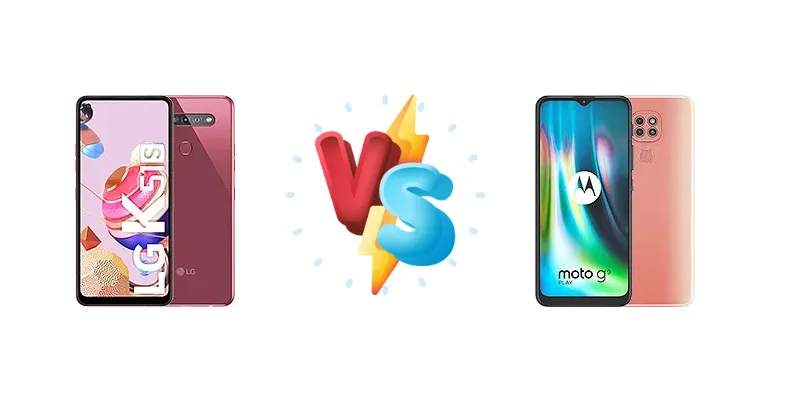
The LG K51S and Motorola Moto G9 Play represent two compelling options in the crowded budget smartphone market. While both aim to deliver essential features at an accessible price point, they take different approaches to achieving this. The K51S relies on MediaTek’s Helio P35, while the Moto G9 Play leverages Qualcomm’s Snapdragon 662. This comparison dives deep into the specifics to determine which device offers the best overall experience.
🏆 Quick Verdict
For most users, the Motorola Moto G9 Play emerges as the stronger choice. Its Snapdragon 662 chipset, coupled with 20W charging, provides a noticeable performance and usability advantage over the LG K51S’s Helio P35. While the LG K51S may be slightly cheaper, the Moto G9 Play’s efficiency and faster charging justify the potential price difference.
| Network |
|---|
| 2G bands | GSM 850 / 900 / 1800 / 1900 | GSM 850 / 900 / 1800 / 1900 |
| 3G bands | HSDPA 850 / 900 / 1900 / 2100 | HSDPA 850 / 900 / 1900 / 2100 |
| 4G bands | 1, 3, 7, 8, 20, 28, 38 | 1, 2, 3, 5, 7, 8, 18, 19, 20, 26, 28, 38, 40, 41 |
| EDGE | - | Class 10 |
| GPRS | - | Class 10 |
| Speed | HSPA 42.2/5.76 Mbps, LTE (2CA) Cat6 300/50 Mbps | HSPA 42.2/5.76 Mbps, LTE Cat4 150/50 Mbps |
| Technology | GSM / HSPA / LTE | GSM / HSPA / LTE |
| Launch |
|---|
| Announced | 2020, February 18. Released 2020, April 27 | 2020, August 24. Released 2020, August 28 |
| Status | Discontinued | Discontinued |
| Body |
|---|
| Build | - | Glass front, plastic back, plastic frame |
| Dimensions | 165.2 x 76.7 x 8.3 mm (6.50 x 3.02 x 0.33 in) | 165.2 x 75.7 x 9.2 mm (6.50 x 2.98 x 0.36 in) |
| Keyboard | - | QWERTY |
| SIM | · Nano-SIM· Nano-SIM + Nano-SIM | · Nano-SIM· Nano-SIM + Nano-SIM |
| Weight | 194.5 g (6.88 oz) | 200 g (7.05 oz) |
| | MIL-STD-810G compliant*
*does not guarantee ruggedness or use in extreme conditions | Water-repellent coating |
| Display |
|---|
| Protection | Scratch-resistant glass | - |
| Resolution | 720 x 1600 pixels, 20:9 ratio (~282 ppi density) | 720 x 1600 pixels, 20:9 ratio (~269 ppi density) |
| Size | 6.55 inches, 93.6 cm2 (~73.8% screen-to-body ratio) | 6.5 inches, 102.8 cm2 (~82.2% screen-to-body ratio) |
| Type | IPS LCD | IPS LCD |
| Platform |
|---|
| CPU | Octa-core (4x2.3 GHz Cortex-A53 & 4x1.8 GHz Cortex-A53) | Octa-core (4x2.0 GHz Kryo 260 Gold & 4x1.8 GHz Kryo 260 Silver) |
| Chipset | Mediatek MT6765 Helio P35 (12 nm) | Qualcomm SM6115 Snapdragon 662 (11 nm) |
| GPU | PowerVR GE8320 | Adreno 610 |
| OS | Android 9.0 (Pie) | Android 10, upgradable to Android 11 |
| Memory |
|---|
| Card slot | microSDXC (dedicated slot) | microSDXC (uses shared SIM slot) |
| Internal | 64GB 3GB RAM | 64GB 4GB RAM, 128GB 4GB RAM |
| | eMMC 5.1 | - |
| Main Camera |
|---|
| Features | LED flash, panorama, HDR | LED flash, HDR, panorama |
| Quad | 32 MP, (wide), PDAF
5 MP, f/2.2, 115˚, (ultrawide)
2 MP (macro)
Auxiliary lens | - |
| Single | - | 1.3 MP |
| Triple | - | 48 MP, f/1.7, (wide), 1/2.0", 0.8µm, PDAF
2 MP (macro)
Auxiliary lens |
| Video | 1080p@30fps | 1080p@30/60fps |
| Selfie camera |
|---|
| Features | - | HDR |
| Single | 13 MP, 1/3.1", 1.12µm | 8 MP, f/2.2, 1.12µm |
| Video | 1080p@30fps | 1080p@30fps |
| Sound |
|---|
| 3.5mm jack | Yes | Yes |
| 35mm jack | Yes | Yes |
| Loudspeaker | Yes | Yes |
| Comms |
|---|
| Bluetooth | 5.0, A2DP, LE | 5.0, A2DP, LE |
| Infrared port | - | Yes |
| NFC | Yes | Yes |
| Positioning | GPS | GPS, GLONASS, GALILEO |
| Radio | No | FM radio |
| USB | USB Type-C 2.0, OTG | USB Type-C 2.0 |
| WLAN | Wi-Fi 802.11 a/b/g/n, Wi-Fi Direct, DLNAorWi-Fi 802.11 b/g/n, Wi-Fi Direct, DLNA | Wi-Fi 802.11 a/b/g/n/ac, dual-band, Wi-Fi Direct |
| Features |
|---|
| Browser | - | WAP 2.0/xHTML, HTML (PocketIE) |
| Sensors | Fingerprint (rear-mounted), accelerometer, proximity, compass | Fingerprint (rear-mounted), accelerometer, gyro, proximity |
| Battery |
|---|
| Charging | - | 20W wired |
| Type | Li-Po 4000 mAh | Li-Po 5000 mAh |
| Misc |
|---|
| Colors | Titanium, Pink, Blue, Red | Forest Green, Sapphire Blue, Spring Pink |
| Models | LMK510EMW, LM-K510EMW, LM-K510 | XT2083, XT2083-1 |
| Price | About 200 EUR | About 430 EUR |
| Tests |
|---|
| Camera | - |
Photo / Video |
| Display | - |
Contrast ratio: 1944:1 |
| Loudspeaker | - |
-27.6 LUFS (Good)
|
| Performance | - |
AnTuTu: 170064 (v8)
GeekBench: 1402 (v5.1)
GFXBench: 13fps (ES 3.1 onscreen) |
LG K51S
- Potentially lower price point
- May offer longer battery life if capacity is higher (unconfirmed)
- Simple and straightforward user experience
- Inferior chipset performance (Helio P35)
- Likely slower charging speeds
- Potentially lower display brightness
Motorola Moto G9 Play
- Superior chipset performance (Snapdragon 662)
- Faster 20W wired charging
- Brighter and more vibrant display (465 nits)
- May be slightly more expensive
- Battery life may be slightly shorter if capacity is lower (unconfirmed)
- Motorola’s software can include bloatware
Display Comparison
The Motorola Moto G9 Play boasts a measured peak brightness of 465 nits and a 1944:1 contrast ratio, indicating a more vibrant and visible display, especially outdoors. The LG K51S’s display specifications are not provided, suggesting a potentially lower brightness and contrast. This difference is significant for users who frequently consume media or use their phones in bright sunlight. While both share the same contrast ratio, the G9 Play’s higher brightness provides a superior viewing experience.
Camera Comparison
Both devices are listed as having Photo/Video capabilities, but lack specific details. Without sensor size, aperture, or image processing information, a direct comparison is difficult. However, given Motorola’s generally more refined image processing algorithms, the Moto G9 Play is likely to produce more consistently pleasing photos, even with a similar sensor. The absence of details suggests both phones likely feature entry-level camera systems focused on basic functionality rather than advanced photography.
Performance
The core difference lies in the chipsets. The Motorola Moto G9 Play’s Qualcomm Snapdragon 662 (11nm) is architecturally superior to the LG K51S’s MediaTek Helio P35 (12nm). The Snapdragon 662 utilizes a combination of Kryo 260 Gold and Silver cores, offering a more balanced and efficient performance profile. The Helio P35, with its all Cortex-A53 configuration, is less capable in demanding tasks. The 11nm process node of the Snapdragon 662 also contributes to better thermal management and power efficiency, meaning less throttling during sustained use. This translates to a smoother experience for multitasking, gaming, and app loading on the Moto G9 Play.
Battery Life
Battery capacity isn’t specified for either device, making a direct mAh comparison impossible. However, the Motorola Moto G9 Play’s 20W wired charging is a significant advantage. This allows for a much faster 0-100% charge time compared to the LG K51S, which likely supports standard 10W or 15W charging. Even if the K51S has a slightly larger battery, the G9 Play’s faster charging mitigates the impact of a smaller capacity, providing more convenient top-ups throughout the day.
Buying Guide
Buy the LG K51S if your primary need is a very basic smartphone for essential tasks like calls, texts, and light social media, and you are prioritizing the absolute lowest possible price. Buy the Motorola Moto G9 Play if you value smoother performance for everyday apps, enjoy occasional gaming, and appreciate the convenience of faster charging – even if it means spending a little more upfront.
Frequently Asked Questions
❓ Will the Motorola Moto G9 Play handle popular games like PUBG Mobile or Call of Duty?
The Snapdragon 662 in the Moto G9 Play is capable of running PUBG Mobile and Call of Duty, but you’ll likely need to use medium or low graphics settings for a smooth experience. The Helio P35 in the LG K51S will struggle with these titles, even on the lowest settings.
❓ How much faster is the 20W charging on the Moto G9 Play compared to a standard charger?
A standard 10W or 15W charger will take significantly longer to fully charge the Moto G9 Play. 20W charging can reduce the 0-100% charge time by 30-50%, providing a much more convenient charging experience.
❓ Does the Motorola Moto G9 Play have a noticeable amount of bloatware?
Motorola phones historically include some pre-installed apps (bloatware). However, most can be uninstalled or disabled, minimizing their impact on performance and storage space. The amount of bloatware is generally manageable.
❓ Is the LG K51S a good option for someone who primarily uses their phone for calls and texts?
Yes, the LG K51S is a suitable option for basic communication. Its Helio P35 chipset is sufficient for calls, texts, and light social media use. However, if you anticipate using your phone for anything more demanding, the Moto G9 Play is a better choice.