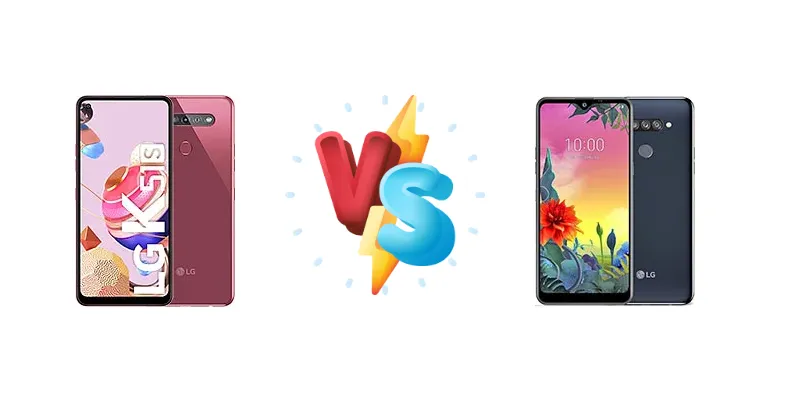
The LG K51S and K50S represent LG’s attempts to capture the ultra-budget smartphone market. While visually similar, a key difference lies under the hood: their chipsets. This comparison dissects the Mediatek Helio P35 in the K51S against the Helio P22 in the K50S, revealing which device offers a smoother experience for everyday use and light multitasking.
🏆 Quick Verdict
For most users, the LG K51S is the better choice. Its Mediatek Helio P35 chipset, with its higher clock speeds and more refined Cortex-A53 architecture, provides a noticeable performance boost over the K50S’s Helio P22, making it more responsive for app loading and general navigation.
| Network |
|---|
| 2G bands | GSM 850 / 900 / 1800 / 1900 | GSM 850 / 900 / 1800 / 1900 |
| 3G bands | HSDPA 850 / 900 / 1900 / 2100 | HSDPA 850 / 900 / 1900 / 2100 |
| 4G bands | 1, 3, 7, 8, 20, 28, 38 | 1, 3, 7, 8, 20 |
| Speed | HSPA 42.2/5.76 Mbps, LTE (2CA) Cat6 300/50 Mbps | HSPA 42.2/5.76 Mbps, LTE (2CA) Cat6 300/50 Mbps |
| Technology | GSM / HSPA / LTE | GSM / HSPA / LTE |
| Launch |
|---|
| Announced | 2020, February 18. Released 2020, April 27 | 2019, August. Released 2019, September |
| Status | Discontinued | Discontinued |
| Body |
|---|
| Dimensions | 165.2 x 76.7 x 8.3 mm (6.50 x 3.02 x 0.33 in) | 165.8 x 77.5 x 8.2 mm (6.53 x 3.05 x 0.32 in) |
| SIM | · Nano-SIM· Nano-SIM + Nano-SIM | · Nano-SIM· Nano-SIM + Nano-SIM |
| Weight | 194.5 g (6.88 oz) | 194 g (6.84 oz) |
| | MIL-STD-810G compliant*
*does not guarantee ruggedness or use in extreme conditions | MIL-STD-810G compliant*
*does not guarantee ruggedness or use in extreme conditions |
| Display |
|---|
| Protection | Scratch-resistant glass | - |
| Resolution | 720 x 1600 pixels, 20:9 ratio (~282 ppi density) | 720 x 1520 pixels, 19:9 ratio (~259 ppi density) |
| Size | 6.55 inches, 93.6 cm2 (~73.8% screen-to-body ratio) | 6.5 inches, 105.5 cm2 (~82.1% screen-to-body ratio) |
| Type | IPS LCD | IPS LCD |
| Platform |
|---|
| CPU | Octa-core (4x2.3 GHz Cortex-A53 & 4x1.8 GHz Cortex-A53) | Octa-core 2.0 GHz Cortex-A53 |
| Chipset | Mediatek MT6765 Helio P35 (12 nm) | Mediatek MT6762 Helio P22 (12 nm) |
| GPU | PowerVR GE8320 | PowerVR GE8320 |
| OS | Android 9.0 (Pie) | Android 9.0 (Pie) |
| Memory |
|---|
| Card slot | microSDXC (dedicated slot) | microSDXC (dedicated slot) |
| Internal | 64GB 3GB RAM | 32GB 3GB RAM |
| | eMMC 5.1 | eMMC 5.1 |
| Main Camera |
|---|
| Features | LED flash, panorama, HDR | LED flash, panorama, HDR |
| Quad | 32 MP, (wide), PDAF
5 MP, f/2.2, 115˚, (ultrawide)
2 MP (macro)
Auxiliary lens | - |
| Triple | - | 13 MP, f/2.2, 26mm (wide), PDAF
5 MP, f/2.2, 115˚ (ultrawide)
Auxiliary lens |
| Video | 1080p@30fps | 1080p@30fps |
| Selfie camera |
|---|
| Single | 13 MP, 1/3.1", 1.12µm | 13 MP, f/2.0, 1/3.1", 1.12µm |
| Video | 1080p@30fps | 1080p@30fps |
| Sound |
|---|
| 3.5mm jack | Yes | Yes |
| 35mm jack | Yes | Yes |
| Loudspeaker | Yes | Yes |
| Comms |
|---|
| Bluetooth | 5.0, A2DP, LE | 5.0, A2DP, LE |
| NFC | Yes | Yes (market/region dependent) |
| Positioning | GPS | GPS, GLONASS |
| Radio | No | FM radio |
| USB | USB Type-C 2.0, OTG | USB Type-C 2.0, OTG |
| WLAN | Wi-Fi 802.11 a/b/g/n, Wi-Fi Direct, DLNAorWi-Fi 802.11 b/g/n, Wi-Fi Direct, DLNA | Wi-Fi 802.11 a/b/g/n/ac, dual-band, Wi-Fi Direct, DLNA |
| Features |
|---|
| Sensors | Fingerprint (rear-mounted), accelerometer, proximity, compass | Fingerprint (rear-mounted), accelerometer, proximity |
| Battery |
|---|
| Type | Li-Po 4000 mAh | Li-Po 4000 mAh, non-removable |
| Misc |
|---|
| Colors | Titanium, Pink, Blue, Red | New Aurora Black, New Moroccan Blue |
| Models | LMK510EMW, LM-K510EMW, LM-K510 | LMX540HM, LM-X540, LM-X540BMW, LMX540BMW |
| Price | About 200 EUR | About 200 EUR |
LG K51S
- Faster processor for smoother multitasking
- Potentially better image processing
- Slightly more efficient chipset
- May be slightly more expensive than the K50S
- Likely similar display quality to the K50S
LG K50S
- Lower price point
- Adequate for basic tasks like calls and texts
- Similar battery life (potentially)
- Slower processor leading to lag
- Less responsive user interface
- Limited multitasking capabilities
Display Comparison
Both the LG K51S and K50S likely feature similar LCD panels, given their market positioning. Specifics like resolution and brightness are not provided, but the display experience will likely be comparable. The focus here isn't on visual fidelity, but on the underlying processing power to drive the UI smoothly. Bezels are expected to be substantial on both devices, typical of this price bracket.
Camera Comparison
Without detailed camera specifications, a direct comparison is difficult. However, both phones likely employ similar budget-oriented camera sensors. The image signal processor (ISP) within the Helio P35 of the K51S *may* offer slightly better image processing capabilities, potentially resulting in marginally improved photo quality in good lighting conditions. However, the difference will likely be minimal. Focusing on the chipset, the P35's ISP could handle faster image capture and processing, but this is speculative without further data.
Performance
The core difference lies in the chipsets. The LG K51S’s Mediatek Helio P35 (12nm) features an octa-core CPU configuration with a split design: four cores clocked at 2.3 GHz and four at 1.8 GHz, all Cortex-A53. This contrasts with the LG K50S’s Helio P22 (12nm) which utilizes an octa-core 2.0 GHz Cortex-A53 setup. While both are based on the Cortex-A53 architecture, the higher clock speeds on the P35, particularly the 2.3 GHz cores, translate to faster processing for demanding tasks. The P35 also benefits from slight architectural improvements over the P22, leading to better overall efficiency. This means the K51S will handle app switching and multitasking more effectively.
Battery Life
Battery capacity details are missing for both devices. However, given their similar target market, they likely feature comparable battery sizes. The Helio P35 in the K51S, being slightly more efficient, *could* translate to marginally better battery life, but this would depend heavily on usage patterns. Charging wattage is also unknown, making it impossible to compare charging speeds.
Buying Guide
Buy the LG K51S if you prioritize a more fluid user experience, even with basic tasks, and anticipate running multiple apps simultaneously. The extra processing power will translate to less lag and a more enjoyable daily experience. Buy the LG K50S if your needs are extremely basic – primarily calls, texts, and light social media – and you are seeking the absolute lowest possible price point, accepting a trade-off in performance.
Frequently Asked Questions
❓ Will the LG K51S handle popular social media apps like Facebook and Instagram without lag?
Yes, the Mediatek Helio P35 in the K51S is sufficiently powerful to run social media apps smoothly. The higher clock speeds and improved architecture compared to the K50S’s Helio P22 will minimize lag when scrolling through feeds and loading content.
❓ Is the performance difference between the K51S and K50S noticeable for everyday tasks like making calls and sending texts?
For basic tasks like calls and texts, the performance difference will be minimal. However, when switching between apps, opening multiple tabs in a browser, or performing any task requiring more processing power, the K51S will feel significantly more responsive due to its superior chipset.
❓ Can the LG K51S run mobile games, and if so, what kind of gaming experience can I expect?
The K51S can run less demanding mobile games, but don't expect high frame rates or graphics settings. Games like Candy Crush or simple puzzle games will run fine. More graphically intensive titles may require significant compromises in settings and may still experience lag. The Helio P35 is not a gaming-focused chipset.