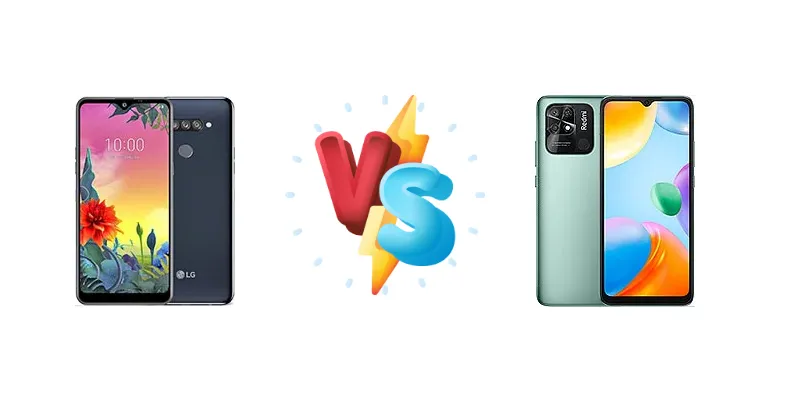
Both the LG K50S and Xiaomi Redmi 10C target the ultra-budget smartphone market, but they take drastically different approaches to achieving affordability. The K50S relies on an older Mediatek chipset, while the Redmi 10C leverages a newer Qualcomm offering. This comparison dives deep into the hardware to determine which phone delivers the best value for your money.
🏆 Quick Verdict
For the average user, the Xiaomi Redmi 10C is the clear winner. Its Snapdragon 680 chipset, built on a 6nm process, provides significantly better performance and power efficiency than the LG K50S’s 12nm Helio P22. The 18W charging is also a welcome addition, making the Redmi 10C a more practical daily driver.
| Network |
|---|
| 2G bands | GSM 850 / 900 / 1800 / 1900 | GSM 850 / 900 / 1800 / 1900 |
| 3G bands | HSDPA 850 / 900 / 1900 / 2100 | HSDPA 850 / 900 / 1700(AWS) / 1900 / 2100 |
| 4G bands | 1, 3, 7, 8, 20 | 1, 2, 3, 4, 5, 7, 8, 20, 28, 38, 40, 41 |
| Speed | HSPA 42.2/5.76 Mbps, LTE (2CA) Cat6 300/50 Mbps | HSPA, LTE |
| Technology | GSM / HSPA / LTE | GSM / HSPA / LTE |
| Launch |
|---|
| Announced | 2019, August. Released 2019, September | 2022, March 21 |
| Status | Discontinued | Available. Released 2022, March 23 |
| Body |
|---|
| Dimensions | 165.8 x 77.5 x 8.2 mm (6.53 x 3.05 x 0.32 in) | 169.6 x 76.6 x 8.3 mm (6.68 x 3.02 x 0.33 in) |
| SIM | · Nano-SIM· Nano-SIM + Nano-SIM | Nano-SIM + Nano-SIM |
| Weight | 194 g (6.84 oz) | 190 g (6.70 oz) |
| | MIL-STD-810G compliant*
*does not guarantee ruggedness or use in extreme conditions | - |
| Display |
|---|
| Protection | - | Corning Gorilla Glass |
| Resolution | 720 x 1520 pixels, 19:9 ratio (~259 ppi density) | 720 x 1650 pixels (~268 ppi density) |
| Size | 6.5 inches, 105.5 cm2 (~82.1% screen-to-body ratio) | 6.71 inches, 106.5 cm2 (~82.0% screen-to-body ratio) |
| Type | IPS LCD | IPS LCD |
| Platform |
|---|
| CPU | Octa-core 2.0 GHz Cortex-A53 | Octa-core (4x2.4 GHz Kryo 265 Gold & 4x1.9 GHz Kryo 265 Silver) |
| Chipset | Mediatek MT6762 Helio P22 (12 nm) | Qualcomm SM6225 Snapdragon 680 4G (6 nm) |
| GPU | PowerVR GE8320 | Adreno 610 |
| OS | Android 9.0 (Pie) | Android 11, MIUI 13 |
| Memory |
|---|
| Card slot | microSDXC (dedicated slot) | microSDXC (dedicated slot) |
| Internal | 32GB 3GB RAM | 64GB 3GB RAM, 64GB 4GB RAM, 128GB 3GB RAM, 128GB 4GB RAM |
| | eMMC 5.1 | UFS 2.2 |
| Main Camera |
|---|
| Dual | - | 50 MP, f/1.8, 26mm (wide), PDAF
Auxiliary lens |
| Features | LED flash, panorama, HDR | LED flash, HDR, panorama |
| Single | - | 5 MP, f/2.2 |
| Triple | 13 MP, f/2.2, 26mm (wide), PDAF
5 MP, f/2.2, 115˚ (ultrawide)
Auxiliary lens | - |
| Video | 1080p@30fps | 1080p@30fps |
| Selfie camera |
|---|
| Single | 13 MP, f/2.0, 1/3.1", 1.12µm | 5 MP, f/2.2 |
| Video | 1080p@30fps | 1080p@30fps |
| Sound |
|---|
| 3.5mm jack | Yes | Yes |
| 35mm jack | Yes | Yes |
| Loudspeaker | Yes | Yes |
| Comms |
|---|
| Bluetooth | 5.0, A2DP, LE | 5.0, A2DP, LE |
| NFC | Yes (market/region dependent) | Yes (market/region dependent) |
| Positioning | GPS, GLONASS | GPS, GLONASS, BDS, GALILEO |
| Radio | FM radio | FM radio |
| USB | USB Type-C 2.0, OTG | USB Type-C 2.0, OTG |
| WLAN | Wi-Fi 802.11 a/b/g/n/ac, dual-band, Wi-Fi Direct, DLNA | Wi-Fi 802.11 a/b/g/n/ac, dual-band, Wi-Fi Direct |
| Features |
|---|
| Sensors | Fingerprint (rear-mounted), accelerometer, proximity | Fingerprint (rear-mounted), accelerometer, proximity |
| Battery |
|---|
| Charging | - | 18W wired |
| Type | Li-Po 4000 mAh, non-removable | Li-Po 5000 mAh |
| Misc |
|---|
| Colors | New Aurora Black, New Moroccan Blue | Graphite Gray, Ocean Blue, Mint Green |
| Models | LMX540HM, LM-X540, LM-X540BMW, LMX540BMW | 220333QAG, 220333QBI, 220333QNY, 220333QL |
| Price | About 200 EUR | £ 99.00 / € 109.86 |
| SAR | - | 0.96 W/kg (head) 1.02 W/kg (body) |
| SAR EU | - | 0.57 W/kg (head) 0.96 W/kg (body) |
LG K50S
- Potentially lower price point (depending on retailer)
- LG's software features (if preferred)
- May be more readily available in certain regions
- Significantly weaker performance due to Helio P22 chipset
- Less power efficient, resulting in shorter battery life
- Slower charging speeds
Xiaomi Redmi 10C
- Superior performance with Snapdragon 680
- Better power efficiency for longer battery life
- Faster 18W wired charging
- May be slightly more expensive than the K50S
- Xiaomi's MIUI software can be polarizing
- Build quality may be similar to the K50S (plastic construction)
Display Comparison
Neither device is known for display excellence. Specifics regarding panel type (IPS vs. LCD) and resolution are not provided, but both likely feature basic LCD panels. The focus here is on the internal hardware, as display quality is unlikely to be a deciding factor. Bezels are expected to be substantial on both devices, typical for this price bracket. Color accuracy is likely to be standard, without any advanced calibration features.
Camera Comparison
Without detailed sensor information, a direct camera comparison is difficult. However, the chipset plays a role in image processing. The Snapdragon 680’s ISP (Image Signal Processor) is more advanced than the Helio P22’s, allowing for better noise reduction, dynamic range, and overall image quality. It's reasonable to assume the Redmi 10C will produce more detailed and visually appealing photos, especially in challenging lighting conditions. The prevalence of low-resolution auxiliary cameras (often 2MP) in this segment suggests focusing on the main sensor's capabilities is crucial, and the Redmi 10C likely has an edge due to its superior processing power.
Performance
The core difference lies in the chipsets. The Xiaomi Redmi 10C’s Qualcomm Snapdragon 680 (6nm) is a substantial upgrade over the LG K50S’s Mediatek Helio P22 (12nm). The 6nm process inherently offers better power efficiency, translating to longer battery life and less heat generation. The Snapdragon 680’s CPU configuration – a mix of 2.4 GHz Kryo 265 Gold and 1.9 GHz Kryo 265 Silver cores – provides a more balanced and powerful processing experience compared to the K50S’s homogenous 2.0 GHz Cortex-A53 octa-core setup. This means the Redmi 10C will handle multitasking and app loading significantly faster. While neither phone is a gaming powerhouse, the Redmi 10C will offer a smoother experience in less demanding titles.
Battery Life
While battery capacity isn't specified, the Redmi 10C’s 18W wired charging is a significant advantage. The K50S likely supports standard 10W or 15W charging, resulting in considerably longer charge times. The Snapdragon 680’s 6nm efficiency also contributes to better battery life, meaning the Redmi 10C will likely last longer on a single charge despite potentially having a similar battery capacity to the K50S. This translates to less frequent charging and a more convenient user experience.
Buying Guide
Buy the LG K50S if you absolutely need a phone with a specific LG software feature or find it at a significantly lower price point than the Redmi 10C. However, be prepared for noticeable performance limitations. Buy the Xiaomi Redmi 10C if you prioritize responsiveness, longer battery life, and faster charging – all crucial aspects for a positive smartphone experience, even on a budget.
Frequently Asked Questions
❓ Will the Redmi 10C handle popular apps like WhatsApp and Facebook smoothly?
Yes, the Snapdragon 680 is more than capable of handling everyday apps like WhatsApp, Facebook, and web browsing without noticeable lag. The increased processing power and efficiency compared to the Helio P22 in the K50S will provide a much smoother user experience.
❓ Is the Snapdragon 680 in the Redmi 10C good enough for playing games like PUBG Mobile?
While the Redmi 10C isn't a dedicated gaming phone, the Snapdragon 680 can run PUBG Mobile at lower settings (balanced graphics, medium frame rate). Expect some occasional frame drops during intense action, but it's playable. The K50S would struggle significantly more with the same game.
❓ How long does it take to fully charge the Redmi 10C with the 18W charger?
With the included 18W charger, the Redmi 10C should fully charge from 0% to 100% in approximately 2-2.5 hours, depending on battery capacity. This is considerably faster than the LG K50S, which likely takes 3+ hours with a standard charger.
❓ Does the Redmi 10C support software updates?
Xiaomi generally provides software updates for its devices, including security patches and potentially Android version upgrades. However, the longevity of software support for budget devices like the Redmi 10C is typically shorter than for flagship models. Check Xiaomi's official website for the latest update information.