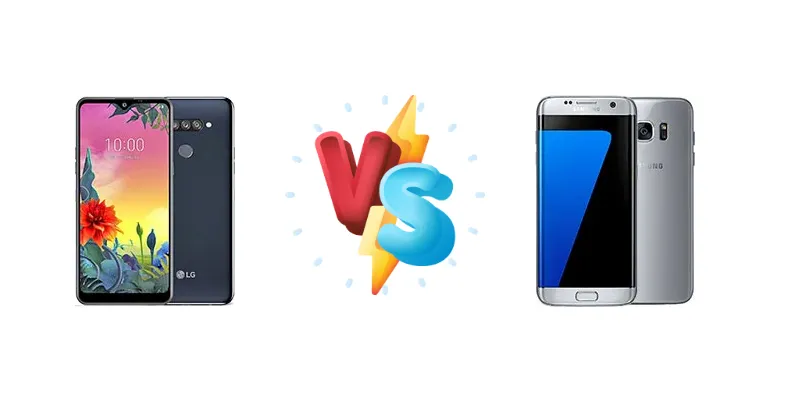
The Samsung Galaxy S7 edge, released in 2016, represented the pinnacle of smartphone design and performance for its time. Now, years later, it faces a new contender: the LG K50S, a modern budget device. This comparison isn't about raw power; it's about value, longevity, and understanding where each phone excels in today's market.
🏆 Quick Verdict
For the average user in 2024, the Samsung Galaxy S7 edge offers a more refined experience thanks to its superior display and faster processor, despite its age. However, the LG K50S provides a longer software support lifespan and a more modern feature set for a significantly lower price.
| Network |
|---|
| 2G bands | GSM 850 / 900 / 1800 / 1900 | GSM 850 / 900 / 1800 / 1900 - SIM 1 & SIM 2 - G935FD, G9350 |
| 3G bands | HSDPA 850 / 900 / 1900 / 2100 | HSDPA 850 / 900 / 1700(AWS) / 1900 / 2100 - G935F, G935FD, G935W8 |
| 4G bands | 1, 3, 7, 8, 20 | 1, 2, 3, 4, 5, 7, 8, 12, 13, 17, 18, 19, 20, 25, 26, 28, 38, 39, 40, 41 - G935F, G935FD |
| Speed | HSPA 42.2/5.76 Mbps, LTE (2CA) Cat6 300/50 Mbps | HSPA 42.2/5.76 Mbps, LTE (3CA) Cat9 450/50 Mbps |
| Technology | GSM / HSPA / LTE | GSM / HSPA / LTE |
| Launch |
|---|
| Announced | 2019, August. Released 2019, September | 2016, February 21. Released 2016, March 11 |
| Status | Discontinued | Discontinued |
| Body |
|---|
| Build | - | Glass front (Gorilla Glass 4), glass back (Gorilla Glass 4), aluminum frame |
| Dimensions | 165.8 x 77.5 x 8.2 mm (6.53 x 3.05 x 0.32 in) | 150.9 x 72.6 x 7.7 mm (5.94 x 2.86 x 0.30 in) |
| SIM | · Nano-SIM· Nano-SIM + Nano-SIM | · Nano-SIM (G935F, G935W8)· Nano-SIM + Nano-SIM (G935FD) |
| Weight | 194 g (6.84 oz) | 157 g (5.54 oz) |
| | MIL-STD-810G compliant*
*does not guarantee ruggedness or use in extreme conditions | - |
| Display |
|---|
| Protection | - | Corning Gorilla Glass 4 |
| Resolution | 720 x 1520 pixels, 19:9 ratio (~259 ppi density) | 1440 x 2560 pixels, 16:9 ratio (~534 ppi density) |
| Size | 6.5 inches, 105.5 cm2 (~82.1% screen-to-body ratio) | 5.5 inches, 83.4 cm2 (~76.1% screen-to-body ratio) |
| Type | IPS LCD | Super AMOLED |
| Platform |
|---|
| CPU | Octa-core 2.0 GHz Cortex-A53 | Quad-core (2x2.15 GHz Kryo & 2x1.6 GHz Kryo) - G9350Octa-core (4x2.3 GHz Mongoose & 4x1.6 GHz Cortex-A53) - G935FD, G935F, G935W8 |
| Chipset | Mediatek MT6762 Helio P22 (12 nm) | Qualcomm MSM8996 Snapdragon 820 (14 nm) - G9350Exynos 8890 Octa (14 nm) - G935FD, G935F, G935W8 |
| GPU | PowerVR GE8320 | Adreno 530 - G9350Mali-T880 MP12 - G935FD, G935F, G935W8 |
| OS | Android 9.0 (Pie) | Android 6.0 (Marshmallow), upgradable to Android 8.0 (Oreo), TouchWiz UI |
| Memory |
|---|
| Card slot | microSDXC (dedicated slot) | microSDXC (uses shared SIM slot) - dual SIM model only |
| Internal | 32GB 3GB RAM | 32GB 4GB RAM, 64GB 4GB RAM, 128GB 4GB RAM |
| | eMMC 5.1 | - |
| Main Camera |
|---|
| Features | LED flash, panorama, HDR | LED flash, auto-HDR, panorama |
| Single | - | 12 MP, f/1.7, 26mm (wide), 1/2.55", 1.4µm, dual pixel PDAF, OIS |
| Triple | 13 MP, f/2.2, 26mm (wide), PDAF
5 MP, f/2.2, 115˚ (ultrawide)
Auxiliary lens | - |
| Video | 1080p@30fps | 4K@30fps, 1080p@30fps (gyro-EIS), 1080p@60fps, 720p@240fps, HDR, stereo sound rec., OIS |
| Selfie camera |
|---|
| Features | - | HDR |
| Single | 13 MP, f/2.0, 1/3.1", 1.12µm | 5 MP, f/1.7, 22mm (wide), 1/4.1", 1.34µm |
| Video | 1080p@30fps | - |
| Sound |
|---|
| 3.5mm jack | Yes | Yes |
| 35mm jack | Yes | Yes |
| Loudspeaker | Yes | Yes |
| Comms |
|---|
| Bluetooth | 5.0, A2DP, LE | 4.2, A2DP, LE, aptX |
| NFC | Yes (market/region dependent) | Yes |
| Positioning | GPS, GLONASS | GPS, GLONASS, BDS |
| Radio | FM radio | No |
| USB | USB Type-C 2.0, OTG | microUSB 2.0, OTG |
| WLAN | Wi-Fi 802.11 a/b/g/n/ac, dual-band, Wi-Fi Direct, DLNA | Wi-Fi 802.11 a/b/g/n/ac, dual-band, Wi-Fi Direct |
| Features |
|---|
| Sensors | Fingerprint (rear-mounted), accelerometer, proximity | Fingerprint (front-mounted), accelerometer, gyro, proximity, compass, barometer, heart rate, SpO2 |
| Battery |
|---|
| Charging | - | 15W wired, QC2
Wireless (Qi) (market dependent) |
| Music play | - | Up to 74 h |
| Talk time | - | Up to 27 h (3G) |
| Type | Li-Po 4000 mAh, non-removable | Li-Ion 3600 mAh, non-removable |
| Misc |
|---|
| Colors | New Aurora Black, New Moroccan Blue | Black, White, Gold, Silver, Pink Gold, Black Pearl, Coral Blue |
| Models | LMX540HM, LM-X540, LM-X540BMW, LMX540BMW | SM-G935F, SM-G935FD, SM-G935W8, SM-G9350, SM-G935S, SC-02H, SM-G935K, SM-G935L, SM-G935R4, SCV33, SM-G935X, SM-G935VC, SM-G935D |
| Price | About 200 EUR | About 330 EUR |
| SAR | - | 0.56 W/kg (head) 0.66 W/kg (body) |
| SAR EU | - | 0.26 W/kg (head) 1.43 W/kg (body) |
| Tests |
|---|
| Audio quality | - |
Noise -92.5dB / Crosstalk -92.2dB |
| Battery life | - |
Endurance rating 92h
|
| Camera | - |
Photo / Video |
| Display | - |
Contrast ratio: Infinite (nominal), 4.439 (sunlight) |
| Loudspeaker | - |
Voice 70dB / Noise 69dB / Ring 71dB
|
| Performance | - |
GFXBench: 8.3fps (ES 3.1 onscreen) |
LG K50S
- Modern software support
- Lower price point
- Potentially better battery health (new battery)
- Significantly weaker performance
- Inferior display quality
- Less refined camera system
Samsung Galaxy S7 edge
- Superior display quality (AMOLED, curved)
- Faster processor for demanding tasks
- Wireless charging support
- Aging battery and potential degradation
- Limited software updates
- Higher price (even used)
Display Comparison
Both devices boast 'Infinite' contrast ratios, a marketing term indicating excellent black levels. However, the S7 edge’s Super AMOLED panel, with a sunlight contrast ratio of 4.439, likely delivers superior outdoor visibility compared to the K50S’s LCD. The S7 edge’s curved display is a key differentiator, offering a more immersive viewing experience, though it also introduces potential issues with accidental touches. The K50S, lacking specific display specs, likely has a lower resolution and color gamut, impacting image clarity and vibrancy.
Camera Comparison
While both phones offer photo and video capabilities, a direct comparison is difficult without detailed camera specs. The S7 edge, being a flagship, likely features a larger sensor and more advanced image processing algorithms. The K50S, typical of budget phones, likely prioritizes quantity over quality, potentially including low-resolution auxiliary cameras. The S7 edge’s image stabilization (OIS) would provide sharper photos and smoother videos, a feature likely absent on the K50S.
Performance
The Samsung Galaxy S7 edge, depending on the region, utilizes either the Qualcomm MSM8996 Snapdragon 820 (14nm) or the Exynos 8890 Octa (14nm). Both are significantly more powerful than the LG K50S’s Mediatek MT6762 Helio P22 (12nm). The Snapdragon 820’s quad-core Kryo architecture (2x2.15 GHz & 2x1.6 GHz) and the Exynos 8890’s octa-core configuration (4x2.3 GHz Mongoose & 4x1.6 GHz Cortex-A53) provide a substantial performance advantage in multitasking and demanding applications. The Helio P22’s octa-core Cortex-A53 at 2.0 GHz is geared towards efficiency, making it suitable for everyday tasks but struggling with graphically intensive games. The 14nm process node used in both S7 edge chipsets also contributes to better thermal management compared to the K50S’s 12nm node.
Battery Life
The Samsung Galaxy S7 edge boasts an endurance rating of 92 hours, indicating excellent battery life for its time. It supports 15W wired charging with Quick Charge 2.0 and wireless charging (Qi, market dependent). The LG K50S’s battery capacity is unknown, but its less powerful processor and likely lower-resolution display suggest comparable, if not slightly better, endurance. However, the S7 edge’s aging battery will likely have degraded significantly, reducing its real-world performance. The K50S benefits from a newer battery and potentially more efficient power management.
Buying Guide
Buy the LG K50S if you need a reliable, affordable smartphone with a guaranteed software update path and don't require top-tier performance. Buy the Samsung Galaxy S7 edge if you prioritize a stunning curved display, faster processing for demanding apps, and are comfortable with a device nearing its end-of-life in terms of software support and battery health.
Frequently Asked Questions
❓ Is the Exynos 8890 chip in some S7 edge models prone to overheating?
Yes, the Exynos 8890 variant of the S7 edge was known to experience thermal throttling under sustained load, particularly in warmer climates. This could lead to performance drops during extended gaming sessions or video recording. The Snapdragon 820 variant generally handled heat better.
❓ Does the LG K50S have enough power to run popular games like PUBG Mobile?
The LG K50S can run PUBG Mobile, but likely at lower graphics settings and frame rates. The Helio P22 chipset is not designed for demanding games, so expect noticeable lag and reduced visual fidelity compared to the S7 edge.
❓ How long will the Samsung Galaxy S7 edge continue to receive security updates?
Samsung officially ended support for the Galaxy S7 edge in 2021. It no longer receives security updates, making it vulnerable to potential security threats. Using the device carries inherent risks.
❓ Is the curved screen on the S7 edge prone to accidental touches?
Yes, the curved screen can sometimes register accidental touches, especially when holding the phone. Screen protectors designed for curved displays can help mitigate this issue, but may slightly reduce the immersive effect.