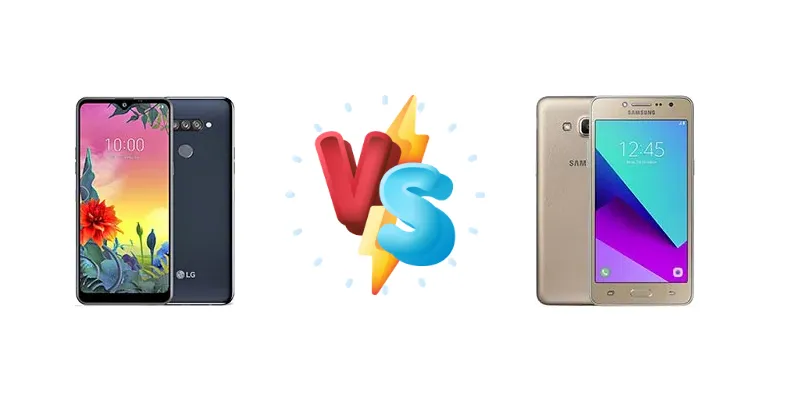
The LG K50S and Samsung Galaxy J2 Prime represent two ends of the ultra-budget smartphone spectrum. While both aim to deliver essential smartphone functionality at a low price point, they differ significantly in their internal hardware. This comparison dissects those differences, focusing on how the chipset choices impact real-world performance and user experience.
🏆 Quick Verdict
For the average user prioritizing responsiveness and future-proofing, the LG K50S is the clear winner. Its Mediatek Helio P22 chipset, built on a 12nm process, offers a substantial performance advantage over the Samsung Galaxy J2 Prime’s older, 28nm MT6737T, making it better suited for multitasking and modern app usage.
| Network |
|---|
| 2G bands | GSM 850 / 900 / 1800 / 1900 | GSM 850 / 900 / 1800 / 1900 - SIM 1 & SIM 2 (dual-SIM model only) |
| 3G bands | HSDPA 850 / 900 / 1900 / 2100 | HSDPA 850 / 900 / 1900 / 2100 - G532F, G532G |
| 4G bands | 1, 3, 7, 8, 20 | 1, 3, 5, 7, 8, 20 - G532F |
| Speed | HSPA 42.2/5.76 Mbps, LTE (2CA) Cat6 300/50 Mbps | HSPA 42.2/5.76 Mbps, LTE Cat4 150/50 Mbps |
| Technology | GSM / HSPA / LTE | GSM / HSPA / LTE |
| Launch |
|---|
| Announced | 2019, August. Released 2019, September | 2016, November. Released 2016, November |
| Status | Discontinued | Discontinued |
| Body |
|---|
| Build | - | Glass front, plastic back, plastic frame |
| Dimensions | 165.8 x 77.5 x 8.2 mm (6.53 x 3.05 x 0.32 in) | 144.8 x 72.1 x 8.9 mm (5.70 x 2.84 x 0.35 in) |
| SIM | · Nano-SIM· Nano-SIM + Nano-SIM | · Single SIM (Micro-SIM) or Hybrid Dual SIM (Micro-SIM, dual stand-by) |
| Weight | 194 g (6.84 oz) | 160 g (5.64 oz) |
| | MIL-STD-810G compliant*
*does not guarantee ruggedness or use in extreme conditions | - |
| Display |
|---|
| Resolution | 720 x 1520 pixels, 19:9 ratio (~259 ppi density) | 540 x 960 pixels, 16:9 ratio (~220 ppi density) |
| Size | 6.5 inches, 105.5 cm2 (~82.1% screen-to-body ratio) | 5.0 inches, 68.9 cm2 (~66.0% screen-to-body ratio) |
| Type | IPS LCD | PLS LCD |
| Platform |
|---|
| CPU | Octa-core 2.0 GHz Cortex-A53 | Quad-core 1.4 GHz Cortex-A53 |
| Chipset | Mediatek MT6762 Helio P22 (12 nm) | Mediatek MT6737T (28 nm) |
| GPU | PowerVR GE8320 | Mali-T720MP2 |
| OS | Android 9.0 (Pie) | Android 6.0 (Marshmallow) |
| Memory |
|---|
| Card slot | microSDXC (dedicated slot) | microSDXC (uses shared SIM slot) - dual SIM model only |
| Internal | 32GB 3GB RAM | 8GB 1.5GB RAM, 16GB 1.5GB RAM |
| | eMMC 5.1 | - |
| Main Camera |
|---|
| Features | LED flash, panorama, HDR | LED flash |
| Single | - | 8 MP, f/2.2, AF |
| Triple | 13 MP, f/2.2, 26mm (wide), PDAF
5 MP, f/2.2, 115˚ (ultrawide)
Auxiliary lens | - |
| Video | 1080p@30fps | 720p@30fps |
| Selfie camera |
|---|
| Features | - | LED flash |
| Single | 13 MP, f/2.0, 1/3.1", 1.12µm | 5 MP, f/2.2 |
| Video | 1080p@30fps | - |
| Sound |
|---|
| 3.5mm jack | Yes | Yes |
| 35mm jack | Yes | Yes |
| Loudspeaker | Yes | Yes |
| Comms |
|---|
| Bluetooth | 5.0, A2DP, LE | 4.2, A2DP, LE |
| NFC | Yes (market/region dependent) | No |
| Positioning | GPS, GLONASS | GPS, GLONASS |
| Radio | FM radio | FM radio, RDS, recording |
| USB | USB Type-C 2.0, OTG | microUSB 2.0, OTG |
| WLAN | Wi-Fi 802.11 a/b/g/n/ac, dual-band, Wi-Fi Direct, DLNA | Wi-Fi 802.11 b/g/n, Wi-Fi Direct |
| Features |
|---|
| Sensors | Fingerprint (rear-mounted), accelerometer, proximity | Accelerometer, proximity |
| Battery |
|---|
| Music play | - | Up to 59 h |
| Talk time | - | Up to 12 h (3G) |
| Type | Li-Po 4000 mAh, non-removable | Li-Ion 2600 mAh, removable |
| Misc |
|---|
| Colors | New Aurora Black, New Moroccan Blue | Black, Gold, Silver, Pink |
| Models | LMX540HM, LM-X540, LM-X540BMW, LMX540BMW | SM-G532G, SM-G532M, SM-G532G, SM-G532F, SM-G532MT |
| Price | About 200 EUR | About 130 EUR |
| SAR | - | 0.45 W/kg (head) 0.99 W/kg (body) |
| SAR EU | - | 0.53 W/kg (head) 1.27 W/kg (body) |
LG K50S
- Significantly faster processor for smoother multitasking.
- More power-efficient chipset leading to better battery life.
- Likely benefits from improved software and image processing.
- May be slightly more expensive than the J2 Prime.
- Still an entry-level device with limitations in high-end tasks.
Samsung Galaxy J2 Prime
- Extremely affordable – ideal for minimal budgets.
- Functional for basic communication tasks.
- Simple and easy to use interface.
- Slow processor struggles with multitasking and modern apps.
- Less power-efficient chipset results in shorter battery life.
- Outdated hardware may not receive future software updates.
Display Comparison
Neither device is known for display excellence. Given the context data focuses on chipsets, we can infer both likely utilize LCD panels. The J2 Prime, being an older model, likely has wider bezels. While specific nit brightness isn't provided, the K50S's later release suggests a potentially brighter display. Color accuracy is expected to be basic on both, geared towards standard sRGB coverage rather than wider color gamuts.
Camera Comparison
Without detailed camera specs, a direct comparison is limited. However, it’s reasonable to assume both phones feature basic camera setups geared towards casual photography. The K50S, being a newer device, likely benefits from improved image processing algorithms, even with similar sensor resolutions. The larger processing power of the Helio P22 allows for faster image capture and potentially better low-light performance. The presence of a 2MP macro lens on either device is largely a marketing gimmick, offering minimal practical benefit.
Performance
The core difference lies in the chipsets. The LG K50S’s Mediatek Helio P22 (12nm) features an octa-core CPU clocked at 2.0 GHz, utilizing Cortex-A53 cores. This contrasts sharply with the Samsung Galaxy J2 Prime’s Mediatek MT6737T (28nm) which has a quad-core CPU at 1.4 GHz, also using Cortex-A53 cores. The 12nm fabrication process of the Helio P22 is significantly more efficient than the 28nm process of the MT6737T, resulting in lower power consumption and less heat generation for similar workloads. The octa-core configuration further enhances multitasking capabilities on the K50S. The J2 Prime will struggle with more than a few apps open simultaneously.
Battery Life
Battery capacity isn't specified, but the K50S’s more efficient chipset (Helio P22, 12nm) will translate to longer battery life under typical usage. The 28nm MT6737T in the J2 Prime will consume more power for the same tasks. While charging wattage is unknown for both, the K50S’s efficiency advantage means it will likely reach a full charge faster with a comparable charger. The difference in power efficiency will be most noticeable during sustained use, such as video playback or gaming.
Buying Guide
Buy the LG K50S if you need a phone capable of handling more demanding apps and multitasking without significant slowdowns. Its newer chipset provides a smoother experience for social media, video streaming, and light gaming. Buy the Samsung Galaxy J2 Prime if your primary needs are basic communication – calls, texts, and very light web browsing – and you prioritize absolute minimal cost over performance. It's a functional device for those with extremely limited budgets.
Frequently Asked Questions
❓ Will the LG K50S handle popular apps like WhatsApp and Facebook Messenger smoothly?
Yes, the Helio P22 chipset in the LG K50S is capable of running apps like WhatsApp and Facebook Messenger without significant lag. The octa-core CPU and improved efficiency provide a much smoother experience compared to the quad-core MT6737T in the J2 Prime, especially when multitasking between these apps.
❓ Is the Samsung Galaxy J2 Prime suitable for playing mobile games?
The Samsung Galaxy J2 Prime is not well-suited for gaming. The MT6737T chipset struggles with graphically demanding games, and the limited processing power will result in low frame rates and stuttering. While basic games might be playable, the experience will likely be frustrating. The LG K50S offers a slightly better gaming experience, but it's still an entry-level device and won't handle demanding titles well.
❓ How much of a difference will the 12nm vs 28nm process make in real-world battery life?
The difference is substantial. The 12nm process used in the Helio P22 is far more efficient. This means the LG K50S will consume less power for the same tasks, resulting in noticeably longer battery life compared to the Samsung Galaxy J2 Prime, which uses the older 28nm process. Expect several extra hours of usage on the K50S.