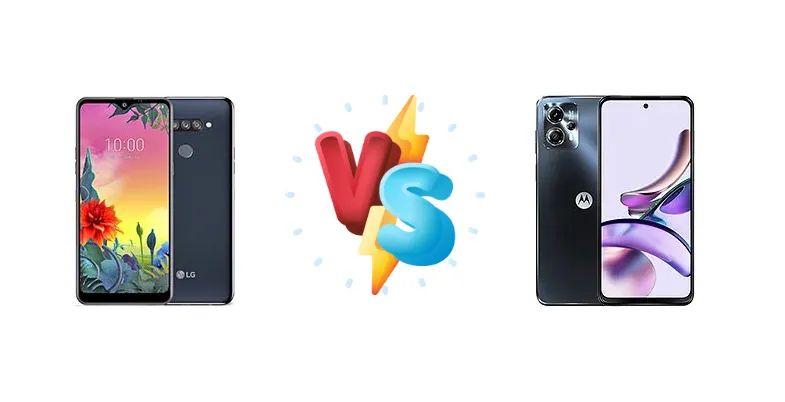
The LG K50S and Motorola Moto G13 represent two approaches to the ultra-budget smartphone market. The K50S, while older, may still be available through various channels. The Moto G13 offers a more modern chipset and faster charging, but at what cost? This comparison dissects the key differences to determine which device delivers the best value.
🏆 Quick Verdict
For most users, the Motorola Moto G13 is the superior choice. Its Helio G85 chipset provides a noticeable performance uplift over the LG K50S’s Helio P22, particularly in multitasking and gaming. While both phones target the budget segment, the G13’s faster charging and more efficient CPU architecture justify the potential price difference.
| Network |
|---|
| 2G bands | GSM 850 / 900 / 1800 / 1900 | GSM 850 / 900 / 1800 / 1900 |
| 3G bands | HSDPA 850 / 900 / 1900 / 2100 | HSDPA 850 / 900 / 1900 / 2100 |
| 4G bands | 1, 3, 7, 8, 20 | 1, 2, 3, 5, 7, 8, 20, 38, 40, 41 |
| Speed | HSPA 42.2/5.76 Mbps, LTE (2CA) Cat6 300/50 Mbps | HSPA, LTE |
| Technology | GSM / HSPA / LTE | GSM / HSPA / LTE |
| Launch |
|---|
| Announced | 2019, August. Released 2019, September | 2023, January 24 |
| Status | Discontinued | Available. Released 2023, January 24 |
| Body |
|---|
| Build | - | Glass front, plastic frame, plastic back |
| Dimensions | 165.8 x 77.5 x 8.2 mm (6.53 x 3.05 x 0.32 in) | 162.7 x 74.7 x 8.2 mm (6.41 x 2.94 x 0.32 in) |
| SIM | · Nano-SIM· Nano-SIM + Nano-SIM | · Nano-SIM· Nano-SIM + Nano-SIM |
| Weight | 194 g (6.84 oz) | 183.5 g (6.49 oz) |
| | MIL-STD-810G compliant*
*does not guarantee ruggedness or use in extreme conditions | Water-resistant design |
| Display |
|---|
| Protection | - | Panda glass |
| Resolution | 720 x 1520 pixels, 19:9 ratio (~259 ppi density) | 720 x 1600 pixels, 20:9 ratio (~270 ppi density) |
| Size | 6.5 inches, 105.5 cm2 (~82.1% screen-to-body ratio) | 6.5 inches, 102.0 cm2 (~83.9% screen-to-body ratio) |
| Type | IPS LCD | IPS LCD, 90Hz, 400 nits (peak) |
| Platform |
|---|
| CPU | Octa-core 2.0 GHz Cortex-A53 | Octa-core (2x2.0 GHz Cortex-A75 & 6x1.8 GHz Cortex-A55) |
| Chipset | Mediatek MT6762 Helio P22 (12 nm) | Mediatek MT6769Z Helio G85 (12 nm) |
| GPU | PowerVR GE8320 | Mali-G52 MC2 |
| OS | Android 9.0 (Pie) | Android 13 |
| Memory |
|---|
| Card slot | microSDXC (dedicated slot) | microSDXC (dedicated slot) |
| Internal | 32GB 3GB RAM | 64GB 4GB RAM, 128GB 4GB RAM |
| | eMMC 5.1 | - |
| Main Camera |
|---|
| Features | LED flash, panorama, HDR | LED flash, HDR, panorama |
| Triple | 13 MP, f/2.2, 26mm (wide), PDAF
5 MP, f/2.2, 115˚ (ultrawide)
Auxiliary lens | 50 MP, f/1.8, (wide), 0.64µm, PDAF
2 MP (macro)
Auxiliary lens |
| Video | 1080p@30fps | 1080p@30fps |
| Selfie camera |
|---|
| Single | 13 MP, f/2.0, 1/3.1", 1.12µm | 8 MP, f/2.0, (wide), 1/4.0", 1.12µm |
| Video | 1080p@30fps | 1080p@30fps |
| Sound |
|---|
| 3.5mm jack | Yes | Yes |
| 35mm jack | Yes | Yes |
| Loudspeaker | Yes | Yes, with stereo speakers |
| Comms |
|---|
| Bluetooth | 5.0, A2DP, LE | 5.1, A2DP, LE |
| NFC | Yes (market/region dependent) | Yes (market/region dependent) |
| Positioning | GPS, GLONASS | GPS, GLONASS, GALILEO |
| Radio | FM radio | Unspecified |
| USB | USB Type-C 2.0, OTG | USB Type-C 2.0 |
| WLAN | Wi-Fi 802.11 a/b/g/n/ac, dual-band, Wi-Fi Direct, DLNA | Wi-Fi 802.11 a/b/g/n/ac, dual-band |
| Features |
|---|
| Sensors | Fingerprint (rear-mounted), accelerometer, proximity | Fingerprint (side-mounted), accelerometer, gyro, proximity |
| Battery |
|---|
| Charging | - | 20W or 10W wired |
| Type | Li-Po 4000 mAh, non-removable | Li-Po 5000 mAh |
| Misc |
|---|
| Colors | New Aurora Black, New Moroccan Blue | Matte Charcoal, Blue Lavender, Rose Gold |
| Models | LMX540HM, LM-X540, LM-X540BMW, LMX540BMW | - |
| Price | About 200 EUR | About 160 EUR |
LG K50S
- Potentially lower price point
- May be readily available in some markets
- Simple and straightforward user experience
- Significantly slower performance
- Outdated chipset
- Likely slower charging speeds
- Inferior camera performance
Motorola Moto G13
- Faster and more responsive performance
- More efficient CPU architecture
- Faster charging (20W)
- Better camera with 50MP main sensor
- May be slightly more expensive
- Still a budget device with limitations
- Software updates may be limited
Display Comparison
Neither device is expected to boast a premium display experience. Both utilize 12nm chipsets, suggesting a focus on cost optimization over display technology. While specific display specs for the K50S are unavailable, the Moto G13 likely features a standard LCD panel. The key difference will be in processing power to drive the display smoothly; the G13’s more powerful GPU will handle UI transitions and video playback with less stuttering.
Camera Comparison
Camera performance on both devices is expected to be basic. The LG K50S’s camera configuration is unknown, but the Moto G13 features a 50MP main sensor, which is a significant advantage over any likely sensor on the K50S. While megapixel count isn’t everything, a larger sensor generally captures more light and detail. The Moto G13 also includes 2MP macro and depth sensors, which are of limited utility. Image processing will likely be the differentiating factor, with Motorola’s software potentially offering better dynamic range and noise reduction than LG’s older algorithms.
Performance
The Motorola Moto G13’s Mediatek Helio G85 is a clear upgrade over the LG K50S’s Helio P22. The G85 features a combination of 2x 2.0 GHz Cortex-A75 cores and 6x 1.8 GHz Cortex-A55 cores, compared to the K50S’s all Cortex-A53 cores clocked at 2.0 GHz. The A75 cores in the G85 provide significantly better single-core performance, crucial for app launch speeds and general responsiveness. The G85’s GPU also offers a substantial improvement for gaming. The K50S will struggle with demanding titles, while the G13 can handle many popular games at medium settings. Both devices likely utilize LPDDR3 RAM, limiting overall memory bandwidth.
Battery Life
Battery capacity is not specified for the LG K50S, but both phones likely feature batteries in the 4000-5000 mAh range. The Moto G13’s advantage lies in its 20W (or 10W depending on region) wired charging, significantly faster than any charging capability likely found on the K50S. This means the G13 can top up its battery much quicker, reducing downtime. While the K50S might offer similar battery life in typical usage, the G13’s faster charging provides a more convenient experience.
Buying Guide
Buy the LG K50S if you prioritize absolute minimal cost and are only using the phone for very basic tasks like calls, texts, and light social media. Its older chipset is sufficient for these limited workloads. Buy the Motorola Moto G13 if you want a more responsive experience, enjoy occasional gaming, or value faster charging speeds. The G13 offers a significantly better user experience for a modest price increase.
Frequently Asked Questions
❓ Will the Moto G13 handle popular games like PUBG Mobile or Call of Duty Mobile?
The Moto G13’s Helio G85 chipset can run PUBG Mobile and Call of Duty Mobile, but you’ll likely need to play at medium graphics settings and potentially lower the frame rate for a smooth experience. The Helio P22 in the LG K50S will struggle significantly with these titles.
❓ How much faster is the charging on the Moto G13 compared to the LG K50S?
The Moto G13 supports 20W charging (or 10W depending on region), while the LG K50S likely uses a much slower 5W or 10W charger. This means the Moto G13 can charge from 0-100% in approximately 1.5-2 hours, while the K50S could take 3-4 hours or longer.
❓ Is the 50MP camera on the Moto G13 a significant improvement over the LG K50S?
Yes, a 50MP sensor generally captures more detail and performs better in low-light conditions than the likely lower-resolution sensor on the LG K50S. While software processing plays a role, the larger sensor provides a fundamental advantage.
❓ Will I notice a difference in everyday tasks like browsing and social media between these two phones?
Absolutely. The Moto G13’s Helio G85 chipset and more efficient CPU cores will result in snappier app launches, smoother scrolling, and a more responsive overall experience compared to the LG K50S’s Helio P22.