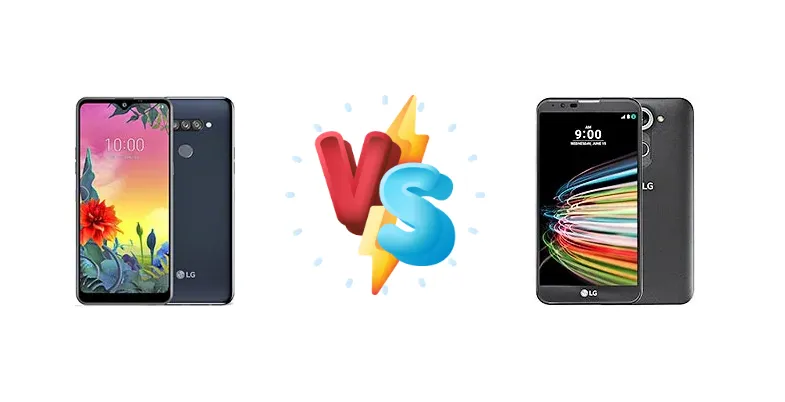
The LG K50S and X mach represent different approaches to the budget smartphone market. The K50S, released later, leverages MediaTek's Helio P22, while the X mach relies on the older, but historically more powerful, Qualcomm Snapdragon 808. This comparison dissects the trade-offs between newer efficiency and established, albeit aging, performance.
🏆 Quick Verdict
For the average user prioritizing responsiveness and smoother multitasking, the LG X mach emerges as the better choice. Despite its older 20nm process, the Snapdragon 808’s hexa-core architecture, including Cortex-A57 cores, delivers a noticeable performance advantage over the K50S’s Helio P22. However, the K50S offers potentially better battery life due to the P22’s more efficient design.
| Network |
|---|
| 2G bands | GSM 850 / 900 / 1800 / 1900 | GSM 850 / 900 / 1800 / 1900 - SIM 1 & SIM 2 |
| 3G bands | HSDPA 850 / 900 / 1900 / 2100 | HSDPA 850 / 900 / 1900 / 2100 |
| 4G bands | 1, 3, 7, 8, 20 | 1, 2, 3, 4, 5, 7, 8, 12, 17, 20, 28, 38 |
| Speed | HSPA 42.2/5.76 Mbps, LTE (2CA) Cat6 300/50 Mbps | HSPA 42.2/5.76 Mbps, LTE (3CA) Cat9 450/50 Mbps |
| Technology | GSM / HSPA / LTE | GSM / HSPA / LTE |
| Launch |
|---|
| Announced | 2019, August. Released 2019, September | 2016, June. Released 2016, September |
| Status | Discontinued | Discontinued |
| Body |
|---|
| Dimensions | 165.8 x 77.5 x 8.2 mm (6.53 x 3.05 x 0.32 in) | 149.1 x 76.5 x 8.9 mm (5.87 x 3.01 x 0.35 in) |
| SIM | · Nano-SIM· Nano-SIM + Nano-SIM | · Nano-SIM· Nano-SIM + Nano-SIM |
| Weight | 194 g (6.84 oz) | 150 g (5.29 oz) |
| | MIL-STD-810G compliant*
*does not guarantee ruggedness or use in extreme conditions | - |
| Display |
|---|
| Protection | - | Corning Gorilla Glass (unspecified version) |
| Resolution | 720 x 1520 pixels, 19:9 ratio (~259 ppi density) | 1440 x 2560 pixels, 16:9 ratio (~538 ppi density) |
| Size | 6.5 inches, 105.5 cm2 (~82.1% screen-to-body ratio) | 5.5 inches, 82.2 cm2 (~72.0% screen-to-body ratio) |
| Type | IPS LCD | IPS LCD |
| Platform |
|---|
| CPU | Octa-core 2.0 GHz Cortex-A53 | Hexa-core (4x1.4 GHz Cortex-A53 & 2x1.8 GHz Cortex-A57) |
| Chipset | Mediatek MT6762 Helio P22 (12 nm) | Qualcomm MSM8992 Snapdragon 808 (20 nm) |
| GPU | PowerVR GE8320 | Adreno 418 |
| OS | Android 9.0 (Pie) | Android 6.0.1 (Marshmallow) |
| Memory |
|---|
| Card slot | microSDXC (dedicated slot) | microSDXC (dedicated slot) |
| Internal | 32GB 3GB RAM | 32GB 3GB RAM |
| | eMMC 5.1 | eMMC 5.0 |
| Main Camera |
|---|
| Features | LED flash, panorama, HDR | LED flash, HDR, panorama |
| Single | - | 12.3 MP, f/2.0, 1.55µm, AF |
| Triple | 13 MP, f/2.2, 26mm (wide), PDAF
5 MP, f/2.2, 115˚ (ultrawide)
Auxiliary lens | - |
| Video | 1080p@30fps | 4K@30fps |
| Selfie camera |
|---|
| Single | 13 MP, f/2.0, 1/3.1", 1.12µm | 8 MP |
| Video | 1080p@30fps | 1080p@30fps |
| Sound |
|---|
| 3.5mm jack | Yes | Yes |
| 35mm jack | Yes | Yes |
| Loudspeaker | Yes | Yes |
| Comms |
|---|
| Bluetooth | 5.0, A2DP, LE | 4.2, A2DP, LE |
| NFC | Yes (market/region dependent) | Yes |
| Positioning | GPS, GLONASS | GPS, GLONASS |
| Radio | FM radio | FM radio |
| USB | USB Type-C 2.0, OTG | microUSB 2.0 |
| WLAN | Wi-Fi 802.11 a/b/g/n/ac, dual-band, Wi-Fi Direct, DLNA | Wi-Fi 802.11 a/b/g/n/ac, dual-band, Wi-Fi Direct, DLNA |
| Features |
|---|
| Sensors | Fingerprint (rear-mounted), accelerometer, proximity | Fingerprint (rear-mounted), accelerometer, gyro, proximity, compass |
| Battery |
|---|
| Stand-by | - | Up to 300 h (3G) |
| Talk time | - | Up to 13 h (3G) |
| Type | Li-Po 4000 mAh, non-removable | Li-Ion 3000 mAh, removable |
| Misc |
|---|
| Colors | New Aurora Black, New Moroccan Blue | Titan, White |
| Models | LMX540HM, LM-X540, LM-X540BMW, LMX540BMW | K600 |
| Price | About 200 EUR | About 240 EUR |
| SAR EU | - | 0.44 W/kg (head) |
LG K50S
- More power-efficient chipset (Helio P22, 12nm)
- Potentially longer battery life
- Likely more affordable
- Lower overall performance compared to Snapdragon 808
- Less responsive multitasking
- Potentially slower app launch times
LG X mach
- Superior performance thanks to Snapdragon 808’s architecture
- Smoother multitasking and app responsiveness
- More capable ISP for potentially better image processing
- Less power-efficient chipset (Snapdragon 808, 20nm)
- Potentially shorter battery life
- May experience more thermal throttling under heavy load
Display Comparison
Neither device is known for display prowess. Given the context data focuses solely on chipsets, we can infer both likely feature LCD panels common in their price brackets. The X mach, being a slightly older model, may exhibit wider bezels. Color accuracy is likely similar, leaning towards the standard sRGB coverage typical of budget displays. Without specific nit brightness data, it’s difficult to definitively state which offers a better viewing experience outdoors.
Camera Comparison
Without detailed camera specifications, a direct comparison is challenging. However, given the market segment, both phones likely feature modest camera setups. The image processing capabilities of the Snapdragon 808’s ISP (Image Signal Processor) are likely more advanced than the Helio P22’s, potentially resulting in better dynamic range and noise reduction. The presence of a dedicated ISP in the 808 allows for faster image processing and potentially better video recording quality. We can assume both phones feature a primary camera and potentially a depth sensor, but detailed sensor sizes and apertures are unknown.
Performance
The core difference lies in the chipsets. The LG X mach’s Snapdragon 808 (20nm) features a hexa-core configuration: four Cortex-A53 cores clocked at 1.4 GHz and two Cortex-A57 cores at 1.8 GHz. This architecture provides a performance ceiling significantly higher than the LG K50S’s MediaTek Helio P22 (12nm) with its eight Cortex-A53 cores clocked at 2.0 GHz. While the P22 has more cores, the A57 cores in the 808 offer superior single-core performance, crucial for app launch speeds and UI responsiveness. The 20nm process of the 808 is less efficient, potentially leading to more heat generation and throttling under sustained load, but the architectural advantage still provides a noticeable edge. The K50S’s 12nm process offers better efficiency, but the A53 cores are less powerful individually.
Battery Life
The Helio P22’s 12nm manufacturing process inherently offers better power efficiency compared to the Snapdragon 808’s 20nm process. This translates to potentially longer battery life for the LG K50S, even with a similar battery capacity. However, the Snapdragon 808’s ability to complete tasks faster means it may spend less time actively processing, partially offsetting the efficiency disadvantage. Without knowing the battery capacities of each device, it’s difficult to quantify the real-world difference, but the K50S has a clear advantage in theoretical efficiency.
Buying Guide
Buy the LG K50S if you need a phone primarily for basic tasks like calling, texting, and light social media use, and battery life is your absolute top priority. You’ll benefit from the newer chipset’s power efficiency. Buy the LG X mach if you prefer a more responsive experience for multitasking, occasional gaming, or running more demanding apps, and are willing to accept potentially shorter battery life. The Snapdragon 808 provides a significant performance boost for these use cases.
Frequently Asked Questions
❓ Will the Snapdragon 808 in the LG X mach struggle with modern apps?
While the Snapdragon 808 is an older chip, its hexa-core architecture with Cortex-A57 cores still provides enough power for most everyday apps. However, demanding games or heavily optimized applications may experience some slowdown or require lower graphics settings. It won't match the performance of newer chips, but it's surprisingly capable for its age.
❓ Is the power efficiency difference between the Helio P22 and Snapdragon 808 significant in real-world use?
Yes, the 12nm Helio P22 is demonstrably more power-efficient than the 20nm Snapdragon 808. This translates to potentially several hours of extra battery life on the K50S, especially with moderate usage. However, the 808’s faster processing speeds can also reduce overall power consumption by completing tasks quicker.
❓ Does the LG X mach suffer from significant thermal throttling during gaming?
The Snapdragon 808 is known to generate more heat than newer chipsets. Prolonged gaming sessions on the LG X mach may lead to thermal throttling, reducing performance to prevent overheating. While not crippling, users should expect some performance degradation during extended gameplay.