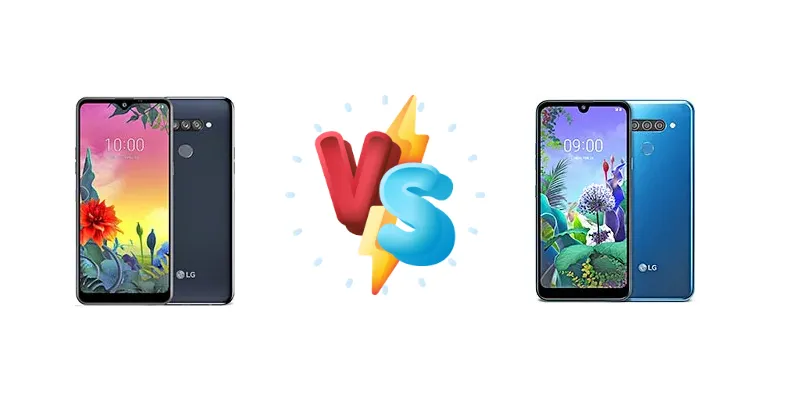
The LG K50S and LG Q60 represent LG’s attempts to capture the budget smartphone market. Both devices launched around the same time and share a remarkably similar core specification set, centered around the Mediatek Helio P22 chipset. This comparison aims to dissect the nuances between these two models, identifying which offers the best value for users prioritizing affordability and essential smartphone functionality.
🏆 Quick Verdict
For the average user, the LG Q60 emerges as the slightly better choice. While both phones share the same Helio P22 chipset and CPU, the Q60’s potential for slightly better build quality and potentially more refined software experience, even if marginal, gives it a small edge. Both are excellent options for basic smartphone use.
| Network |
|---|
| 2G bands | GSM 850 / 900 / 1800 / 1900 | GSM 850 / 900 / 1800 / 1900 |
| 3G bands | HSDPA 850 / 900 / 1900 / 2100 | HSDPA 850 / 900 / 1900 / 2100 |
| 4G bands | 1, 3, 7, 8, 20 | 1, 3, 7, 8, 20, 38 |
| Speed | HSPA 42.2/5.76 Mbps, LTE (2CA) Cat6 300/50 Mbps | HSPA 42.2/5.76 Mbps, LTE (2CA) Cat6 300/75 Mbps |
| Technology | GSM / HSPA / LTE | GSM / HSPA / LTE |
| Launch |
|---|
| Announced | 2019, August. Released 2019, September | 2019, February. Released 2019, May |
| Status | Discontinued | Discontinued |
| Body |
|---|
| Dimensions | 165.8 x 77.5 x 8.2 mm (6.53 x 3.05 x 0.32 in) | 161.3 x 77 x 8.7 mm (6.35 x 3.03 x 0.34 in) |
| SIM | · Nano-SIM· Nano-SIM + Nano-SIM | · Nano-SIM· Nano-SIM + Nano-SIM |
| Weight | 194 g (6.84 oz) | 172 g (6.07 oz) |
| | MIL-STD-810G compliant*
*does not guarantee ruggedness or use in extreme conditions | MIL-STD-810G compliant*
*does not guarantee ruggedness or use in extreme conditions |
| Display |
|---|
| Resolution | 720 x 1520 pixels, 19:9 ratio (~259 ppi density) | 720 x 1520 pixels, 19:9 ratio (~269 ppi density) |
| Size | 6.5 inches, 105.5 cm2 (~82.1% screen-to-body ratio) | 6.26 inches, 97.8 cm2 (~78.8% screen-to-body ratio) |
| Type | IPS LCD | IPS LCD |
| Platform |
|---|
| CPU | Octa-core 2.0 GHz Cortex-A53 | Octa-core 2.0 GHz Cortex-A53 |
| Chipset | Mediatek MT6762 Helio P22 (12 nm) | Mediatek MT6762 Helio P22 (12 nm) |
| GPU | PowerVR GE8320 | PowerVR GE8320 |
| OS | Android 9.0 (Pie) | Android 9.0 (Pie), LG UX 7 |
| Memory |
|---|
| Card slot | microSDXC (dedicated slot) | microSDXC (dedicated slot) |
| Internal | 32GB 3GB RAM | 64GB 3GB RAM |
| | eMMC 5.1 | eMMC 5.1 |
| Main Camera |
|---|
| Features | LED flash, panorama, HDR | LED flash, panorama, HDR |
| Triple | 13 MP, f/2.2, 26mm (wide), PDAF
5 MP, f/2.2, 115˚ (ultrawide)
Auxiliary lens | 16 MP, f/2.0, 26mm (wide), PDAF
5 MP, f/2.2, 13mm (ultrawide)
Auxiliary lens |
| Video | 1080p@30fps | 1080p@30fps |
| Selfie camera |
|---|
| Single | 13 MP, f/2.0, 1/3.1", 1.12µm | 13 MP, 1/3.1", 1.12µm |
| Video | 1080p@30fps | 1080p@30fps |
| Sound |
|---|
| 3.5mm jack | Yes | Yes |
| 35mm jack | Yes | Yes |
| Loudspeaker | Yes | Yes |
| Comms |
|---|
| Bluetooth | 5.0, A2DP, LE | 5.0, A2DP, LE |
| NFC | Yes (market/region dependent) | Yes |
| Positioning | GPS, GLONASS | GPS, GLONASS |
| Radio | FM radio | No |
| USB | USB Type-C 2.0, OTG | microUSB 2.0 |
| WLAN | Wi-Fi 802.11 a/b/g/n/ac, dual-band, Wi-Fi Direct, DLNA | Wi-Fi 802.11 a/b/g/n/ac, dual-band, Wi-Fi Direct, DLNA |
| Features |
|---|
| Sensors | Fingerprint (rear-mounted), accelerometer, proximity | Fingerprint (rear-mounted), accelerometer, proximity, compass |
| Battery |
|---|
| Type | Li-Po 4000 mAh, non-removable | Li-Ion 3500 mAh, non-removable |
| Misc |
|---|
| Colors | New Aurora Black, New Moroccan Blue | New Moroccan Blue, Aurora Black |
| Models | LMX540HM, LM-X540, LM-X540BMW, LMX540BMW | LMX525EAW, LMX525BAW, LM-X525 |
| Price | About 200 EUR | About 230 EUR |
LG K50S
- Potentially lower price point
- Identical performance to the Q60 for basic tasks
- Reliable Mediatek Helio P22 chipset
- Potentially lower build quality
- Likely less refined software experience
- May receive fewer software updates
LG Q60
- Potentially better build quality
- Slightly more refined software experience
- May receive longer software support
- Identical performance to the K50S
- Potentially slightly higher price
- Still limited by the Helio P22 chipset
Display Comparison
Both the LG K50S and Q60 feature displays that prioritize size over resolution or advanced technology. Given the shared chipset, neither display is expected to drive demanding graphical tasks. While specific nit brightness figures aren't provided, both likely target the 400-500 nit range, adequate for indoor use but potentially washed out in direct sunlight. The panel technology is likely IPS LCD on both, offering acceptable viewing angles. The focus here isn't on display quality, but rather on usability for basic tasks.
Camera Comparison
Camera performance is likely to be similar on both devices, relying heavily on software processing to enhance image quality. Without specific sensor details, it's difficult to make a definitive judgment. Both phones likely feature a primary camera and potentially depth/macro sensors. However, the quality of these secondary sensors is often minimal. Image processing will be crucial, and LG’s software algorithms will determine the final image output. Expect acceptable results in good lighting conditions, but struggles in low-light scenarios.
Performance
The core of both devices is the Mediatek MT6762 Helio P22 (12 nm) paired with an Octa-core 2.0 GHz Cortex-A53 CPU. This means performance will be virtually identical across both phones. The Helio P22 is a capable processor for everyday tasks like browsing, social media, and light app usage. However, it will struggle with graphically intensive games or demanding multitasking. The 12nm process node offers reasonable power efficiency, but don't expect exceptional battery life under heavy load. RAM configurations are not specified, but are likely similar, further minimizing performance differences.
Battery Life
Battery capacity isn't specified, but both phones likely house batteries in the 3000-4000 mAh range, typical for this price segment. Charging wattage is also unknown, suggesting slow charging speeds. Real-world battery life will depend heavily on usage patterns, but users can expect a full day of light to moderate use. The power efficiency of the Helio P22 chipset will play a role, but the relatively small battery capacity will limit endurance under heavy load.
Buying Guide
Buy the LG K50S if you need a reliably functional smartphone at the absolute lowest possible price point and are comfortable with potentially less durable construction. Buy the LG Q60 if you prefer a device that *might* offer a slightly more premium feel and potentially longer software support, even if the core performance remains identical. Both are suited for users who primarily browse the web, use social media, and make calls.
Frequently Asked Questions
❓ Will the Helio P22 chipset struggle with popular games like PUBG Mobile or Call of Duty Mobile?
Yes, the Mediatek Helio P22 is not a gaming-focused chipset. While you might be able to run these games at the lowest settings, expect significant frame rate drops and a generally subpar gaming experience. These phones are better suited for casual gaming or less demanding titles.
❓ How long will software updates be supported on the LG K50S and Q60?
Given the age and budget nature of these devices, software update support is likely limited. Expect at most one major Android version update, and security patches may cease after a year or two. Don't rely on these phones for long-term software support.
❓ Is the camera quality sufficient for social media sharing?
The camera quality is adequate for casual social media sharing in good lighting conditions. However, expect limited detail and dynamic range, especially in low-light environments. The image processing will attempt to enhance photos, but results may vary.