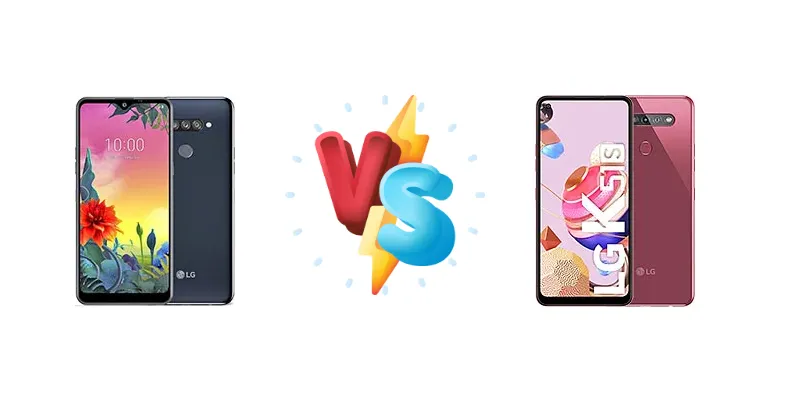
The LG K50S and K51S represent LG’s attempts to capture the budget smartphone market. While visually similar, a key difference lies under the hood. The K51S boasts a newer Mediatek Helio P35 chipset, aiming to provide a smoother user experience than the K50S’s Helio P22. This comparison dissects the nuances between these two devices to determine which offers the best value for everyday tasks.
🏆 Quick Verdict
For most users, the LG K51S is the better choice. Its Helio P35 chipset, with its faster core clock speeds, delivers a tangible performance improvement over the K50S’s Helio P22. While both phones target the budget segment, the K51S offers a more responsive experience for multitasking and app usage.
| Network |
|---|
| 2G bands | GSM 850 / 900 / 1800 / 1900 | GSM 850 / 900 / 1800 / 1900 |
| 3G bands | HSDPA 850 / 900 / 1900 / 2100 | HSDPA 850 / 900 / 1900 / 2100 |
| 4G bands | 1, 3, 7, 8, 20 | 1, 3, 7, 8, 20, 28, 38 |
| Speed | HSPA 42.2/5.76 Mbps, LTE (2CA) Cat6 300/50 Mbps | HSPA 42.2/5.76 Mbps, LTE (2CA) Cat6 300/50 Mbps |
| Technology | GSM / HSPA / LTE | GSM / HSPA / LTE |
| Launch |
|---|
| Announced | 2019, August. Released 2019, September | 2020, February 18. Released 2020, April 27 |
| Status | Discontinued | Discontinued |
| Body |
|---|
| Dimensions | 165.8 x 77.5 x 8.2 mm (6.53 x 3.05 x 0.32 in) | 165.2 x 76.7 x 8.3 mm (6.50 x 3.02 x 0.33 in) |
| SIM | · Nano-SIM· Nano-SIM + Nano-SIM | · Nano-SIM· Nano-SIM + Nano-SIM |
| Weight | 194 g (6.84 oz) | 194.5 g (6.88 oz) |
| | MIL-STD-810G compliant*
*does not guarantee ruggedness or use in extreme conditions | MIL-STD-810G compliant*
*does not guarantee ruggedness or use in extreme conditions |
| Display |
|---|
| Protection | - | Scratch-resistant glass |
| Resolution | 720 x 1520 pixels, 19:9 ratio (~259 ppi density) | 720 x 1600 pixels, 20:9 ratio (~282 ppi density) |
| Size | 6.5 inches, 105.5 cm2 (~82.1% screen-to-body ratio) | 6.55 inches, 93.6 cm2 (~73.8% screen-to-body ratio) |
| Type | IPS LCD | IPS LCD |
| Platform |
|---|
| CPU | Octa-core 2.0 GHz Cortex-A53 | Octa-core (4x2.3 GHz Cortex-A53 & 4x1.8 GHz Cortex-A53) |
| Chipset | Mediatek MT6762 Helio P22 (12 nm) | Mediatek MT6765 Helio P35 (12 nm) |
| GPU | PowerVR GE8320 | PowerVR GE8320 |
| OS | Android 9.0 (Pie) | Android 9.0 (Pie) |
| Memory |
|---|
| Card slot | microSDXC (dedicated slot) | microSDXC (dedicated slot) |
| Internal | 32GB 3GB RAM | 64GB 3GB RAM |
| | eMMC 5.1 | eMMC 5.1 |
| Main Camera |
|---|
| Features | LED flash, panorama, HDR | LED flash, panorama, HDR |
| Quad | - | 32 MP, (wide), PDAF
5 MP, f/2.2, 115˚, (ultrawide)
2 MP (macro)
Auxiliary lens |
| Triple | 13 MP, f/2.2, 26mm (wide), PDAF
5 MP, f/2.2, 115˚ (ultrawide)
Auxiliary lens | - |
| Video | 1080p@30fps | 1080p@30fps |
| Selfie camera |
|---|
| Single | 13 MP, f/2.0, 1/3.1", 1.12µm | 13 MP, 1/3.1", 1.12µm |
| Video | 1080p@30fps | 1080p@30fps |
| Sound |
|---|
| 3.5mm jack | Yes | Yes |
| 35mm jack | Yes | Yes |
| Loudspeaker | Yes | Yes |
| Comms |
|---|
| Bluetooth | 5.0, A2DP, LE | 5.0, A2DP, LE |
| NFC | Yes (market/region dependent) | Yes |
| Positioning | GPS, GLONASS | GPS |
| Radio | FM radio | No |
| USB | USB Type-C 2.0, OTG | USB Type-C 2.0, OTG |
| WLAN | Wi-Fi 802.11 a/b/g/n/ac, dual-band, Wi-Fi Direct, DLNA | Wi-Fi 802.11 a/b/g/n, Wi-Fi Direct, DLNAorWi-Fi 802.11 b/g/n, Wi-Fi Direct, DLNA |
| Features |
|---|
| Sensors | Fingerprint (rear-mounted), accelerometer, proximity | Fingerprint (rear-mounted), accelerometer, proximity, compass |
| Battery |
|---|
| Type | Li-Po 4000 mAh, non-removable | Li-Po 4000 mAh |
| Misc |
|---|
| Colors | New Aurora Black, New Moroccan Blue | Titanium, Pink, Blue, Red |
| Models | LMX540HM, LM-X540, LM-X540BMW, LMX540BMW | LMK510EMW, LM-K510EMW, LM-K510 |
| Price | About 200 EUR | About 200 EUR |
LG K50S
- Potentially lower price point.
- Sufficient for basic smartphone tasks.
- Likely similar battery life to K51S.
- Slower processor compared to K51S.
- Less responsive user experience.
- May struggle with multitasking.
LG K51S
- Faster processor for smoother performance.
- Improved multitasking capabilities.
- More responsive user interface.
- Potentially slightly higher price.
- May not offer a significant camera upgrade.
- Battery life could be marginally lower under heavy load.
Display Comparison
Both the LG K50S and K51S likely feature similar LCD panels, given their market positioning. Specifics like resolution and brightness are not provided, but we can assume they target a 720p+ resolution. The lack of information prevents a detailed comparison of color accuracy or viewing angles. However, the display is unlikely to be a deciding factor for most buyers in this segment, focusing instead on functionality over fidelity.
Camera Comparison
Without detailed sensor information, a camera comparison is limited. Both phones likely feature a multi-camera setup, but the quality will heavily depend on the main sensor and image processing algorithms. It's reasonable to assume both devices include a standard, wide-angle, and potentially a depth sensor. The presence of a 2MP macro lens on either device is unlikely to significantly impact image quality, serving more as a marketing feature than a practical improvement. Image processing differences, driven by software, could be a differentiating factor, but without sample images, it's impossible to assess.
Performance
The core difference between these devices is the chipset. The LG K50S utilizes the Mediatek Helio P22, an octa-core processor clocked at 2.0 GHz using exclusively Cortex-A53 cores. The LG K51S steps up to the Helio P35, also an octa-core processor, but with a more sophisticated configuration: four Cortex-A53 cores clocked at 2.3 GHz paired with four Cortex-A53 cores at 1.8 GHz. This 'big.LITTLE' architecture allows the P35 to dynamically allocate tasks to the faster cores for demanding applications, resulting in a noticeable performance boost. The higher clock speeds on the K51S translate to quicker app launch times and smoother multitasking.
Battery Life
Battery capacity details are missing for both devices. However, given their similar form factors and target market, we can expect capacities around 3000-4000 mAh. The Helio P35 in the K51S, being a slightly more efficient chipset, *may* offer marginally better battery life under similar usage conditions. Charging wattage is also unknown, but both are likely to support standard 10W or 15W charging, resulting in similar 0-100% charge times.
Buying Guide
Buy the LG K50S if you prioritize absolute affordability and your smartphone usage is limited to basic tasks like calls, texts, and light social media. Buy the LG K51S if you frequently switch between apps, play casual games, or simply prefer a more fluid and responsive user interface. The K51S’s performance advantage justifies the potential slight price premium.
Frequently Asked Questions
❓ Will the LG K51S handle popular social media apps like TikTok and Instagram smoothly?
Yes, the Helio P35 in the K51S provides a noticeable performance boost over the K50S’s Helio P22. This translates to smoother scrolling, faster loading times, and a more responsive experience when using social media applications like TikTok and Instagram. While it won't compete with flagship performance, it will handle these apps without significant lag.
❓ Is the difference in performance between the Helio P22 and Helio P35 noticeable in everyday use?
Absolutely. The Helio P35’s combination of faster clock speeds and a big.LITTLE core configuration makes a tangible difference. You’ll notice it in quicker app launch times, smoother transitions between apps, and a generally more fluid user experience. The K50S will feel noticeably slower when multitasking or running slightly more demanding applications.
❓ Are software updates likely to be provided for either of these devices?
Given LG’s exit from the smartphone market, long-term software support for both the K50S and K51S is highly unlikely. While they may have received initial updates, expect limited or no further security patches or Android version upgrades. This is a significant consideration when purchasing either device.