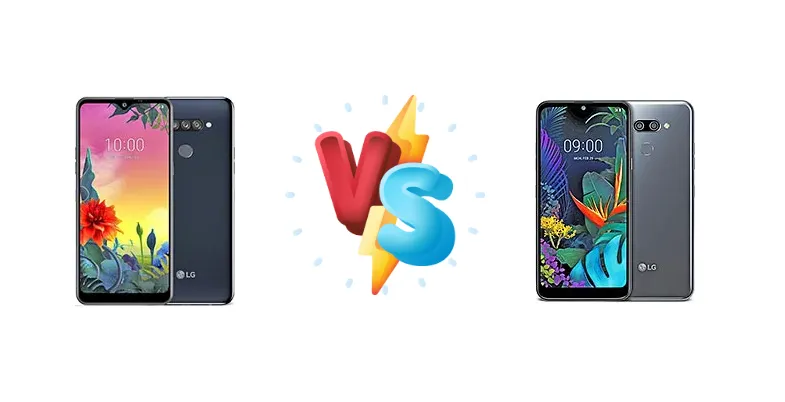
The LG K50 and K50S represent LG's entry into the ultra-budget smartphone market. While appearing nearly identical on paper, a closer examination reveals that the K50S aims to refine the K50 experience. This comparison dives deep into the nuances of these two devices, focusing on where the 'S' makes a difference for the average user.
🏆 Quick Verdict
For most users, the LG K50S is the better choice. Despite sharing the same Mediatek Helio P22 chipset, the K50S offers a slightly more polished experience, potentially benefiting from software optimizations. However, if price is the absolute primary concern, the K50 remains a viable option.
| Network |
|---|
| 2G bands | GSM 850 / 900 / 1800 / 1900 | GSM 850 / 900 / 1800 / 1900 |
| 3G bands | HSDPA 850 / 900 / 1900 / 2100 | HSDPA 850 / 900 / 1900 / 2100 |
| 4G bands | 1, 3, 7, 8, 20 | 1, 3, 7, 8, 20, 38 |
| Speed | HSPA 42.2/5.76 Mbps, LTE (2CA) Cat6 300/50 Mbps | HSPA 42.2/5.76 Mbps, LTE (2CA) Cat6 300/75 Mbps |
| Technology | GSM / HSPA / LTE | GSM / HSPA / LTE |
| Launch |
|---|
| Announced | 2019, August. Released 2019, September | 2019, February. Released 2019, August |
| Status | Discontinued | Discontinued |
| Body |
|---|
| Dimensions | 165.8 x 77.5 x 8.2 mm (6.53 x 3.05 x 0.32 in) | 161.3 x 77 x 8.7 mm (6.35 x 3.03 x 0.34 in) |
| SIM | · Nano-SIM· Nano-SIM + Nano-SIM | · Nano-SIM· Nano-SIM + Nano-SIM |
| Weight | 194 g (6.84 oz) | 170 g (6.00 oz) |
| | MIL-STD-810G compliant*
*does not guarantee ruggedness or use in extreme conditions | MIL-STD-810G compliant*
*does not guarantee ruggedness or use in extreme conditions |
| Display |
|---|
| Resolution | 720 x 1520 pixels, 19:9 ratio (~259 ppi density) | 720 x 1520 pixels, 19:9 ratio (~269 ppi density) |
| Size | 6.5 inches, 105.5 cm2 (~82.1% screen-to-body ratio) | 6.26 inches, 97.8 cm2 (~78.8% screen-to-body ratio) |
| Type | IPS LCD | IPS LCD |
| Platform |
|---|
| CPU | Octa-core 2.0 GHz Cortex-A53 | Octa-core 2.0 GHz Cortex-A53 |
| Chipset | Mediatek MT6762 Helio P22 (12 nm) | Mediatek MT6762 Helio P22 (12 nm) |
| GPU | PowerVR GE8320 | PowerVR GE8320 |
| OS | Android 9.0 (Pie) | Android 9.0 (Pie) |
| Memory |
|---|
| Card slot | microSDXC (dedicated slot) | microSDXC (dedicated slot) |
| Internal | 32GB 3GB RAM | 32GB 3GB RAM |
| | eMMC 5.1 | eMMC 5.1 |
| Main Camera |
|---|
| Dual | - | 13 MP, f/2.2, 26mm (wide), PDAF
Auxiliary lens |
| Features | LED flash, panorama, HDR | LED flash, panorama, HDR |
| Triple | 13 MP, f/2.2, 26mm (wide), PDAF
5 MP, f/2.2, 115˚ (ultrawide)
Auxiliary lens | - |
| Video | 1080p@30fps | 1080p@30fps |
| Selfie camera |
|---|
| Single | 13 MP, f/2.0, 1/3.1", 1.12µm | 13 MP, f/2.0, 1/3.1", 1.12µm |
| Video | 1080p@30fps | 1080p@30fps |
| Sound |
|---|
| 3.5mm jack | Yes | Yes |
| 35mm jack | Yes | Yes |
| Loudspeaker | Yes | Yes |
| Comms |
|---|
| Bluetooth | 5.0, A2DP, LE | 5.0, A2DP, LE |
| NFC | Yes (market/region dependent) | Yes (market/region dependent) |
| Positioning | GPS, GLONASS | GPS, GLONASS |
| Radio | FM radio | No |
| USB | USB Type-C 2.0, OTG | microUSB 2.0, OTG |
| WLAN | Wi-Fi 802.11 a/b/g/n/ac, dual-band, Wi-Fi Direct, DLNA | Wi-Fi 802.11 a/b/g/n/ac, dual-band, Wi-Fi Direct, DLNA |
| Features |
|---|
| Sensors | Fingerprint (rear-mounted), accelerometer, proximity | Fingerprint (rear-mounted), accelerometer, proximity |
| Battery |
|---|
| Type | Li-Po 4000 mAh, non-removable | Li-Po 3500 mAh, non-removable |
| Misc |
|---|
| Colors | New Aurora Black, New Moroccan Blue | Aurora Black, Moroccan Blue, Platinum Gray |
| Models | LMX540HM, LM-X540, LM-X540BMW, LMX540BMW | LMX520BMW, LMX520EMW, LM-X520, 802LG |
| Price | About 200 EUR | About 180 EUR |
LG K50S
- Potentially optimized software for smoother performance.
- May benefit from minor hardware revisions.
- Slightly more refined overall experience.
- Likely a higher price point than the K50.
- Shares the same core chipset limitations.
LG K50
- Most affordable option.
- Identical core performance to the K50S.
- Functional smartphone for basic tasks.
- May exhibit slightly less polished software.
- Potentially lower build quality.
Display Comparison
Both the LG K50 and K50S feature displays that prioritize affordability over cutting-edge technology. While specific display specs like resolution and panel type aren't provided, both likely utilize IPS LCD panels common in this price bracket. The focus here isn't on visual fidelity, but rather on basic usability. Bezels are expected to be substantial on both devices, maximizing screen real estate within a budget-friendly form factor. Color accuracy is likely to be standard for this segment, prioritizing power efficiency over precise color reproduction.
Camera Comparison
Camera performance on both devices is likely to be modest. Without specific sensor details, it's safe to assume both rely on budget sensors. The absence of information regarding Optical Image Stabilization (OIS) suggests neither phone will excel in low-light photography. Image processing will likely focus on basic enhancements, with limited dynamic range and detail. While both may include multiple rear cameras, the utility of secondary sensors (like 2MP macro lenses, if present) is questionable, often serving more as marketing features than genuine improvements to image quality.
Performance
The core of both the LG K50 and K50S is the Mediatek MT6762 Helio P22 (12 nm) chipset, paired with an octa-core 2.0 GHz Cortex-A53 CPU. This configuration indicates similar performance capabilities for everyday tasks like browsing, social media, and light app usage. The 12nm process node suggests reasonable power efficiency, but don't expect sustained high performance. The identical CPU and chipset mean that any performance differences will likely stem from software optimization and RAM management, rather than raw processing power. Gaming performance will be limited to less demanding titles at lower settings.
Battery Life
Battery life will be a key consideration for budget smartphone buyers. While the exact battery capacity isn't specified, both the K50 and K50S likely feature batteries in the 3000-4000 mAh range. Charging wattage is also unknown, but is expected to be relatively slow, potentially taking several hours to fully charge from 0-100%. Real-world battery performance will depend heavily on usage patterns, but both phones should be capable of lasting a full day with moderate use. The similar hardware suggests comparable battery life between the two models.
Buying Guide
Buy the LG K50S if you prioritize a potentially smoother user experience and are willing to spend a small premium. Its refinements, while subtle, could translate to better app responsiveness and overall stability. Buy the LG K50 if you are on an extremely tight budget and need a functional smartphone for basic tasks like calling, texting, and light social media use. The K50 delivers essential smartphone functionality at the lowest possible price point.
Frequently Asked Questions
❓ Will the Helio P22 chipset struggle with modern apps?
The Mediatek Helio P22 is an entry-level chipset. While it can handle basic apps and tasks, it will likely struggle with demanding applications or multitasking. Expect slower loading times and occasional lag when running resource-intensive apps.
❓ Is the camera quality sufficient for casual social media use?
Both the K50 and K50S cameras are adequate for casual social media sharing in good lighting conditions. However, don't expect professional-quality photos, especially in low-light environments. Image quality will be noticeably lower than that of higher-end smartphones.
❓ How long will the battery last with typical usage?
With typical usage (browsing, social media, calls), both the K50 and K50S should last a full day on a single charge. However, heavy usage (gaming, video streaming) will significantly reduce battery life. Expect to charge the phone daily.