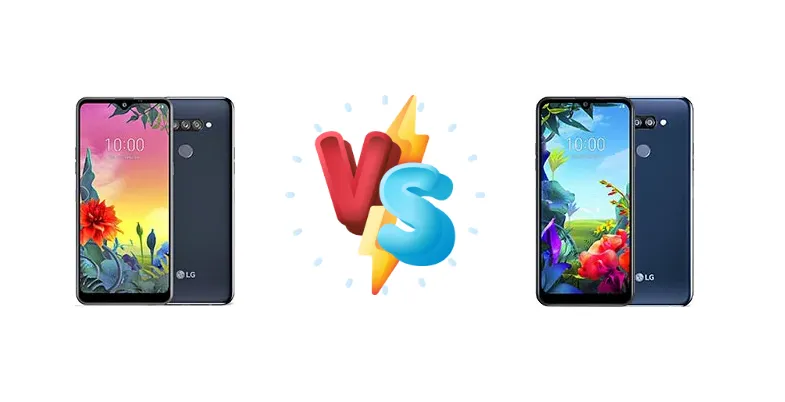
The LG K50S and K40S represent LG's foray into the ultra-budget smartphone market. Released around the same timeframe, these devices offer remarkably similar hardware, making a direct comparison crucial for consumers seeking the best value. This analysis will dissect the nuances between these two models, focusing on where potential differences might impact the user experience.
🏆 Quick Verdict
For the average user, the choice between the LG K50S and K40S is largely academic. Both utilize the same Mediatek Helio P22 chipset and CPU. The K50S *may* offer a slightly better software experience depending on regional updates, making it the marginal winner, but price will likely be the deciding factor.
| Network |
|---|
| 2G bands | GSM 850 / 900 / 1800 / 1900 | GSM 850 / 900 / 1800 / 1900 |
| 3G bands | HSDPA 850 / 900 / 1900 / 2100 | HSDPA 850 / 900 / 1900 / 2100 |
| 4G bands | 1, 3, 7, 8, 20 | 1, 3, 7, 8, 20 |
| Speed | HSPA 42.2/5.76 Mbps, LTE (2CA) Cat6 300/50 Mbps | HSPA 42.2/5.76 Mbps, LTE (2CA) Cat6 300/50 Mbps |
| Technology | GSM / HSPA / LTE | GSM / HSPA / LTE |
| Launch |
|---|
| Announced | 2019, August. Released 2019, September | 2019, August. Released 2019, September |
| Status | Discontinued | Discontinued |
| Body |
|---|
| Dimensions | 165.8 x 77.5 x 8.2 mm (6.53 x 3.05 x 0.32 in) | 156.3 x 73.9 x 8.6 mm (6.15 x 2.91 x 0.34 in) |
| SIM | · Nano-SIM· Nano-SIM + Nano-SIM | · Nano-SIM· Nano-SIM + Nano-SIM |
| Weight | 194 g (6.84 oz) | 186 g (6.56 oz) |
| | MIL-STD-810G compliant*
*does not guarantee ruggedness or use in extreme conditions | MIL-STD-810G compliant*
*does not guarantee ruggedness or use in extreme conditions |
| Display |
|---|
| Resolution | 720 x 1520 pixels, 19:9 ratio (~259 ppi density) | 720 x 1520 pixels, 19:9 ratio (~276 ppi density) |
| Size | 6.5 inches, 105.5 cm2 (~82.1% screen-to-body ratio) | 6.1 inches, 92.9 cm2 (~80.4% screen-to-body ratio) |
| Type | IPS LCD | IPS LCD |
| Platform |
|---|
| CPU | Octa-core 2.0 GHz Cortex-A53 | Octa-core 2.0 GHz Cortex-A53 |
| Chipset | Mediatek MT6762 Helio P22 (12 nm) | Mediatek MT6762 Helio P22 (12 nm) |
| GPU | PowerVR GE8320 | PowerVR GE8320 |
| OS | Android 9.0 (Pie) | Android 9.0 (Pie), upgradable to Android 10 |
| Memory |
|---|
| Card slot | microSDXC (dedicated slot) | microSDXC (dedicated slot) |
| Internal | 32GB 3GB RAM | 32GB 2GB RAM, 32GB 3GB RAM |
| | eMMC 5.1 | eMMC 5.1 |
| Main Camera |
|---|
| Dual | - | 13 MP, f/2.2, 26mm (wide), PDAF
5 MP, (ultrawide) |
| Features | LED flash, panorama, HDR | LED flash, panorama, HDR |
| Triple | 13 MP, f/2.2, 26mm (wide), PDAF
5 MP, f/2.2, 115˚ (ultrawide)
Auxiliary lens | - |
| Video | 1080p@30fps | 1080p@30fps |
| Selfie camera |
|---|
| Single | 13 MP, f/2.0, 1/3.1", 1.12µm | 13 MP, f/2.0, 1/3.1", 1.12µm |
| Video | 1080p@30fps | 1080p@30fps |
| Sound |
|---|
| 3.5mm jack | Yes | Yes |
| 35mm jack | Yes | Yes |
| Loudspeaker | Yes | Yes |
| Comms |
|---|
| Bluetooth | 5.0, A2DP, LE | 5.0, A2DP, LE |
| NFC | Yes (market/region dependent) | Yes (market/region dependent) |
| Positioning | GPS, GLONASS | GPS, GLONASS |
| Radio | FM radio | No |
| USB | USB Type-C 2.0, OTG | microUSB 2.0, OTG |
| WLAN | Wi-Fi 802.11 a/b/g/n/ac, dual-band, Wi-Fi Direct, DLNA | Wi-Fi 802.11 a/b/g/n/ac, dual-band, Wi-Fi Direct, DLNA |
| Features |
|---|
| Sensors | Fingerprint (rear-mounted), accelerometer, proximity | Fingerprint (rear-mounted), accelerometer, proximity |
| Battery |
|---|
| Type | Li-Po 4000 mAh, non-removable | Li-Po 3500 mAh, non-removable |
| Misc |
|---|
| Colors | New Aurora Black, New Moroccan Blue | New Aurora Black, New Moroccan Blue |
| Models | LMX540HM, LM-X540, LM-X540BMW, LMX540BMW | LMX430HM, LM-X430 |
| Price | About 200 EUR | About 160 EUR |
LG K50S
- Identical CPU/Chipset to K40S
- Potentially better software support
- Slightly wider availability
- May be slightly more expensive than K40S
- No standout features compared to K40S
LG K40S
- Identical CPU/Chipset to K50S
- Likely more affordable
- Good value for basic smartphone needs
- Potentially limited software updates
- May be harder to find accessories
Display Comparison
Both the LG K50S and K40S are expected to feature similar LCD panels, given their market positioning. While specific details like screen resolution and brightness are not provided, the shared chipset suggests comparable graphical capabilities. The absence of high refresh rates or advanced panel technologies like LTPO is typical for this price segment. Bezels are likely to be substantial on both devices, maximizing screen real estate within a budget-friendly design. Color accuracy will likely be standard for LCDs in this class, prioritizing visibility over color fidelity.
Camera Comparison
Camera specifications are not detailed in the provided data. However, given the budget nature of these phones, it's reasonable to expect a primary camera supplemented by auxiliary lenses (likely a depth sensor and potentially a macro lens). Image quality will be heavily reliant on software processing and the size of the primary sensor, which is unknown. The Helio P22's ISP (Image Signal Processor) is capable of basic image enhancement, but don't expect flagship-level results. The absence of Optical Image Stabilization (OIS) suggests that low-light performance will be limited. The usefulness of any included macro lens is questionable, as 2MP sensors typically produce low-resolution, noisy images.
Performance
The core of both devices is the Mediatek MT6762 Helio P22 (12 nm) chipset, paired with an Octa-core 2.0 GHz Cortex-A53 CPU. This means identical CPU performance for everyday tasks like browsing, social media, and basic app usage. The 12nm manufacturing process offers a reasonable balance between power efficiency and performance. While not a powerhouse, the Helio P22 is sufficient for light gaming. RAM capacity, which is not specified, will be a key determinant of multitasking performance; more RAM will allow for smoother switching between apps. Thermal management will likely be passive, relying on the phone's chassis to dissipate heat, potentially leading to some throttling under sustained load.
Battery Life
Battery capacity and charging wattage are not specified. However, given the Helio P22's power efficiency, both devices should offer all-day battery life with moderate usage. Charging speeds are likely to be slow, utilizing standard 5W or 10W charging. The absence of fast charging technology is typical for this price point. Battery life will be heavily influenced by usage patterns, with gaming and video streaming consuming significantly more power than basic tasks.
Buying Guide
Buy the LG K50S if you prioritize potential software support and are willing to pay a small premium. Its slightly wider availability might also mean easier access to accessories and repairs. Buy the LG K40S if you find it significantly cheaper; the core performance will be identical, and the savings can be allocated elsewhere. Both are ideal for first-time smartphone users or those needing a reliable, basic device for calls, texts, and light app usage.
Frequently Asked Questions
❓ Will the Helio P22 struggle with popular apps like WhatsApp and Facebook?
No, the Mediatek Helio P22 is perfectly capable of running popular social media apps like WhatsApp and Facebook smoothly. It's designed for everyday tasks and light multitasking, and these apps are not particularly demanding.
❓ Can I play games like PUBG Mobile on the LG K50S or K40S?
You can *attempt* to play PUBG Mobile, but expect a very basic experience. The Helio P22 is not a gaming chipset. You'll likely need to run the game at the lowest graphics settings and frame rate to achieve playable performance, and even then, you may experience lag and stuttering.
❓ Is the software on these phones likely to be updated to the latest Android version?
Given LG's exit from the smartphone market, it's highly unlikely that either the K50S or K40S will receive major Android updates. Security patches may be limited or non-existent. Consider this a significant drawback if software updates are important to you.